What is the duty of peace?
The duty of peace means that no industrial action may be taken while a valid collective bargaining agreement is in effect. Once the duty of peace ends, we can call for warning strikes. We generally do so to increase the pressure on employers to negotiate and reach an agreement.
The peace obligation can also be extended by the bargaining parties to allow more time for a peaceful settlement. Example: The Arbitration and Conciliation Agreement in the metal and electrical industry stipulates a four-week extension of the peace obligation after the collective bargaining agreements expire.
What are warning strikes?
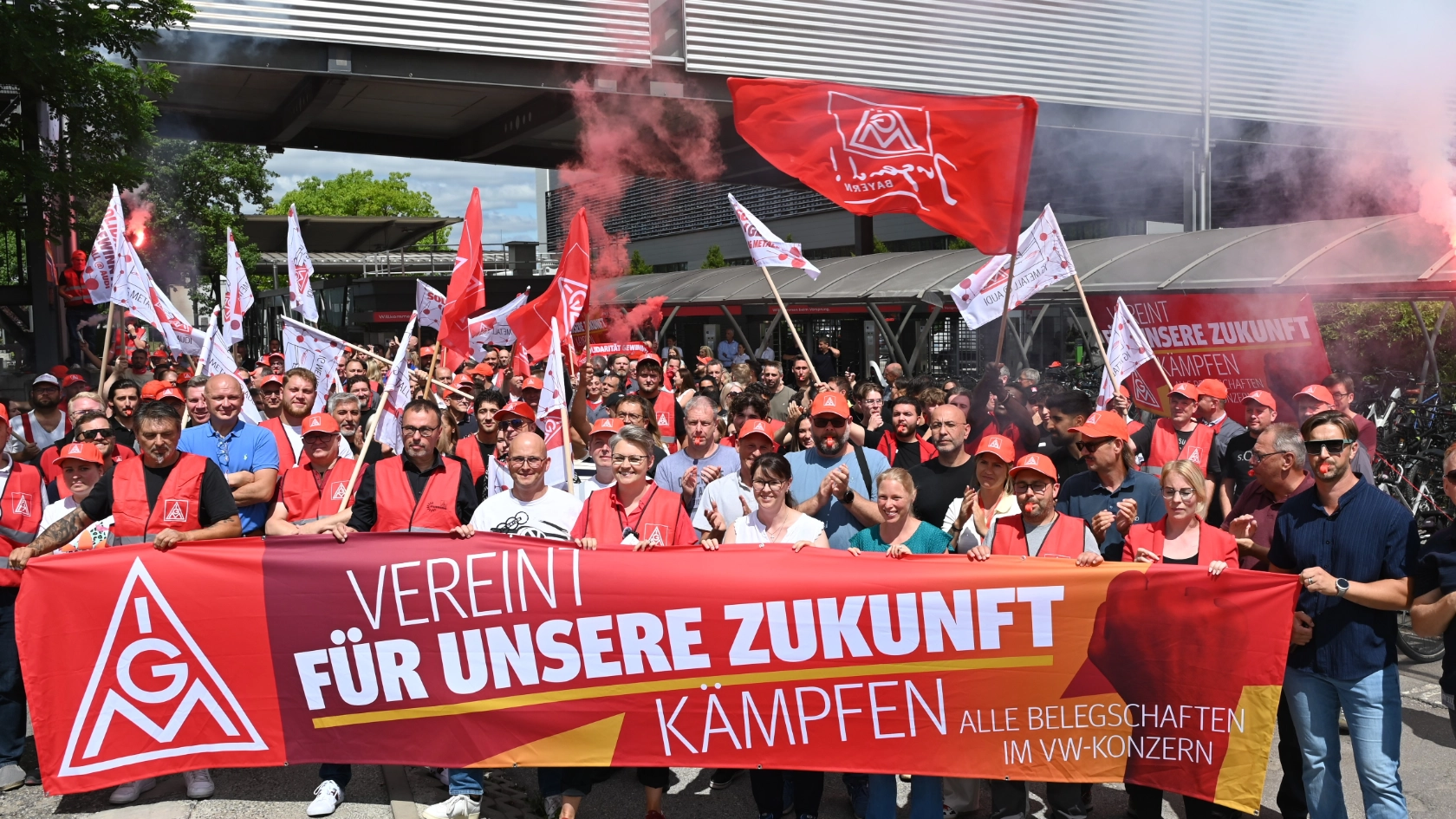
Warning strikes are temporary work stoppages lasting a few hours. IG Metall and employees use them to pressure employers into making an offer or to protest against an offer they consider too low. Like full-scale strikes, warning strikes are guaranteed as a fundamental right under the Constitution. The right to strike derives from the “freedom of association and assembly,” which is enshrined in Article 9, Paragraph 3 of the Basic Law . Therefore, every employee may participate in a warning strike—whether or not they are union members.
Works council members may participate in warning strikes in their capacity as employees and union members.
Those who participate in warning strikes need not fear any consequences under labor law. Employers may not discipline participants in warning strikes or terminate their employment either during or after the work stoppage. To ensure protection, a so-called disciplinary clause is also included in the collective bargaining agreement, which safeguards against written warnings and other forms of discrimination.
What about apprentices?
Outside of vocational school classes, all apprentices and dual-track students may also participate in the warning strike. After all, we are also demanding a pay increase for them.
What about temporary agency workers?
Temporary agency workers may not be used as strike breakers during warning strikes or full-scale strikes. This is stipulated in the DGB collective bargaining agreements on temporary agency work, as well as in the Temporary Employment Act, which has been in effect since April 1, 2017, and which includes such a prohibition.
It is prohibited for temporary agency workers at the client company to directly take over the duties of employees who are engaged in industrial action—or even indirectly from employees who have taken over the duties of employees engaged in industrial action. The temporary staffing agency must inform the temporary agency worker that, in such cases, they have the right to refuse to work.
Warning strikes while working from home—is that allowed?
Of course, employees working from home can participate in warning strikes just like their colleagues at the workplace. However, the challenge here is that in-person participation is often not possible, so digital formats must be used. The question then is how to reach these employees and unite them in a joint “action.” This calls for creative ideas, and the local IG Metall chapter is there to help put them into practice. Whether in front of a computer or at the factory gate: the key is to act decisively and participate as a united front!
Do I have to “clock out” or “punch out” for this?
No, participation in industrial action is a collective work stoppage, not “free time.” Therefore, your absence does not need to be documented, and you do not have to make up the missed hours.
Do I have to notify my supervisor if I respond to a call for a warning strike or a strike?
No, when participating in a warning strike, there is no obligation to notify your supervisor or clock out in the time-tracking system. Simply participating is sufficient. During a strike, the mutual rights and primary obligations arising from the employment relationship are suspended. There is therefore no obligation to notify your supervisor. If IG Metall has called for a warning strike and employees join the strike, the obligation to work is automatically suspended for the duration of the warning strike. This also applies to colleagues who participate in warning strikes while working from home.
Am I entitled to pay if I respond to a call for a warning strike or a strike?
No. During a strike, there is no obligation to work, but there is also no obligation on the part of the employer to pay wages. The employer may therefore reduce pay for the duration of the strike, including apprenticeship wages. However, the employer is not required to do so.
Questions and Answers: How Do Collective Bargaining Negotiations Work?














To load this video, you must enable YouTube cookies and thereby agree to the YouTube privacy policy.