Automatic translation
This article has been translated automatically using computer technology. While we strive for accuracy, some wording or details may differ from those in the original article.
This translation was not manually reviewed. For important facts, quotations or legally sensitive information, please consult the German original. Individual selections, images, embedded media or technical terms may have been translated differently or incompletely.

2026 Metal and Electrical Industry Collective Bargaining Round How IG Metall Secures Jobs

Collective bargaining negotiations for the metal and electrical industries in 2026 are underway. In addition to higher wages, the talks also focus on job security: Do we need to expand our collective bargaining agreements to address this? Or do we already have sufficient provisions in place to safeguard employment? Here’s what IG Metall has already established in this regard.

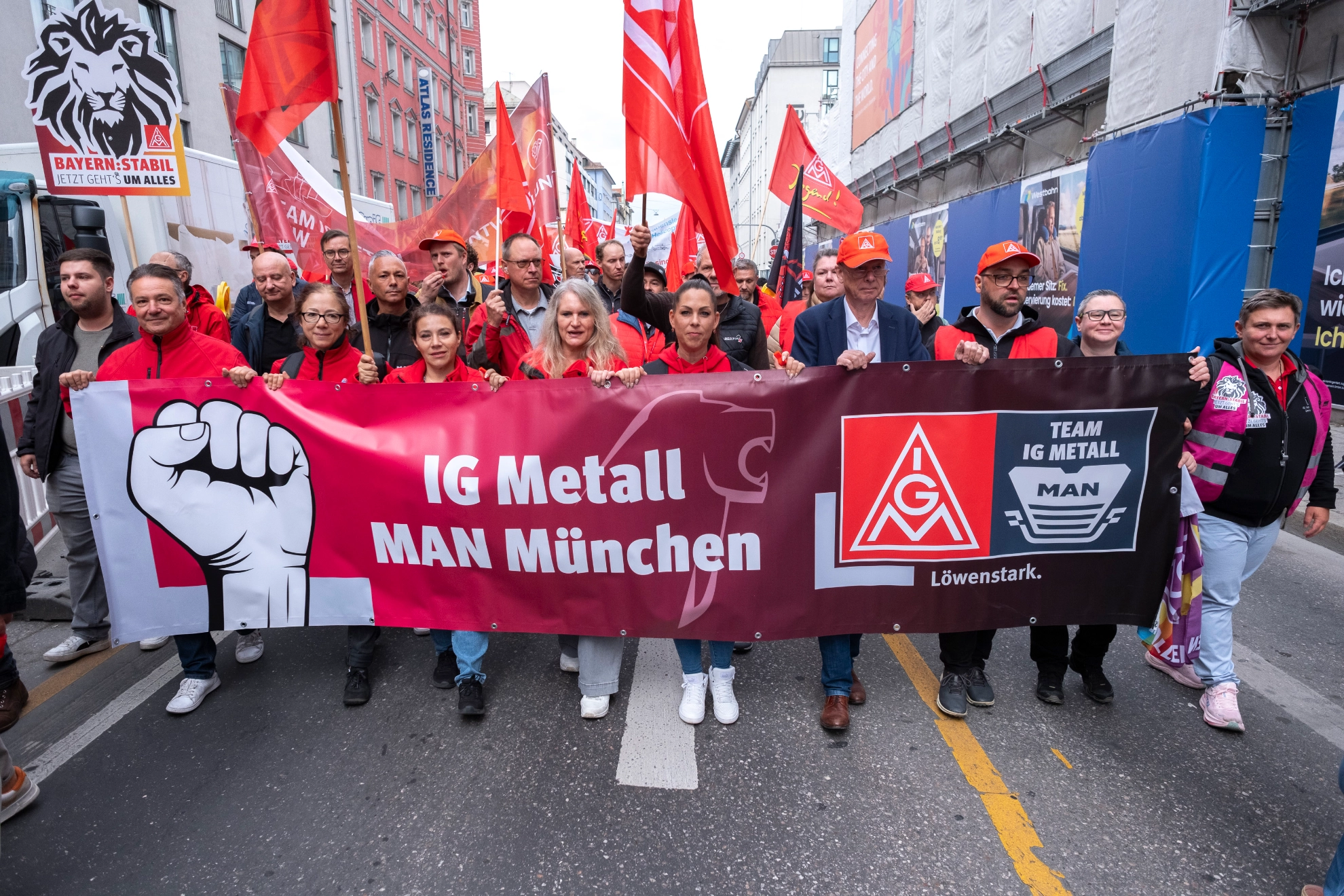
IGM Bezirk Bayern -  1. Verhandlung /Demo Tarifrunde  "Bayern: Stabil - Jetzt geht's um alles", Bayerischer Hof, München

21 October 2026 21 October 2026


One issue in the ongoing collective bargaining negotiations in the metal and electrical industries —in addition to wage increases—is securing jobs and the future of companies: We want to examine whether, in light of the crisis in the industry, we need to strengthen our collective bargaining provisions to secure jobs.

Job security was also a top concern in a survey of 267,000 employees at 2,285 companies —ranking second only to rising costs of living, healthcare, and retirement security: More than half of employees are concerned about the security of their own jobs (56.3%) or the future of their company (56.7%).

In fact, there are numerous collective bargaining and company-level provisions in the metal and electrical industries designed to safeguard employment. Here are the key ones:


Work-time accounts

Accumulating time credits during good times, using them during bad times

To bridge periods of low workload, working time accounts can be drawn down. The framework collective bargaining agreements in the metal and electrical industry provide for various flexible working time accounts to offset fluctuations in company workload.

The upper and lower limits on working hours are negotiated by the works council, but within the framework of the collective bargaining agreement. If the working time account exceeds defined upper limits, an agreement must be in place on how the account will be reduced again. The collective bargaining agreements also provide for protection against insolvency.

Collective Conversion of T-ZUG into Time

Days Off Instead of Collective Bargaining Supplementary Pay in Case of Insufficient Work

With their July pay stub, employees in the metal and electrical industries receive the collective bargaining supplementary payment (T-ZUG A) amounting to 27.5 percent of their individual monthly pay. Employees under particular strain—such as those with children, dependents requiring care, or those working shifts—can convert the T-ZUG (A) into up to 8 days off.

In companies facing a shortage of orders and work, the works council and employer may also agree to collectively convert the T-ZUG (A) into 6 days off for all employees. This reduces the annual working hours for everyone, thereby preventing layoffs and securing jobs.

The additional T-ZUG payment (T-ZUG B), amounting to 26.5 percent of the base pay (approximately 900 euros), is not affected by this regulation—and is paid out as usual, typically at the end of February.

Short-time work

Statutory Short-Time Work Plus Collective Bargaining Supplement

Under statutory short-time work, employees receive short-time work benefits from the Federal Employment Agency amounting to 60 percent of their lost net pay; for employees with at least one child, the rate is 67 percent.

The employer must notify the Federal Employment Agency of short-time work, but cannot unilaterally impose it. If there is a works council at the company, the employer must reach an agreement with it regarding the implementation of short-time work. Short-time work benefits can be applied for up to 12 months. Currently, a special provision is in effect through the end of 2026 that allows for up to 24 months of short-time work benefits.

IG Metall and works councils have secured collective bargaining and company-specific supplements and extensions to short-time work benefits, enabling employees to receive 80 to 90 percent of their normal net pay. In addition, there are collective bargaining provisions regarding employee training during short-time work.

Questions and Answers on Short-Time Work 

Short-time work benefit calculator 

Temporary reduction of working hours under the collective bargaining agreement on job security

When there isn’t enough work: work fewer hours instead of cutting jobs

Companies facing employment challenges can reduce working hours—for example, from 35 to 30 hours in the metal and electrical industries. The collective bargaining agreements on employment security (TV Besch) provide for various models to this end.

The reduction in working hours is temporary; the duration can be agreed upon individually within the company for several years. During the period of reduced working hours, employment protection generally applies. Layoffs for operational reasons should be prevented or ruled out during this phase. IG Metall and the employers’ association must agree to this.

The reduction in working hours under the TV Besch can be applied to entire companies—but also to parts of the company, such as individual departments and employee groups suffering from a lack of orders and employment problems. Instead of laying off some of the employees, working hours are reduced for everyone.

As working hours are reduced, pay generally decreases as well. However, IG Metall and works councils have secured compensation payments and partial wage adjustments that at least guarantee the monthly wage.

Part-time work for older employees

Early Retirement Instead of Layoffs

Collective bargaining agreements on flexible transition to retirement (TV FlexÜ) allow employees in the metal and electrical industries to participate in partial retirement. Partial retirement can generally begin no earlier than age 57 and last up to six years. Under the commonly used “block model,” employees continue working initially and are then released from work for the second half of the partial retirement period. 
Over the entire duration, working hours are halved. The partial retirement pay therefore initially amounts to 50 percent of the employee’s previous salary. However, the collective bargaining agreements stipulate that the employer must supplement the partial retirement pay. As a result, employees in partial retirement receive 85 to 89 percent of their previous net salary.
The collective bargaining provisions for partial retirement can be expanded at the company level. This allows partial retirement to be used to make unavoidable staff reductions more socially acceptable.

Differentiation of the transformation allowance

Companies in crisis do not have to pay T-money

In addition to the T-ZUG (A), employees will receive the transformation allowance (T-Geld or Trafobaustein) in the amount of 18.4 percent of their monthly pay with their July paycheck. In the event of economic difficulties, the employer could postpone payment of the T-Geld in 2025 and 2026 until April 30 of the following year, or suspend it entirely if the net return on sales was below 2.3 percent.
Alternatively, during a reduction in working hours (see above), the transformation allowance may also be used to finance partial wage compensation.

Supplementary and Restructuring Collective Bargaining Agreements

Temporary deviations from the collective bargaining agreement to secure jobs and investments

In hundreds of companies, IG Metall has concluded so-called supplementary collective bargaining agreements or restructuring collective bargaining agreements to address operational crises. This means that the standard collective bargaining agreements remain in effect, but the company temporarily deviates from them—for example, by having employees forgo special payments or by postponing the next wage increase.
In return, the employer commits to ruling out layoffs for operational reasons, securing the location, and/or making investments.

Future collective bargaining agreements and arrangements

Site and Investment Commitments Plus Expanded Co-determination

In many workplace conflicts, with the help of IG Metall, workforces secure commitments regarding locations, investments, and employment, which are then enshrined in future agreements or future collective bargaining agreements. IG Metall and employees often succeed in securing expanded co-determination, for example by having works councils participate in steering and management committees alongside company management to discuss innovations and investments.

Social collective bargaining agreements

Securing collective bargaining-based social plans with better severance packages and transfer companies

While IG Metall and works councils generally cannot legally prevent employers from implementing workforce reduction programs, relocations, or plant closures, they can significantly mitigate the consequences for employees and secure comprehensive safeguards.
To this end, works councils negotiate compromises and social plans. These may include, for example, severance pay, training programs, or outplacement agencies. IG Metall can also secure a collective social agreement. To achieve this, it may call on employees to participate in warning strikes or strikes.
Social collective bargaining agreements often go beyond the benefits provided by a social plan. For example, higher severance payments, additional financial benefits, training opportunities, or provisions to protect employees—such as a ban on layoffs for operational reasons for several years—can be agreed upon.

5 good Reasons to Join IG Metall

Working together for good jobs and a good life.

Beschäftigte machen zur Metall-Tarifrunde 2024 Druck für ihre Forderungen

Collective bargaining agreements—our strongest service

Our collective bargaining agreements set standards. They regulate wages, working hours, vacation time, and overtime pay, as well as the right to permanent employment after completing an apprenticeship. We are committed to ensuring that employees share in the success of their companies.
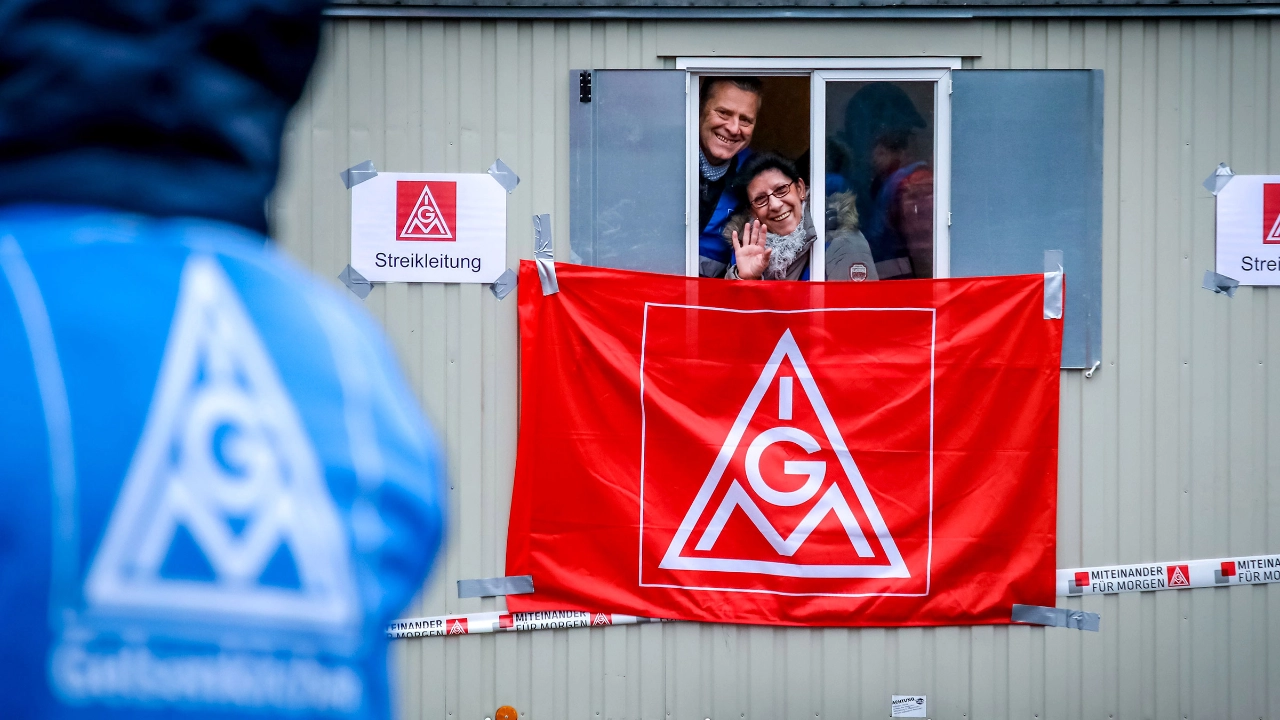
Eine Frau und ein Mann winken aus einem Bauwagen an dem eine IG Metall-Fahne hängt.

There for you locally

Dedicated works councils and shop stewards in the workplaces, along with around 150 local offices across Germany: We provide our members with knowledgeable contacts right where they work. Anyone who joins IG Metall can count on effective support and excellent service.
Metaller mit roter IG Metall-Kappe, Regencape und Lautsprecher.

Have a say and make a difference

Anyone affected by regulations and working conditions should also have a say in shaping them. IG Metall helps establish works councils and supports its members—including financially—when collective bargaining disputes lead to strikes.
Eine Statue der Justitia wird von der Sonne angestrahlt.

Our legal protection

When it comes to proper job classification or reviewing employment contracts and pension notices, we’re here to offer advice and assistance. In the event of disputes, we provide our members with free legal advice and representation in court—through all levels of the judicial system if necessary.
Mit Flatterband abgesperrtes Werkstor.

Support during strikes

Strikes are not an end in themselves, but they are sometimes unavoidable. In such cases, IG Metall also provides financial support to its members. The amount of strike support is based on the length of membership and the amount of membership dues paid.
Beschäftigte stehen zu einem großen Herz zusammen
Become a member
Become part of a strong community

From legal protection in labor and social law matters to fair wages and salaries—we take personal and reliable care of our members.

New on igmetall.de

Subscribe to the newsletter