The pandemic has affected all areas of life
As the figures show, metalworkers have experienced the COVID-19 crisis in much the same way as the rest of the population. The pandemic has affected all areas of life; it has been—and continues to be—accompanied by major restrictions. Sixty percent of respondents reported feeling anxious about their health or that of their loved ones; for 82 percent, restrictions on leisure activities and social contacts rank among the most defining aspects of the pandemic. Furthermore, the strain was enormous, especially for parents, during the closures of daycare centers and schools. 78 percent of families with children under 14 in their households had to completely reorganize their daily lives. More than two-thirds of those affected perceived the additional childcare responsibilities resulting from the temporary closure of daycare centers and schools as a major burden; women were particularly affected. And the majority of employees with family members requiring care also struggled with specific challenges in organizing their daily lives.
With the onset of the pandemic, daily work life in many companies changed radically within a very short time—this had, and continues to have, a major impact on employees.
Satisfied with Prevention Measures and Working from Home
While respondents are generally satisfied with the protective measures implemented at their workplaces—thanks in part to the efforts of works councils and IG Metall—the experience of recent months has shown that remote work is technically feasible even on this scale, and 85 percent of respondents would like to be able to work from home regularly in the future. However, nearly half of the respondents were uncertain about where and how they could continue working at the company at all. One-third of the respondents had to cope with—or are still coping with—significant financial constraints. And: Working from home must also be good, healthy work. Occupational safety and health, working hours, insurance coverage, or the financing of reasonable office equipment—the list of issues that need to be addressed is long, and the legal framework is still lacking.
And everything points to this crisis not ending anytime soon.
Severe Economic Crisis, Profound Change
One thing is certain: COVID-19 has caused the most severe economic crisis in postwar Germany. At the same time, the pandemic is a global crisis: supply chains have been disrupted for a long time, demand has plummeted dramatically, and uncertainties persist in many places to this day. For many of our industries, which are already undergoing profound structural change, COVID-19 is acting as an explosive accelerant. The figures from the survey underscore the severity of the economic downturn. More than half of the employees surveyed were on short-time work, at least temporarily. In the automotive industry, the figure was two-thirds of colleagues; in the steel industry, it was as high as 73 percent.
Short-time work remains important
But it wasn’t just in the automotive sector or the steel industry that the number of colleagues on short-time work was high. The survey shows that, across all industries, the proportion of employees on short-time work was high. Short-time work is therefore, without a doubt, the key tool for safeguarding jobs during the COVID-19 crisis. This made the extension of the short-time work benefit regulations beyond the end of the year all the more important. Employees recognize this: 94 percent of those on short-time work say they are glad that short-time work has allowed them to keep their jobs even during the crisis.
However, this figure should not obscure one fact: uncertainty among the workforce remains high. While employees are very satisfied with the commitment of works councils and IG Metall—both works councils and local IG Metall representatives were equally accessible—a large majority also appreciates the company-level regulations and the influence on political decisions.
Fear of Job Loss
However, the figures also reveal this: the fear of job loss is pervasive; 71 percent of respondents report increased anxiety about the future among the workforce. This uncertainty runs deep within the core workforce. This perception is particularly pronounced among employees who are worried about their own jobs—here, 96 percent share this sense of crisis.
This is no coincidence. The survey results show that job cuts are often the order of the day, or at the very least cast a dark cloud over the outlook for the coming months. Fifty-three percent of respondents state that jobs are to be cut at their companies either currently or in the near future. Colleagues in the automotive manufacturing sector (69 percent) and the steel industry (63 percent) are disproportionately affected.
No Strategy for Transformation
Employers’ inadequate communication policies also contribute to the crisis-ridden mood. The survey shows that only 44 percent of employees feel sufficiently informed about the economic situation and the future prospects of their company. And 85 percent of employees who feel inadequately informed, in turn, perceive increased anxiety about the future among the workforce. However, the transformation cannot be successfully managed with an unsettled workforce.
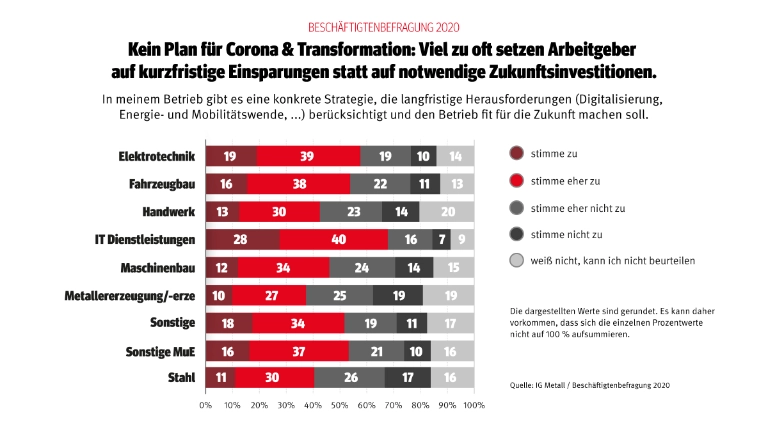
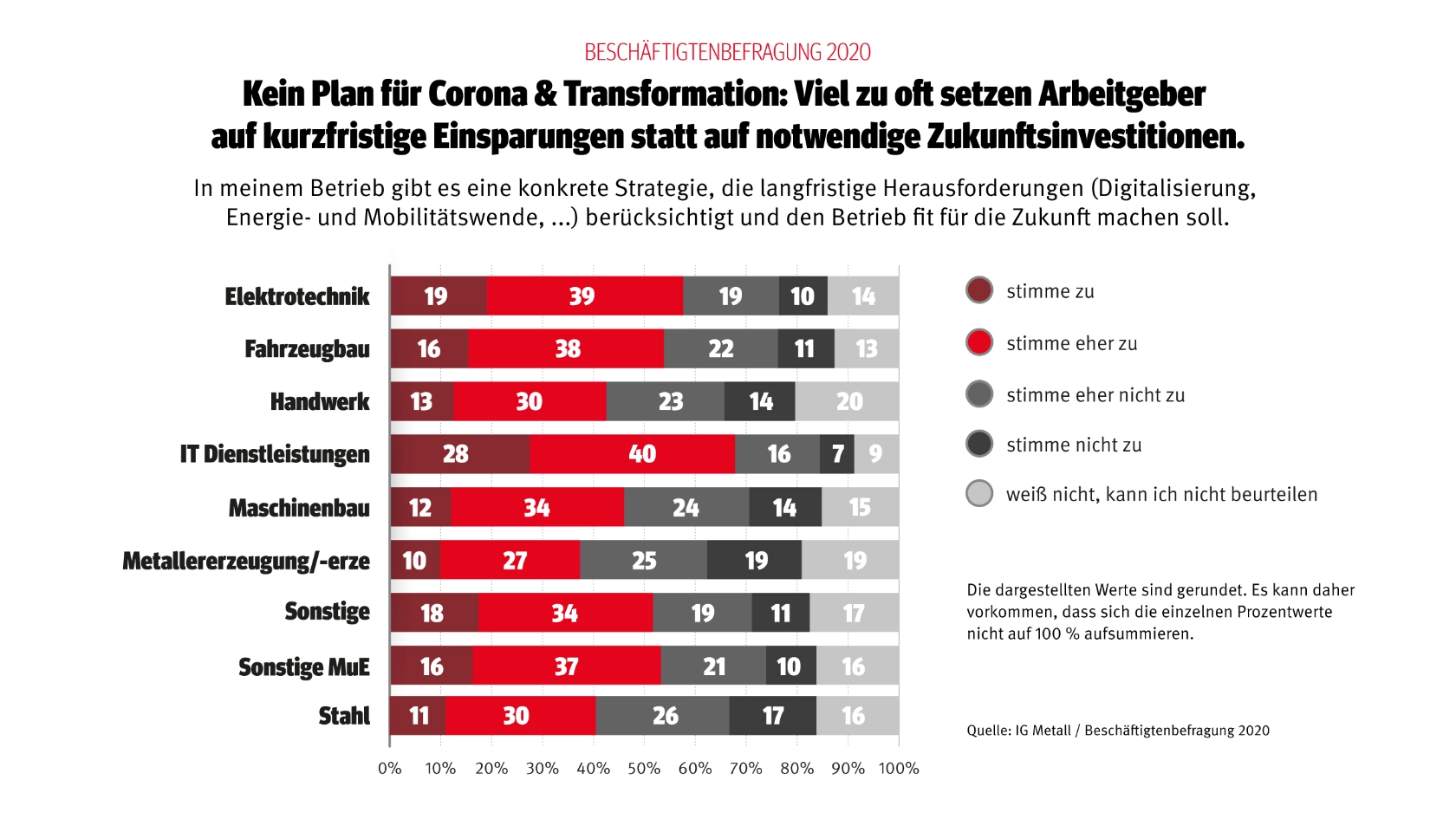
In many companies, the problem goes beyond a lack of transparency. Often, a concrete, long-term strategy for addressing structural challenges has been missing for quite some time. The COVID-19 crisis is now brutally exposing this: Many companies are focusing on short-term cost-cutting rather than on necessary investments in the future.
Employees share this impression of a lack of strategic direction: when asked whether they agree with the statement that their company has a concrete strategy for the long-term challenges of structural change, on average across industries, only about one in two respondents agrees. In certain sectors, employees particularly often complain about their employers’ lack of strategy. In the steel sector, for example, only 41 percent of employees agree with the statement that a strategy exists.
Employees Want to Get Involved
Despite—or perhaps precisely because of—all the concerns and uncertainty, however, employees show themselves to be extremely willing to mobilize. Faith in the success of collective action remains high. Seventy percent of employees are convinced that they can overcome workplace challenges through solidarity. There is also a strong willingness to fight for the future of entire regions together with colleagues from neighboring plants. Among automotive workers, 77 percent support regional actions; among steelworkers, the figure is as high as 82 percent. This sends a clear signal: The path through structural change must be taken together with the workers, not without them.
Workers are ready to fight for a social, ecological, and democratic transformation. However, change requires security. The government must continue to step up. For example, 81 percent of respondents support ensuring the economic survival of companies through financial support and economic stimulus measures.
The survey clearly shows that workers demand security and prospects amid change. This explains the high level of support—87 percent across all employee groups—for forward-looking collective bargaining agreements that include commitments to investment, products, and business locations. However, our colleagues are not just making demands—they are also willing to take action. Employees know that skills development is a key tool for securing jobs during the transformation. Ninety-two percent of respondents support securing the future through skills development. This shows that our colleagues are fully aware of the depth of the recession and the force of the transformation.
The mandate for IG Metall is therefore clear: Further efforts are needed at the company, collective bargaining, and political levels to shape the transformation in a socially, environmentally, and democratically responsible manner. IG Metall and the workers are ready to take responsibility for the future—and we expect the same from employers.
Demands on Policymakers
Industrial policy, taxes, the welfare state: In the employee survey, we also asked about key federal policy issues. As the 2021 “super election year” gets underway, the results are now available (see below: PDF “Setting the Political Course”).
87 percent of respondents support an active industrial policy with targeted funding for key future sectors (hydrogen economy, artificial intelligence, battery cell manufacturing, etc.). In doing so, they share a central demand of IG Metall regarding the shaping of the transformation. 91 percent support the approach of securing industrial jobs through collaboration in regional alliances.
Well over half of employees (58 percent) believe it is justified for the government to take on more debt to fund investments in the socio-ecological transition.
Nearly two-thirds (65 percent) of workers support higher taxes on high incomes and large fortunes. Twenty-one percent oppose this—they are concerned about additional burdens on businesses and job losses.
37 percent want to further expand the welfare state—for example, in terms of unemployment benefits, basic income support, and pensions. This view is held more frequently than average by young workers up to age 24 (41 percent), IG Metall members (43 percent), workers in production (47 percent), temporary workers (47 percent), and those without completed vocational training (56 percent).
About 96 percent support tailored and socially secure transitions to retirement. 89 percent favor stabilizing and, in the medium term, increasing pension levels without further raising the retirement age. The picture is similar when it comes to the demand for a right to employer-funded occupational pension plans: Nearly nine out of ten colleagues (88 percent) fully agree or somewhat agree.
Further results and data from the 2020 Employee Survey
Fact Sheet “Employers Without a Plan” (PDF)
Data sheet “Works Council and Union Activities” (PDF)
Data sheet “Working from Home” (PDF)
Data Sheet “Crisis Experience” (PDF)
Fact Sheet: “Short-Time Work” (PDF)
Fact Sheet “Collective Bargaining Demands” (PDF)
Fact Sheet: “Uncertainty and Solidarity” (PDF)
Fact Sheet: “Setting the Political Course in Times of COVID-19 and Transformation” (PDF)