“The drone hovered in front of my excavator and filmed me,” recalls current works council member Waldemar B. (*name changed by the editors). The CEO of Hark Recycling then urged the staff to walk with him around the premises and confronted individual employees with photos taken by his drone: “Why did you take such a long break here, drinking coffee and smoking?”
“In the process, he used words like, ‘You’re too stupid and dumb, and you still haven’t learned anything in 20 years,’” reports Andreas W.*, who is now the works council chair. “Our foreman was called stupid and incompetent in front of the entire crew—and was fired.”
Employees Elect Works Council—Management Splits
That was the last straw—after grievances at Hark Recycling at the local freight yard in Hamm had been piling up over the past few years. Eleven of the 50 employees at the time reached out to IG Metall Hamm-Lippstadt—and then things moved very quickly. On November 3, 2025, the election notice was posted at the plant. On November 19, 2025, they elected a five-member works council for the first time. After the votes were counted, the results were announced on November 25.
“The managing director declared that he would never accept the works council,” says works council chair Andreas W.*, who, as a “torch operator,” cuts large metal parts with a cutting torch.
As early as November 14—five days before the works council election —a notice from management was posted at the plant: Hark must vacate the site at the local freight yard by the end of the year. The business is to be relocated to Dortmund. The newly founded Aluminiumservice Hamm GmbH & Co. KG (ASH), which is also owned by the Westarp family and their Westarp GmbH, is to be established on the company premises in Hamm.
The majority of Hark employees are offered new contracts with ASH—in exchange for signing bonuses ranging from 500 to 1,500 euros. The works council members do not receive such offers. Three of the five elected members will step down from their positions on December 29, 2025. Two other elected employees, Mustafa A.* and Artur B.*, will take their places. Following a meeting on January 12, 2026, the four works council members will be asked to begin work in Dortmund. Employees who do not wish to sign the new ASH contracts must also relocate to Dortmund along with them.
Dortmund: No Water, No Heat, Mold
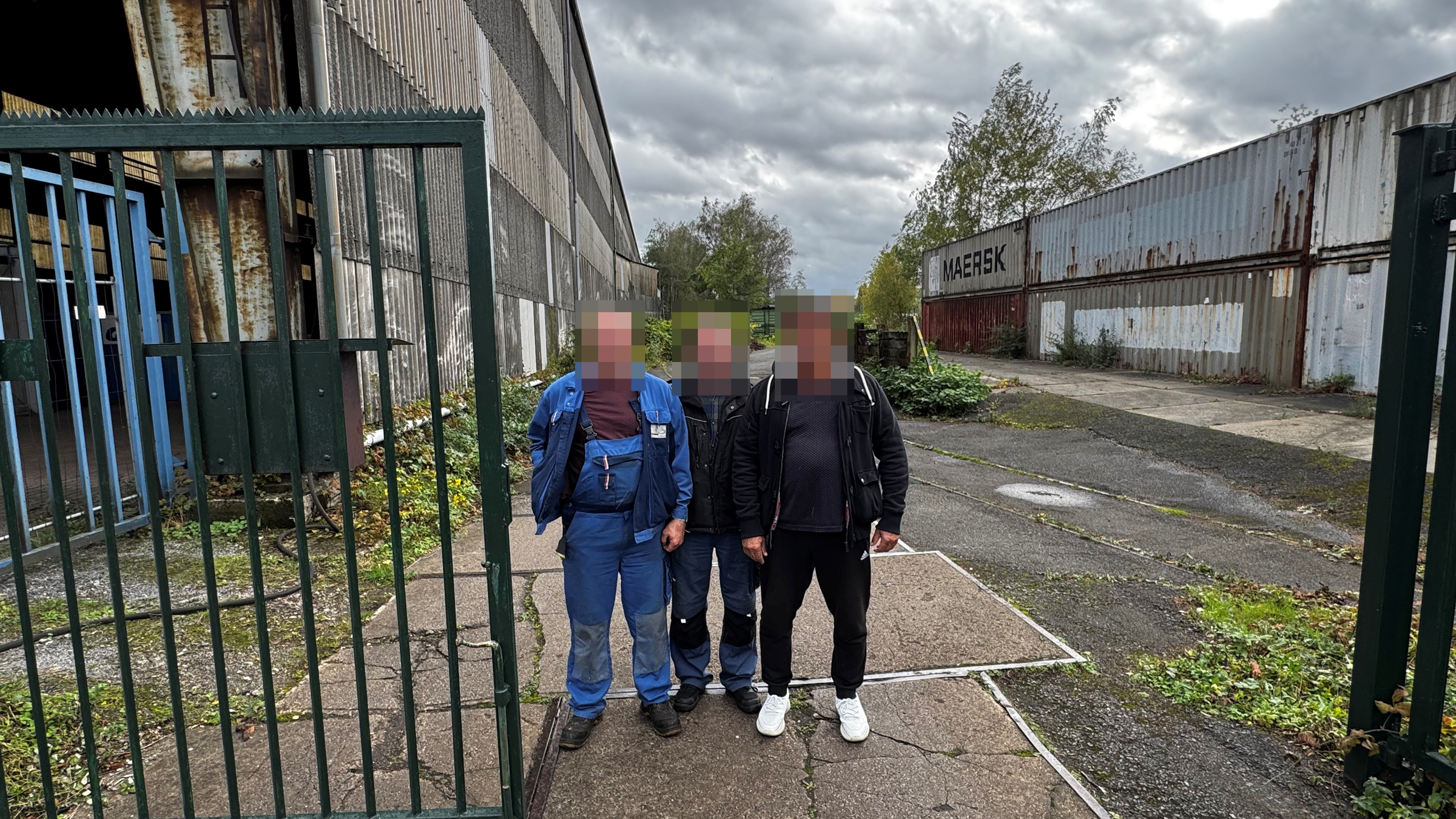
Dortmund—officially the new headquarters of Hark Recycling—seems more like a derelict wasteland to the employees. The site at the harbor has not been used for years and is completely overgrown. The employees first have to clear the overgrown vegetation themselves. In addition, many pipes have simply been stolen over the years. There is no water and no heat—even with sub-zero temperatures. The old wooden shack, which houses the office and the scale control system, is completely covered in mold.
“Management then came to a meeting where we pointed out the deficiencies to them,” reports Andreas W.* “I said, ‘Can you smell the mold? Take another deep breath.’ And then, all of a sudden, they had to leave urgently for another appointment.”
Management then began to address the most glaring deficiencies. But for a long time, there was a lack of work and equipment in Dortmund. An excavator was delivered in early March. Without a grapple, it was initially unusable. About three weeks later, the grapple finally arrives. But the scrap shears aren’t working, and a magnetic plate for the excavator is still missing. The employer doesn’t provide welding equipment or small tools. The workers repair an angle grinder and a ladder themselves, in part using scrap metal on hand.
Workers* on the company grounds in Dortmund—officially the new headquarters of Hark Recycling.
Works Council Addresses Serious Conditions at Hark Recycling
Electing a works council at Hark was urgently needed. Time and again, the employees had pointed out serious occupational safety deficiencies to management: forklifts with brakes that don’t work; safety instructions that exist only on paper.
Then, two years ago, a good colleague of theirs died in a metal shredder. “He was sent there shortly before the end of the workday to clean the shredder—alone, which is actually strictly prohibited,” recalls excavator operator Waldemar B.* “I was still talking to him while he was stuck in the shredder. He said, ‘My legs are burning. But his legs had been shredded all the way up to his thighs.” The colleague died on the way to the hospital. The shredder is still running today.
Currently, the legally elected works council members are barred from the premises in Hamm—which is now officially a different company. And management prohibits employees in Hamm from speaking with the works council members. Nevertheless, they naturally continue to maintain contact and raise concerns about working conditions with management.
“We just want reasonable working conditions”
They are fighting back, together with IG Metall. In a recent resolution process, the works council is demanding, among other things, that the company cease measures aimed at undermining its representation; that it offer contracts with ASH to the four works council members based in Dortmund, recognizing their prior length of service; and that it provide the material resources necessary for works council work. But the elected works council members intend to keep fighting—four of the original 11 employees who helped establish the works council.
“The remaining seven backed out under pressure and out of fear of the consequences,” says Markus Kirchner of IG Metall Hamm-Lippstadt. “Although protection against dismissal for those initiating works council elections was improved in 2021, we at IG Metall are still repeatedly confronted with employees’ fears.”
Their new IG Metall office for the Central Ruhr region is now also standing alongside the eight employees who have been transferred as a disciplinary measure in Dortmund. “I’ve never seen conditions like these here at Hark,” criticizes union secretary Yunus Emre Yildirim, who oversees numerous scrap and recycling companies. “All of them offer better working conditions than Hark, many pay according to the collective bargaining agreement—and all are looking for skilled workers.”
The employees transferred as a disciplinary measure in Dortmund are anything but “underperformers.” Waldemar B.* has been with Hark for 23 years. Andreas W.* used to travel throughout Europe as a self-employed oxy-fuel cutting expert and even gave lectures at universities. They could have found better jobs long ago. Yet they’re still there.
“We finally want decent working conditions for our colleagues,” explains Andreas W.* “And we want to defend our rights as workers—rights we fought for together in the past. I was there during the strikes in the 1980s—and on the Bridge of Solidarity in Duisburg-Rheinhausen, when we supported the steelworkers in their fight for their future. It’s unacceptable that employers in Germany are becoming increasingly brazen and trampling on the rights we fought so hard to win.”
The Hark works council members are receiving solidarity support from IG Metall—and from works councils across Germany in the committee “Solidarity Against Works Council Harassment!” The committee connects affected works council members and unions, compiles information and materials, organizes conferences, protests, and public awareness campaigns, and provides a forum for sharing experiences and offering practical support.
* The names of the works council members in the text have been changed by the editors, and the individuals in the photo have been made unrecognizable.