This is no longer a minor matter: The Munich-based financial investor Aequita (10 billion euros in annual revenue) is expanding rapidly—and is now also taking over Rheinmetall’s automotive division, primarily the auto suppliers Kolbenschmidt and Pierburg, with 7,000 employees worldwide. IG Metall and the works councils have secured an agreement with Aequita that safeguards locations, jobs, and collective bargaining agreements for three years.
There are already a number of other, negative examples where this billion-euro financial investor has drained capital from companies, cut staff, and closed plants.
Ueckermünde Iron Foundry: Shut Down After Just One Year
The iron foundry in Ueckermünde, Mecklenburg-Western Pomerania (which produces castings for brakes) was acquired by Aequita just last year as the Breyden Iron Foundry. On October 2, management announced the closure of the foundry—which employs 283 workers—effective December 31. The company cites declining market conditions and insufficient capacity utilization as reasons for the shutdown, factors that were allegedly not foreseeable a year ago.
The works council and IG Metall were taken completely by surprise. “What is particularly troubling is that the Minister of Economic Affairs for Mecklenburg-Western Pomerania was there just a few weeks earlier and spoke with management without a single word being mentioned about the imminent closure,” criticizes Frank Prenzlau, chief representative of IG Metall Stralsund-Neubrandenburg. IG Metall and the works council are demanding transparency, an examination of alternatives, and the preservation of jobs.
The case in Ueckermünde is reminiscent of the former Breyden Foundry (formerly Bosch, formerly Buderus) in Lollar, Hesse, which also manufactured castings for brakes. Aequita took over Lollar from Bosch in 2024. Despite an initial promise of a site guarantee through the end of 2026, Lollar was closed at the end of 2025. Following protests and negotiations, IG Metall and the works council secured severance packages of up to 115,000 euros as well as a twelve-month outplacement program.
The resistance is now gaining momentum. State politicians and the city council have rallied behind the employees and are sharply criticizing Aequita.
AIOS: “We won’t let them bleed us dry”—strike vote now
The 220 employees of AIOS in Überherrn, Saarland, and Maichingen near Sindelfingen manufacture headliners for the Mercedes S-Class and the Mercedes luxury brand Maybach. In the very early days, these were simply made of fabric—today, premium headliners are packed with electronics. They are used to their owner, management, and company name changing every two years.
But in February, they were taken over by the Munich-based private equity firm Accursia Capital. They didn’t find out until March. As early as May, management is already threatening bankruptcy. Neither the works council nor IG Metall knows what the situation really is. Management isn’t disclosing any figures and isn’t even attending staff meetings.
“We don’t know what they’re planning for us,” criticizes works council chairwoman Gisela Tiefensee-Naaber. “Management is just creating chaos. More and more consultants are walking through our factory and even giving orders, without anyone knowing who they are.”
The AIOS works council and IG Metall Völklingen have a suspicion: Accursia primarily wants to drain the company of money, possibly sell off the buildings, land, and machinery—and also take advantage of the fact that Mercedes can’t just pull a new supplier out of thin air overnight. According to information from IG Metall, AIOS has already demanded compensation for losses from Mercedes.
They don’t know if they’ll still receive pay next month. The employees are fighting back. They won’t let themselves be bled dry. The company bargaining committee is demanding a social collective bargaining agreement with additional severance payments, a transfer company, and insolvency protection.
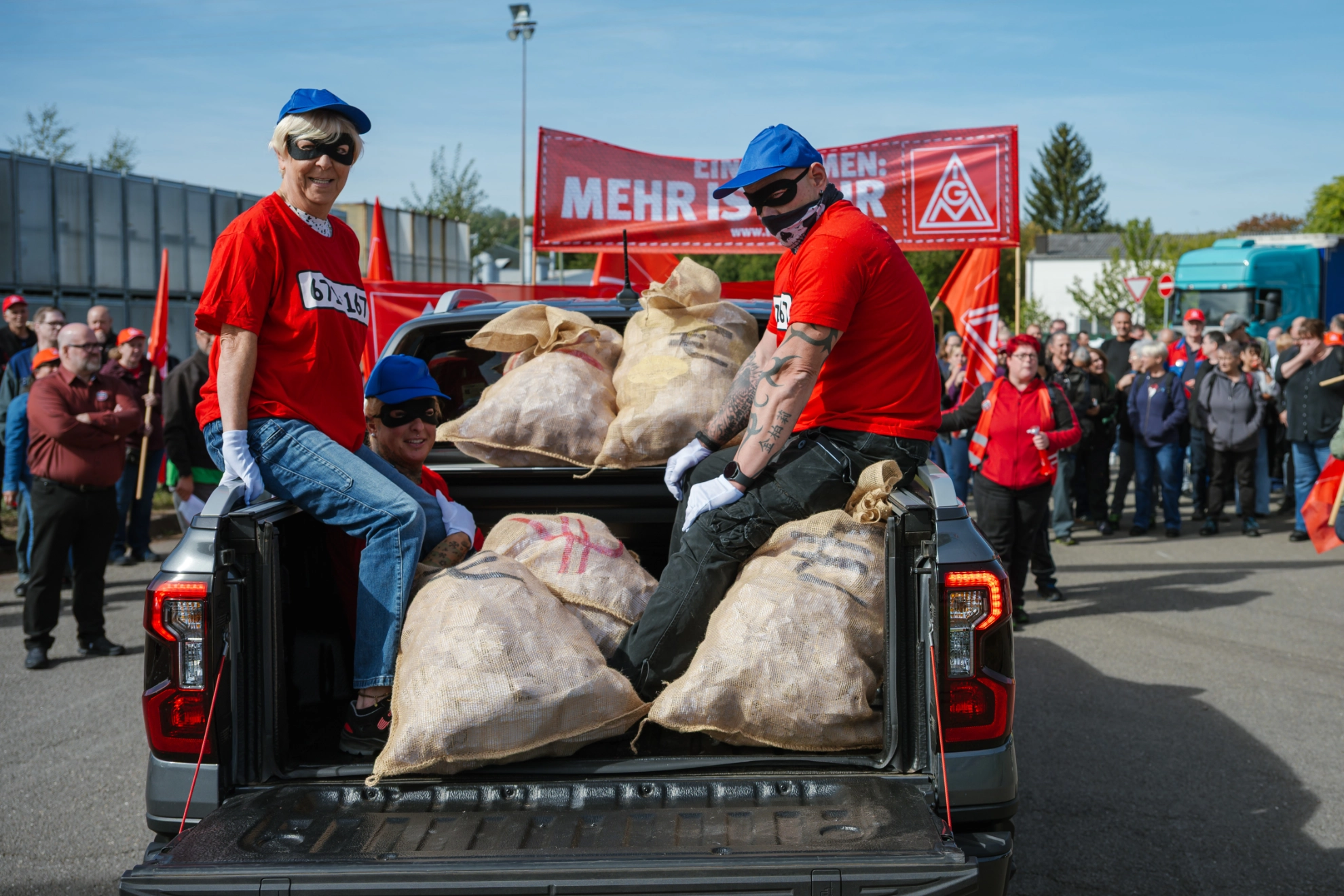
Following protests (photo above: Employees prevent their exploitation), two warning strikes, and a five-day works meeting—during which the employees waited for the managing director, who never showed up despite daily invitations—they are now ramping up the pressure on the financial investor. The IG Metall executive board has now approved the works bargaining committee’s request for a strike vote. Preparations are underway. Then the employees will vote on an indefinite strike.
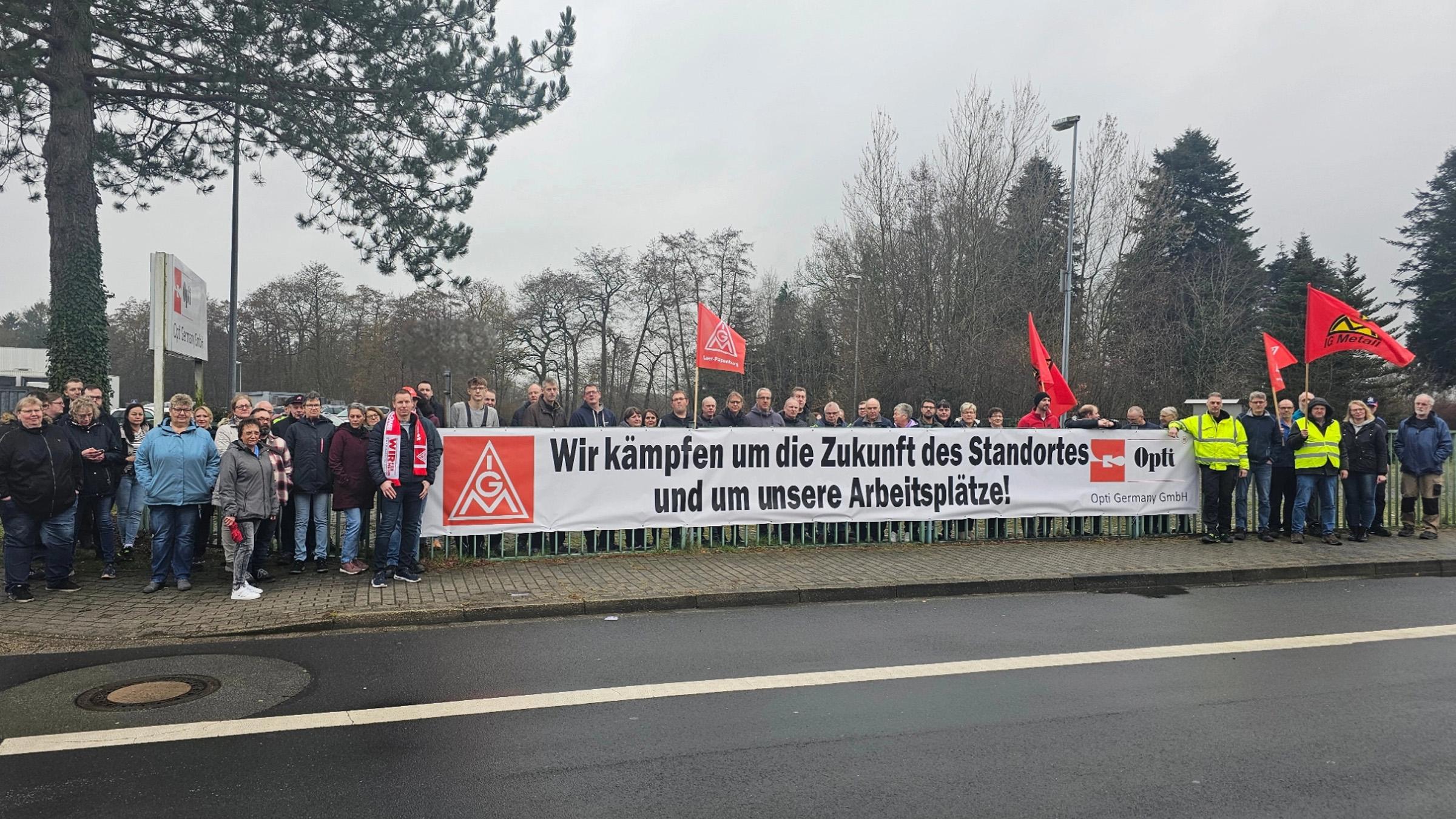
The employees at Opti in Rhauderfehn have been fighting for two and a half years to save the plant and their jobs.
Financial investors specializing in “restructuring cases”
Aequita describes itself as an investment group that supports small and medium-sized enterprises, with a focus on transformation and corporate carve-outs in “special situations,” with 65 investment locations, 15,000 employees, and annual revenue of 10 billion euros. Accursia Capital describes itself as an “industrial holding company focused on complex carve-outs, turnarounds, and succession planning in the SME sector.”
The two sometimes work in tandem: Opti, an industrial zipper manufacturer in Rhauderfehn, Lower Saxony, will be acquired overnight by Aequita at the end of 2023. The first wave of layoffs comes after just a few weeks. For two and a half years, employees and the works council, together with the IG Metall Leer-Papenburg union, fight against layoffs and the removal of machinery, for their location, and for severance pay—for which the financial investor, worth billions, allegedly has no money. Instead, it drains money from Opti, including for overpriced managers and IT services. In mid-2025, Opti employees then learn that Aequita has once again sold Opti to Accursia overnight and renamed it YourZip. One of the three locations (in Italy) has already been closed.
Employees Fight Back
But employees and IG Metall are fighting back and achieving successes, such as at the roller bearing manufacturer Durrkopp in Halle, Westphalia: Just a few months after Aequita’s acquisition, 250 out of 550 employees were slated to be laid off at the end of last year. Here, too, management is threatening bankruptcy. But the employees refuse to be intimidated; they’ve managed to reduce the layoffs to 176, secured severance packages of up to 115,000 euros, and established a transition program. Durrkopp remains bound by the collective bargaining agreement—and the first investments are already flowing in.
At Salzgitter Maschinenbau AG (SMAG), two years after the sale, Aequita is cutting back in mechanical engineering but actually creating jobs overall—though this is due to the boom in the defense industry, for which SMAG builds antennas.
At Rheinmetall Automotive, too, works councils and IG Metall intend to keep a close eye on Aequita—and are demanding a long-term vision extending beyond the three-year period, explains Yvonne Möller, chief negotiator for IG Metall. “We expect investments and innovations to secure long-term employment, with full respect for co-determination.”
But at the Breyden iron foundry in Ueckermünde, the very survival of the company is now at stake. Here, the IG Metall Stralsund-Neubrandenburg chapter is organizing solidarity and the fight to save the site—under the slogan “Breyden must stay.” Outrage over Aequita’s “locust mentality” is growing among politicians and the public.
At the Mercedes supplier AIOS, resistance is already underway. Nearly all employees here—including many women who have been working here for decades—are members of IG Metall. Preparations for a strike vote are underway.
“With a genuine willingness to reach an agreement, management could have avoided a labor dispute at the negotiating table,” criticizes Uwe Zabel, chief negotiator for IG Metall Mitte. “But due to management’s obstruction and provocations, we are forced to fight.”