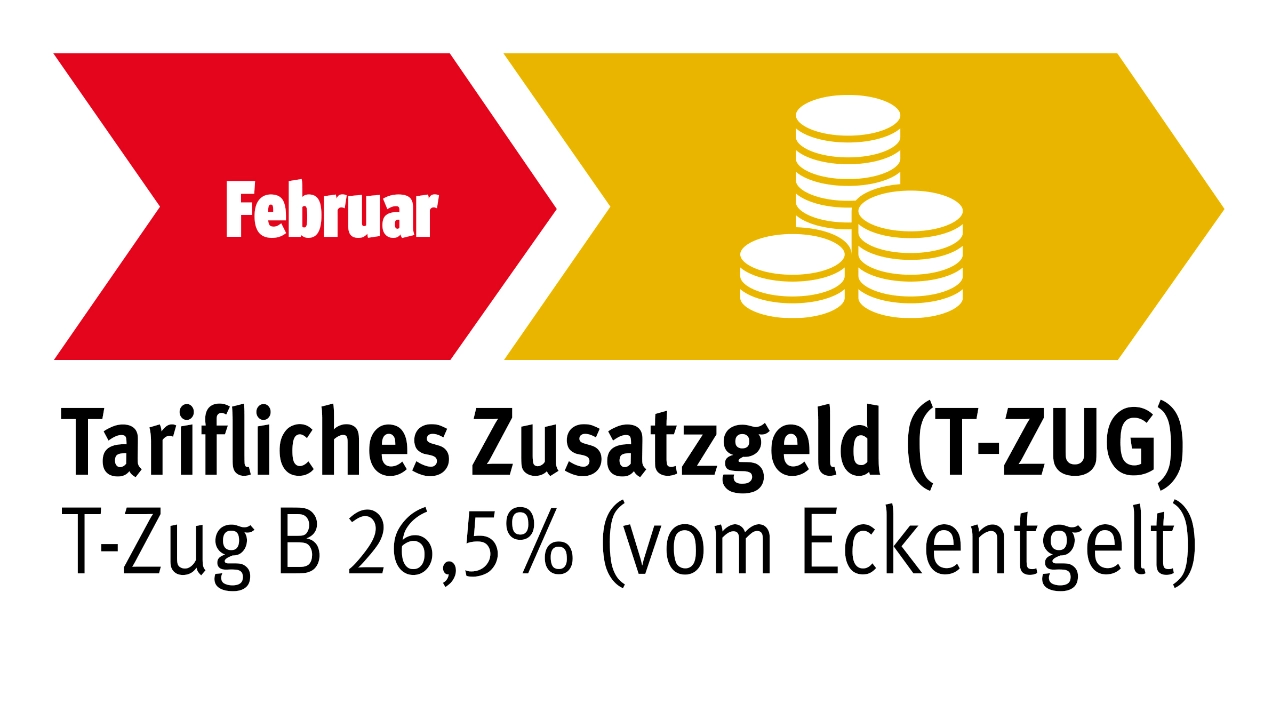
Note:In 2026, the additional amount of the Collective Bargaining Supplement (T-Zug B) will increase from 18.5 percent to 26.5 percent of the base pay for the respective collective bargaining region.
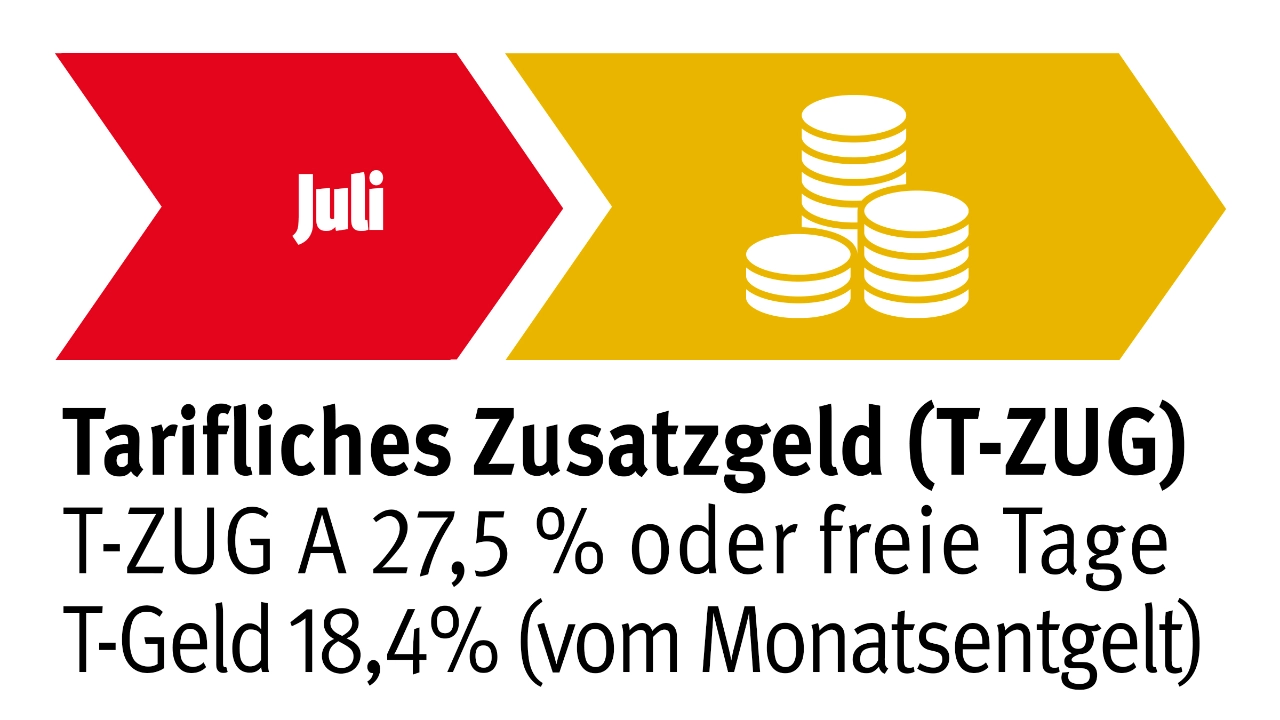
When will I receive the T-Geld?
The T-Geld is to be paid as a one-time payment no later than July 31. However, the payment may be postponed until no later than September 30 by company agreement. If the T-Geld is “differentiated,” it may also be postponed for a longer period or suspended (see below).
What about part-time and partial retirement employees?
Part-time employees receive the T-Geld in the same way as other special payments: 18.4 percent of their regular individual monthly pay.
For employees in partial retirement, their partial retirement pay—that is, half of their previous full-time pay—is used as the basis. Under the block model, this applies to both the work phase and the leave phase. As a one-time payment, the T-Geld—unlike monthly pay—is not topped up in accordance with the collective bargaining agreement.
What applies during parental leave?
Employees on parental leave generally meet the requirements for T-Geld. However, since the employment relationship is suspended during parental leave, the entitlement is reduced proportionally for the duration of the suspension. Example: If you take 6 months of parental leave during the year, you will receive only half of your T-Geld.
Do I still receive T-Geld if I’m receiving sick pay?
Although the employment relationship is suspended while you’re receiving sick pay—unlike during parental leave—this suspension isn’t “by law.” Therefore, you’re still entitled to the full amount of T-Geld even while receiving sick pay.
How is the “regular individual monthly pay” calculated?
Similar to vacation pay, the calculation is based on your regular monthly pay (or regular training allowance).
The calculation is based on the fixed pay components for the current month—primarily the monthly base pay—plus the monthly average of the variable pay components from the last three months (in North Rhine-Westphalia, the last six months).
These include: performance-based variable pay components—that is, performance-based pay (piece rates, bonuses, etc.) as well as premiums for late-night, night, Sunday, and holiday work, hardship allowances, individual bonuses, commissions, and allowances based on the average of the last six paid months, but excluding overtime pay and travel allowances.
Roughly speaking, this means: Check what you’ve earned on average over the last few months and subtract the pay for overtime. You’ll receive 18.4 percent of that amount.
I’m leaving the company. Will I receive severance pay?
In the year you leave, your entitlement is prorated.
Example: If you leave the company on July 1, you’ll receive a pro-rated T-Geld payment for the months of January through June—that is, for 6 out of 12 months, which is half of your annual entitlement.
Eligible employees or trainees whose employment relationship is suspended during the calendar year by law or by agreement do not receive any benefits. If the employment relationship is suspended for part of the calendar year, they receive T-Geld on a pro-rata basis.
The T-Geld can also be used “to secure employment.” How does that work?
In the event of a reduction in working hours due to employment difficulties, the T-Geld can be offset against a partial wage compensation agreed upon by the employer and employee representatives.
Example:
The works council and the employer agree to reduce working hours from 35 to 32 hours per week to bridge a transition phase, such as the shift to new products for electric mobility. For the duration of the reduction—up to three years or longer, depending on the collective bargaining area—layoffs for operational reasons are prohibited.
To keep monthly pay stable despite the shorter workweek, the works council and the employer agree on a partial wage compensation arrangement that includes the T-Geld. This can also be combined with other special payments. In addition, the employer makes contributions. As a result, for 32 hours of work—ideally in a four-day workweek—employees are paid for nearly 34 hours.
What does it mean that the T-Geld can be “adjusted”?
Depending on the company’s economic situation, the T-Geld may be withheld in whole or in part, or its payment may be deferred for up to 5 months, if this serves to maintain or restore competitiveness. This requires the prior consent of IG Metall.