Automatic translation
This article has been translated automatically using computer technology. While we strive for accuracy, some wording or details may differ from those in the original article.
This translation was not manually reviewed. For important facts, quotations or legally sensitive information, please consult the German original. Individual selections, images, embedded media or technical terms may have been translated differently or incompletely.

Vacation Pay in 2026 More vacation days and extra money for travel with a collective bargaining agreement

Vacation at last. Employees at companies covered by collective bargaining agreements have a clear advantage here. With a collective bargaining agreement, you not only get more vacation days, but also a little extra for your travel budget.

Wanderpaar sitzt vor Sonnenuntergang auf Felsgipfel

18 June 2026 18 June 2026


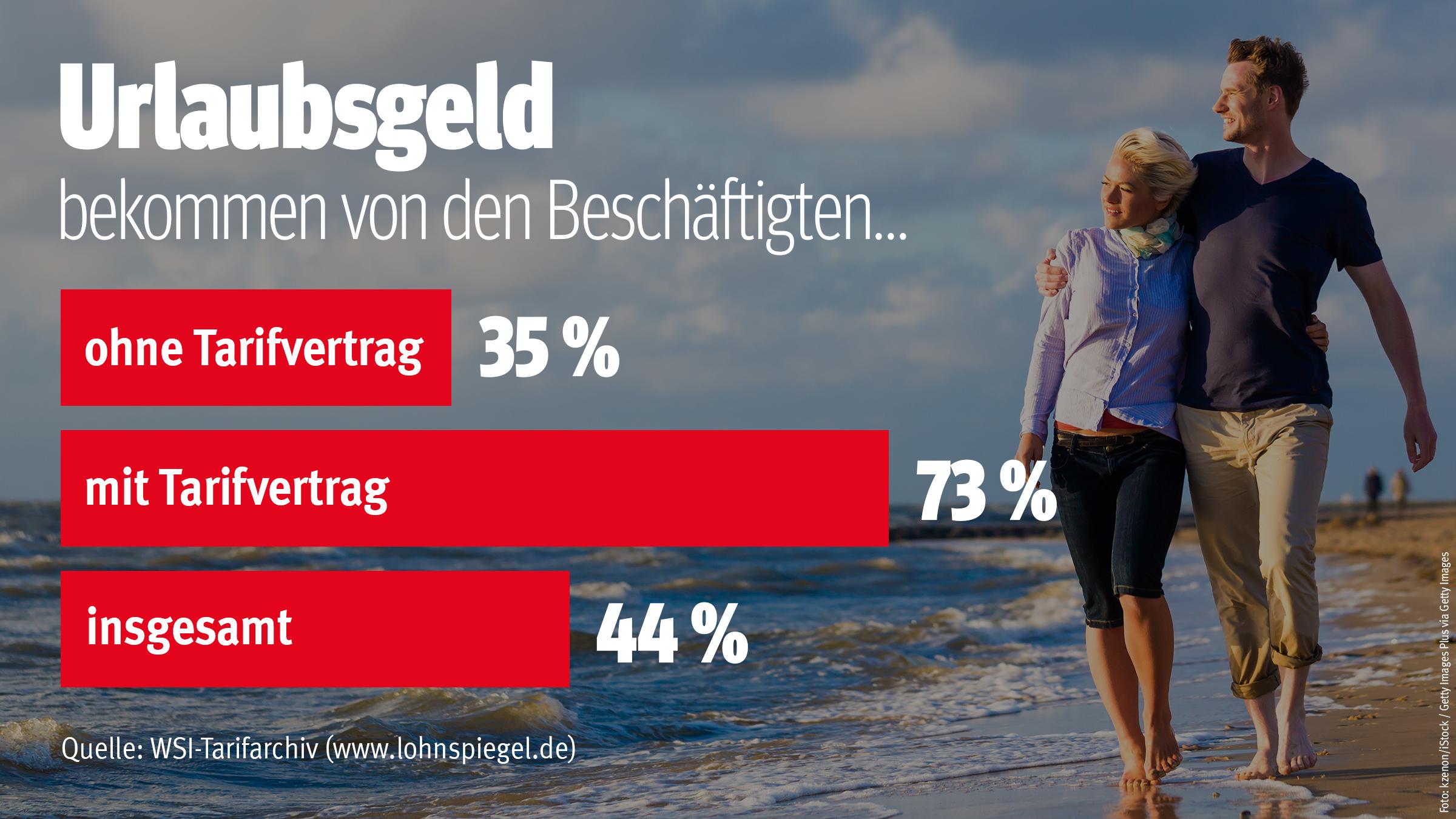
Not everyone in this country gets to enjoy vacation pay. Less than half (44 percent) of all employees are that lucky—as determined by a new analysis from the collective bargaining archive of the Institute for Economic and Social Research (WSI) at the Hans Böckler Foundation.

Whether and how much vacation pay is provided depends, among other things, on the region, industry, company size, and work experience. In western Germany, vacation pay is still higher in many industries than in eastern Germany. And the larger the company, the more likely employees are to receive vacation pay. The longer one’s career, the greater the chance of receiving it.


Infografik: Urlaubsgeld 2025 mit Tarifvertrag, ohne Tarifvertrag und insgesamt


Better Chances of Extra Vacation Pay Under Collective Bargaining Agreements

There is no doubt that employees benefit from additional vacation pay if their company is bound by a collective bargaining agreement. According to the WSI Collective Bargaining Archive, this applies to 73 percent of employees. In contrast, only 35 percent of employees whose companies are not bound by collective bargaining agreements can look forward to vacation pay. The amount of these collective bargaining-based bonuses varies greatly depending on the industry. This year, the range for vacation pay in the middle pay grade is between 186 and 2,904 euros.

The highest payments go to employees covered by IG Metall collective bargaining agreements in the wood and plastics processing industries, the metal and electrical industries, and the automotive sector. As a rule, the vacation bonus amounts to 50 percent of average earnings in the industries covered by IG Metall collective bargaining agreements.


Six Weeks to Relax

And don’t forget: metalworkers are entitled to 30 days of vacation per year. This isn’t a given everywhere. By law, only 24 days are required—and even then, only for employees who work six days a week. For a five-day workweek, the law requires employers to grant their employees as few as 20 days off.

Six weeks—that’s how long metalworkers in the steel industry went on strike in 1978 and 1979 to demand more vacation time. The result was a phased plan that ultimately led to 30 days of vacation, a provision that has been enshrined in IG Metall collective bargaining agreements since 1981.


Analysis of the WSI Collective Bargaining Archive on Vacation Pay in 2025

Better with a Collective Bargaining Agreement
New on igmetall.de
Beschäftigte stehen zu einem großen Herz zusammen
Become a Member
Become part of a strong community

From legal protection in labor and social security matters to fair wages and salaries—we provide personalized and reliable support to our members.

Subscribe to the newsletter