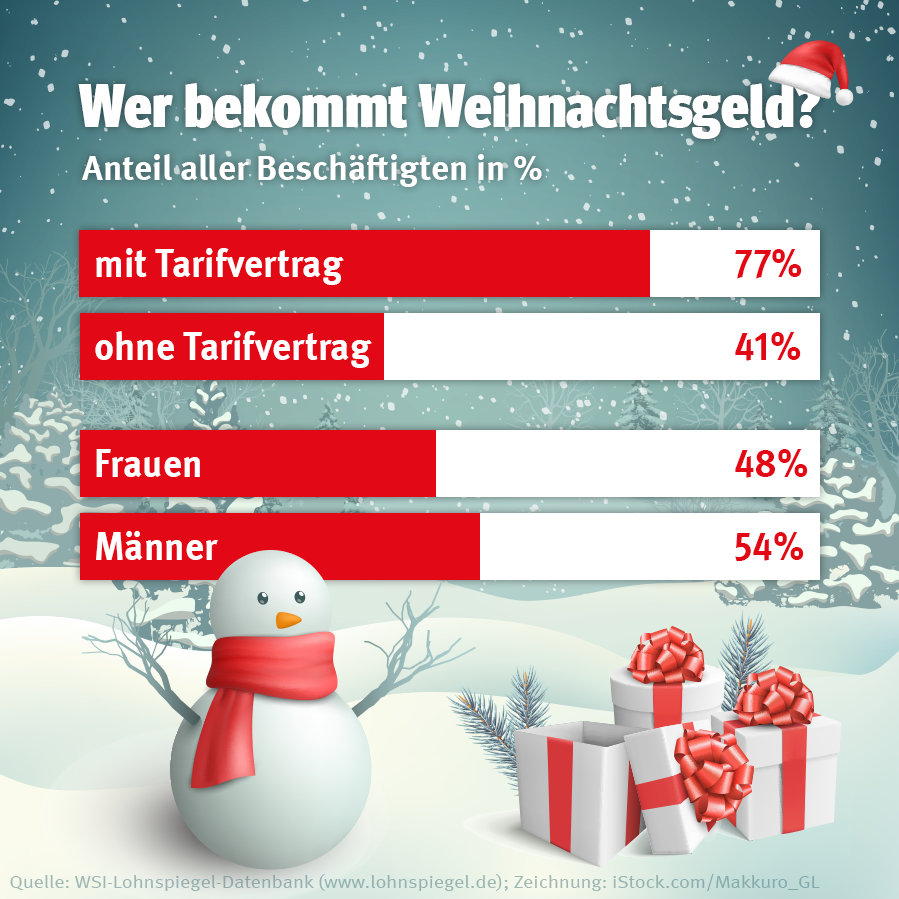
The chances of receiving a Christmas bonus vary. Employees have the best chances if their company is bound by a collective bargaining agreement — 77 percent of them will receive a Christmas bonus this year, compared to only 41 percent of those without a collective bargaining agreement. In addition, employees at companies bound by collective bargaining agreements generally have a legal right to a Christmas bonus under the terms of the agreement. In contrast, at companies without a collective bargaining agreement, employers often pay the Christmas bonus only on a voluntary basis, which they may cancel at any time under certain circumstances.
Women are less likely to receive a Christmas bonus than men. The figure is 48 percent for women and 54 percent for men. Here, too, collective bargaining coverage plays an important role: Women are more likely than men to work in industries such as retail, where collective bargaining coverage has declined sharply in recent years.
Who is eligible for a Christmas bonus?
In general, employees are entitled to a Christmas bonus if it is stipulated in their employment contract, a company agreement, or a collective bargaining agreement. In the latter case, the company belongs to an employers’ association and must adhere to the agreed-upon collective bargaining agreements. This also applies to companies that are not members of the association but follow the industry-wide collective bargaining agreement. In such cases, the employment contract states that the Christmas bonus is based on the collective bargaining agreement.
If there is only an individual employment contract in which a Christmas bonus is promised, the employer can decide anew each year whether to pay it. However, if the employer has granted it unconditionally for three consecutive years, they cannot suddenly refuse to pay it. The workforce can then invoke customary law, which lawyers refer to as “company practice.”
Exceptions to the Rule
Even if all these criteria are met, employees may receive nothing or less than their colleagues—for example, in the case of prolonged illness, parental leave, or termination. However, the employer cannot unilaterally reduce the Christmas bonus; they may do so only if it is stipulated in the employment contract or in a company agreement.
In the metal and electrical industries, even employees with long-term illnesses are entitled to the full Christmas bonus guaranteed by collective bargaining agreements. The specific regulations vary by region and by industry.
Who Gets How Much?
In most industries, the Christmas bonus is calculated as a fixed percentage of monthly pay. For example, employees in the collective bargaining areas of the West German metal industry generally receive between 25 and 55 percent. In the iron and steel industry, 110 percent of one month’s pay is paid, although here the Christmas bonus and vacation pay have been combined into a single annual special payment.
As a rule, only those who have been employed by the company for at least six months are entitled to the collectively bargained Christmas bonus. The amount of the Christmas bonus is also often tied to length of service—full entitlement is usually granted after 36 months.
If the employment relationship ends after the payment date, employees are not required under the collective bargaining agreements of the metal and electrical industries to repay the Christmas bonus. However, individual employment contracts often contain repayment clauses. Such provisions may also be stipulated in company agreements. Therefore, repayment clauses must be expressly agreed upon.
Everyone is treated equally
Like vacation pay, the Christmas bonus is a special payment. The following applies to everyone: The employer may not, without objective justification, exclude individual employees or groups, or place them at a disadvantage; nor may the employer treat blue-collar workers less favorably than white-collar workers. Part-time employees are entitled to a portion of the bonus commensurate with their working hours.
Annual special payments are subject to income tax. However, the tax deduction is calculated according to the annual tax table, so that the progressive tax rate does not fully apply in the month of payment.
Read more in the WSI’s press release on the Christmas bonus