The new collective bargaining agreement at Volvo Trucks Service and its affiliate Renault Trucks Germany will provide the 400 employees with higher wages—in many cases, several hundred euros more per month.
This means that the Volvo and Renault service centers are now the last truck manufacturers in Germany to be covered by a collective bargaining agreement nationwide.
The collective bargaining agreement stipulates that wages will rise in three stages to the level of the IG Metall automotive sector collective bargaining agreements. The first wage increase—equal to one-third of the difference from the automotive sector rate—was already implemented with the January paycheck. The remaining increases will take effect in January 2027, with wages reaching the full automotive sector rate in January 2028.
The IG Metall bargaining committee and management reached this agreement in a company-wide collective bargaining agreement following two years of extremely constructive negotiations.
The first pay increase has already taken effect: In July 2025, wages rose by 2.3 percent, matching the increase in the automotive industry-wide collective bargaining agreement.
In addition, IG Metall and Volvo Trucks also agreed to a reduction in working hours, initially in August 2026 from the current 40 hours per week to 38 hours, and then to 36 hours starting in August 2027.
Future Full Alignment with Automotive Collective Bargaining Rounds
The new company collective bargaining agreement also provides for alignment with IG Metall’s automotive sector collective bargaining rounds: Volvo Trucks will adopt the terms, no-strike clauses, and wage increases from the automotive collective bargaining agreements in the individual federal states.
Until now, only the locations in North Rhine-Westphalia had a collective bargaining agreement, which remains in effect. The attempt to extend the NRW collective bargaining agreement to all Volvo Trucks and Renault Trucks service centers in Germany failed in 2019 due to resistance from the management at the time—but also due to a lack of employee participation in warning strikes, recalls General Works Council Chair Volker Wagner, at whose Cologne location over 80 percent of employees are organized in IG Metall.
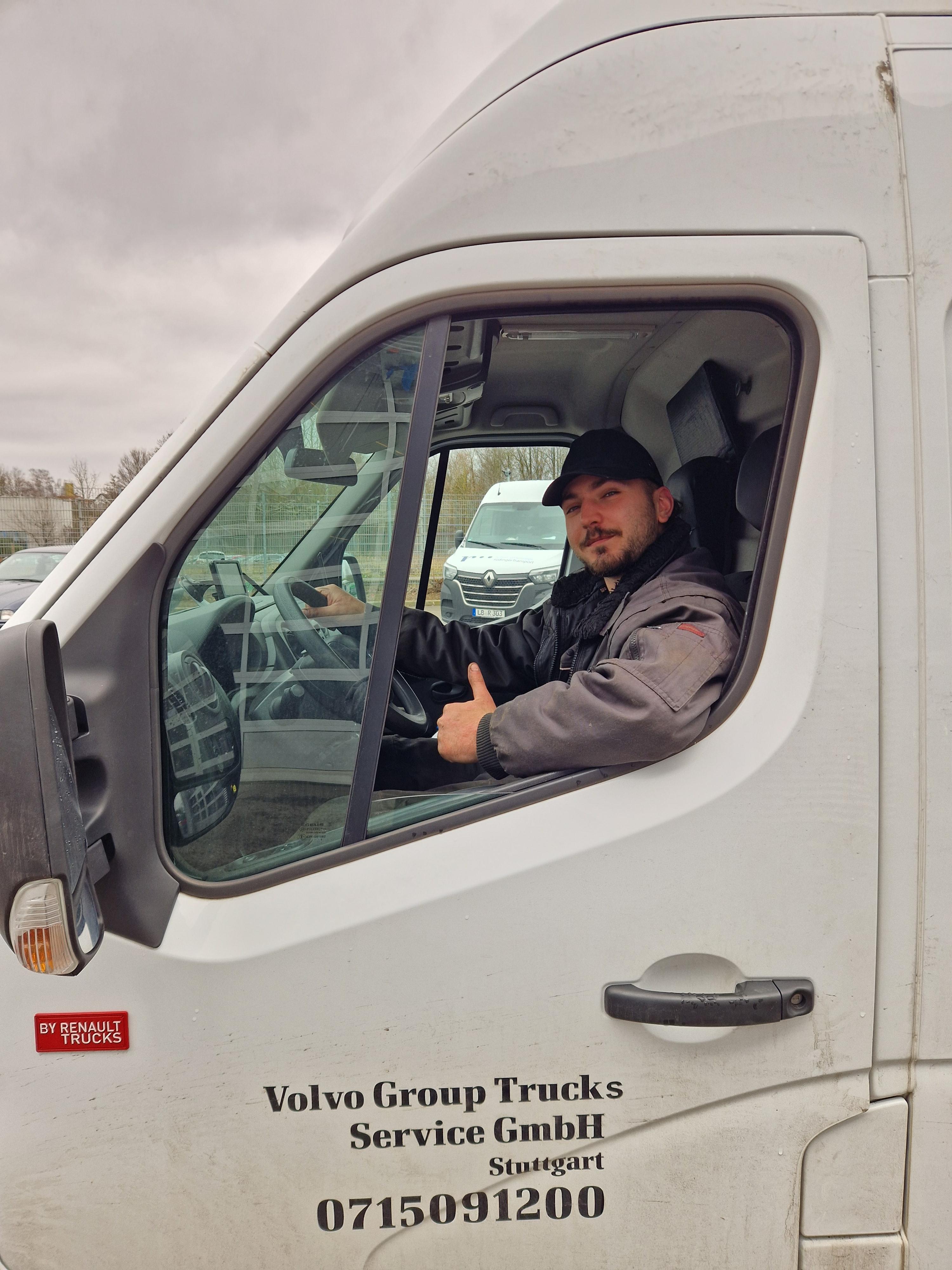
Finally: Max from Volvo Trucks Service in Stuttgart is delighted with her new collective bargaining agreement
But with the change in management three years ago, the attitude shifted. Management has recognized that skilled workers can only be attracted and retained with a collective bargaining agreement. In fact, Volvo Trucks had found it increasingly difficult to find and retain people in recent years.
More Attractive to Skilled Workers with a Collective Bargaining Agreement
Now, employees must be classified into the pay grades of the new company collective bargaining agreement at Volvo Truck Service and Renault Trucks, which requires an assessment of their job duties. Works councils at the individual locations are currently working on this with management. IG Metall has provided comprehensive training to the works councils for this purpose. To resolve conflicts, IG Metall at Volvo Trucks and management have established a joint committee.
“The classification process has been extremely fair so far,” explains Volker Wagner, chairman of the general works council, who is also a member of the collective bargaining and negotiation committee. “The vast majority of employees are seeing improvements—especially at locations where we previously did not have our own works councils and, as a result, had lower wages. In some cases, employees there are receiving up to 750 euros more per month.”
At the sites where works councils have been in place for some time, however, pay levels were already relatively close to the corresponding pay grades in the automotive industry collective bargaining agreement even before the collective bargaining agreement was reached. “Pay grading isn’t an issue for us; so far, almost everything has remained the same,” reports Dennis Ortmann, works council chair at Volvo Trucks in Wildau, where pay is now gradually rising to match the Berlin automotive collective bargaining agreement—a key factor in competing for skilled workers with companies that follow collective bargaining agreements. “MAN, just around the corner from us, is completely full; they’re not even taking on their own apprentices anymore.”
“Adherence to collective bargaining agreements also boosts attractiveness in the labor market,” explains Carsten Kretschmann, IG Metall’s company representative for Volvo and Renault Trucks. “And when management declares that they want to be the best in truck service, that also includes working conditions.”
Works Councils Now Also in Sales
The new company collective bargaining agreement applies to the approximately 400 employees in the workshops of Volvo Trucks Service GmbH and Renault Trucks Deutschland GmbH. During restructuring, Volvo Trucks had spun off its sales division into separate companies, which initially had no co-determination structures whatsoever. But here, too, employees are now electing works councils at an increasing number of locations with the support of IG Metall.