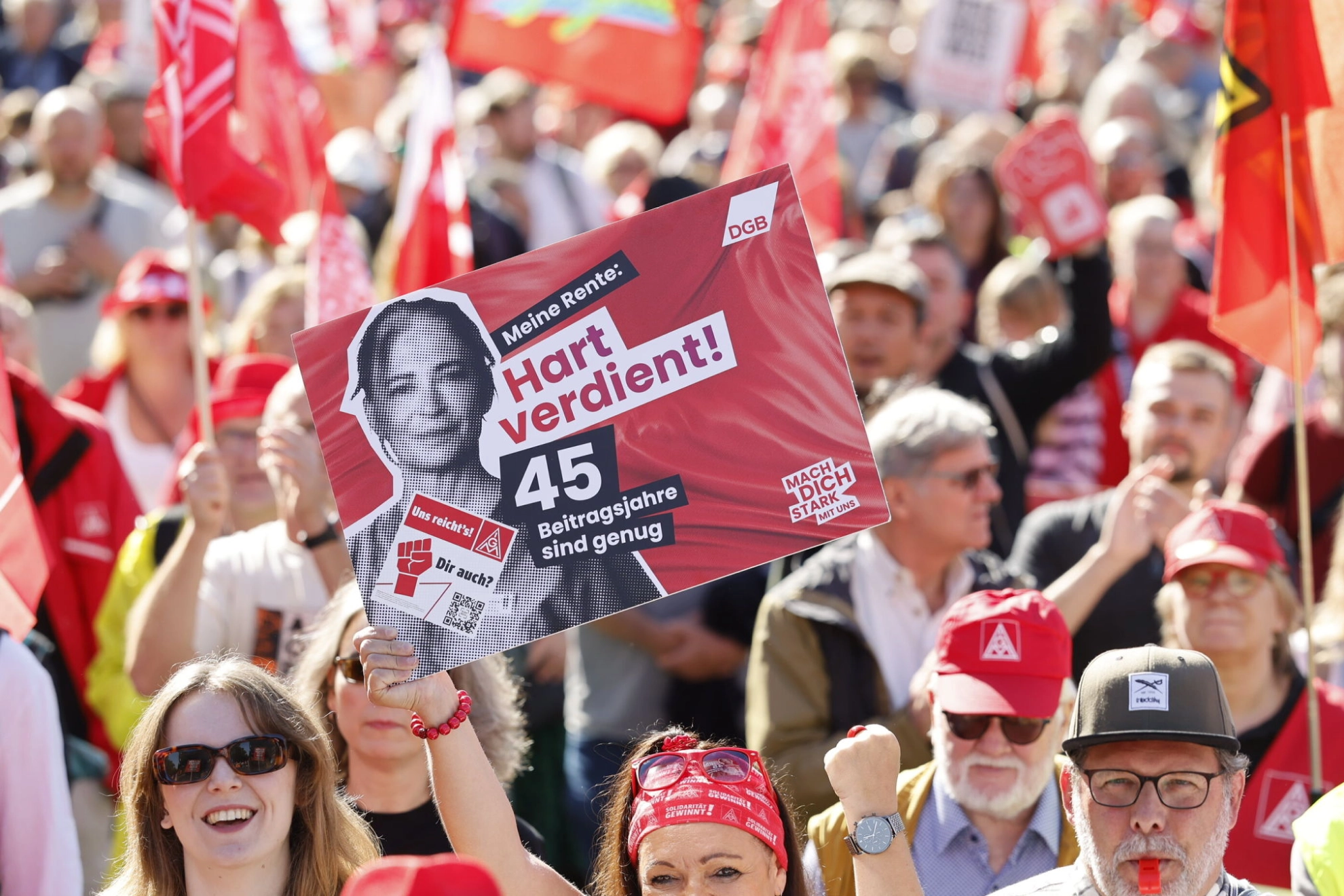
Saturday morning, Frankfurt am Main. Katharina Lenz stands in the shadow of the bank skyscrapers—alongside thousands of colleagues from across the Rhine-Main region. Anyone who asks the metalworker why she’s taking to the streets today gets a clear answer.
“I want to show the federal government that things can’t go on like this,” says the 36-year-old. “The planned cuts to social benefits, pension cuts, the requirement to provide a doctor’s note starting on the first day of illness—it’s all madness!”
Lenz has brought her two children along to the demonstration. She’s standing up for their interests as well today in Frankfurt, wearing her IG Metall cap and carrying a flag. “I want a socially just future for my children,” she says. “We have to defend the rights we’ve fought so hard to win.”
Protests Across the Country
Like Katharina Lenz, many thousands of people demonstrated today: Protest marches and rallies took place in 15 major German cities, from Freiburg to Kiel, from Leipzig to Essen.
“Hard-earned! Your work, your health, your pension” —under this slogan, the German Trade Union Federation and its member unions had called for a day of action.
Many metalworkers were also out on the streets. Many of them were seething with anger.
No wonder: Chancellor Friedrich Merz (CDU) rarely misses an opportunity to call on the people of Germany to “work more” and take fewer sick days. To hard-working steelworkers, mechanics, and assembly-line workers, this sounds like a mockery.
And many workers see the announced requirement to provide a doctor’s note starting on the first day of illness as a vote of no confidence—as if they were constantly skipping work and therefore needed to be strictly monitored.
Added to this are the numerous planned cuts to pensions, long-term care, and healthcare. And last but not least, the attacks on hard-won rights such as the eight-hour workday or the 35-hour workweek in the metal industry.
For many, enough is enough.
Deserving of Respect
“Hardworking people deserve respect, security, and reliability,” demanded Christiane Benner, President of IG Metall, at the DGB rally in Nuremberg. “The true drivers of the country’s economy are the workers. Their interests must take center stage; they must not be made to foot the bill for the crisis.” Benner warned that drastic cuts and the dismantling of social programs pose a threat to democracy. Therefore: “Hands off working hours, the block partial retirement program, and the full pension after 45 years of insurance contributions.”
More respect for work—at the rally in Berlin, Jürgen Kerner put it this way: “It makes me angry when so-called experts badmouth the pension after 45 years of insurance contributions but have no idea what everyday work life is like for many workers.” In his speech, the vice president of IG Metall criticized the planned abolition of the eight-hour workday: “Anyone who is trying to undermine the Working Hours Act today wants to treat unprotected workers like serfs. Not with us!”
Ralf Reinstädtler, IG Metall’s Social Affairs Director, emphasized that the welfare state is not charity but is earned by workers: “Pensions, health care, long-term care, and family benefits are not political handouts, but rights that workers have earned through hard work and struggle,” he said in Saarbrücken.
What our colleagues demonstrated for today:
-
For growth and investment
Specifically, this means industrial policy— —that secures jobs and business locations. More investment—financed by taxes on high net worth.
-
For good, healthy, and collectively bargained work
In concrete terms, this means: Reliable working hours. The abolition of unfounded fixed-term contracts and chain contracts. No mandatory sick leave on the first day.
-
For an efficient and affordable healthcare and long-term care system
In concrete terms: Fair financing to which everyone contributes. No new wage pressure in the care sector. Comprehensive health care coverage throughout the country.
-
For a pension that’s enough to live on
In concrete terms: Pensions without reductions for long-term insured individuals and block-age part-time work. An attainable retirement age. Fairly financed occupational pensions for all.
A Blueprint for Social Security
What many thousands of union members demanded on this day of action is not a luxury. It is a blueprint for social security. And this security is especially important in times of crisis. The federal government is currently doing the exact opposite: it is creating uncertainty for many people in the country.
The mood that was palpable today at the day of action can be quantified. In a recent IG Metall survey, the top concerns cited were: rising costs of living and healthcare, as well as retirement security.
More than 40 percent of adults are already cutting back on their consumer spending because of such concerns. This is poison for Germany’s already faltering economy.
How could things be different?
IG Metall’s Social Affairs Director Ralf Reinstädtler has an answer: “If you want to create security amid change, you have to strengthen the welfare state. The future isn’t built on austerity programs. The future is built on courage and investment.” Strong shoulders must finally bear more of the burden again. “We expect reforms that make life better—not social policy cutbacks.”
Metalworker Katharina Lenz, who demonstrated today in Frankfurt with her colleagues, also hopes for such policies.
She can be certain: The message she sent today alongside thousands of colleagues could not be overlooked, not even by the Chancellery.