Automatic translation
This article has been translated automatically using computer technology. While we strive for accuracy, some wording or details may differ from those in the original article.
This translation was not manually reviewed. For important facts, quotations or legally sensitive information, please consult the German original. Individual selections, images, embedded media or technical terms may have been translated differently or incompletely.

2026 Metal and Electrical Industry Collective Bargaining Round We want a 5 percent pay increase, job security, and profit sharing

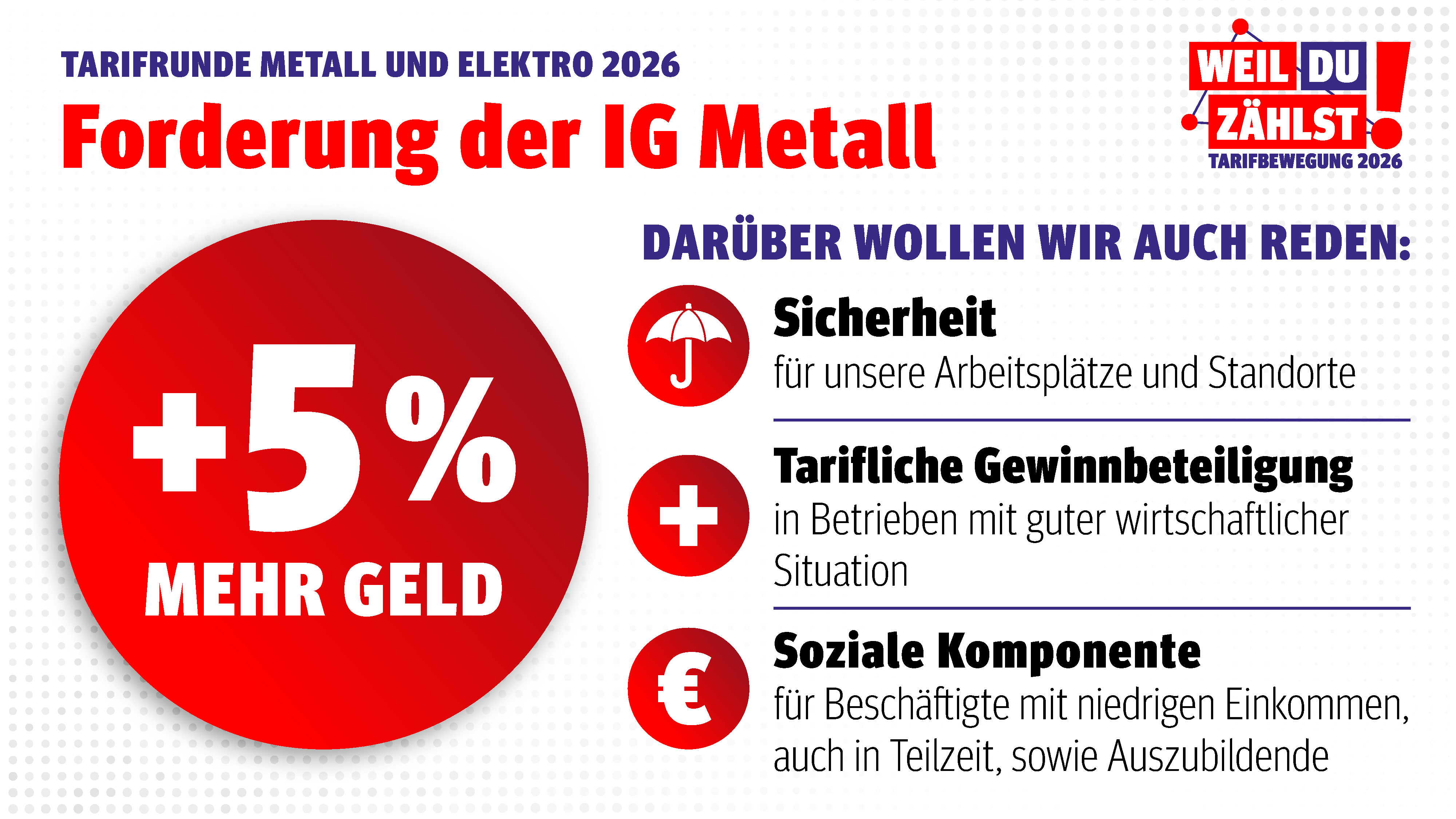
IG Metall has finalized its demands for collective bargaining in the metal and electrical industries: a 5 percent pay increase. In addition, IG Metall wants to discuss job and plant security, as well as a profit-sharing scheme under the collective bargaining agreement and a social component.
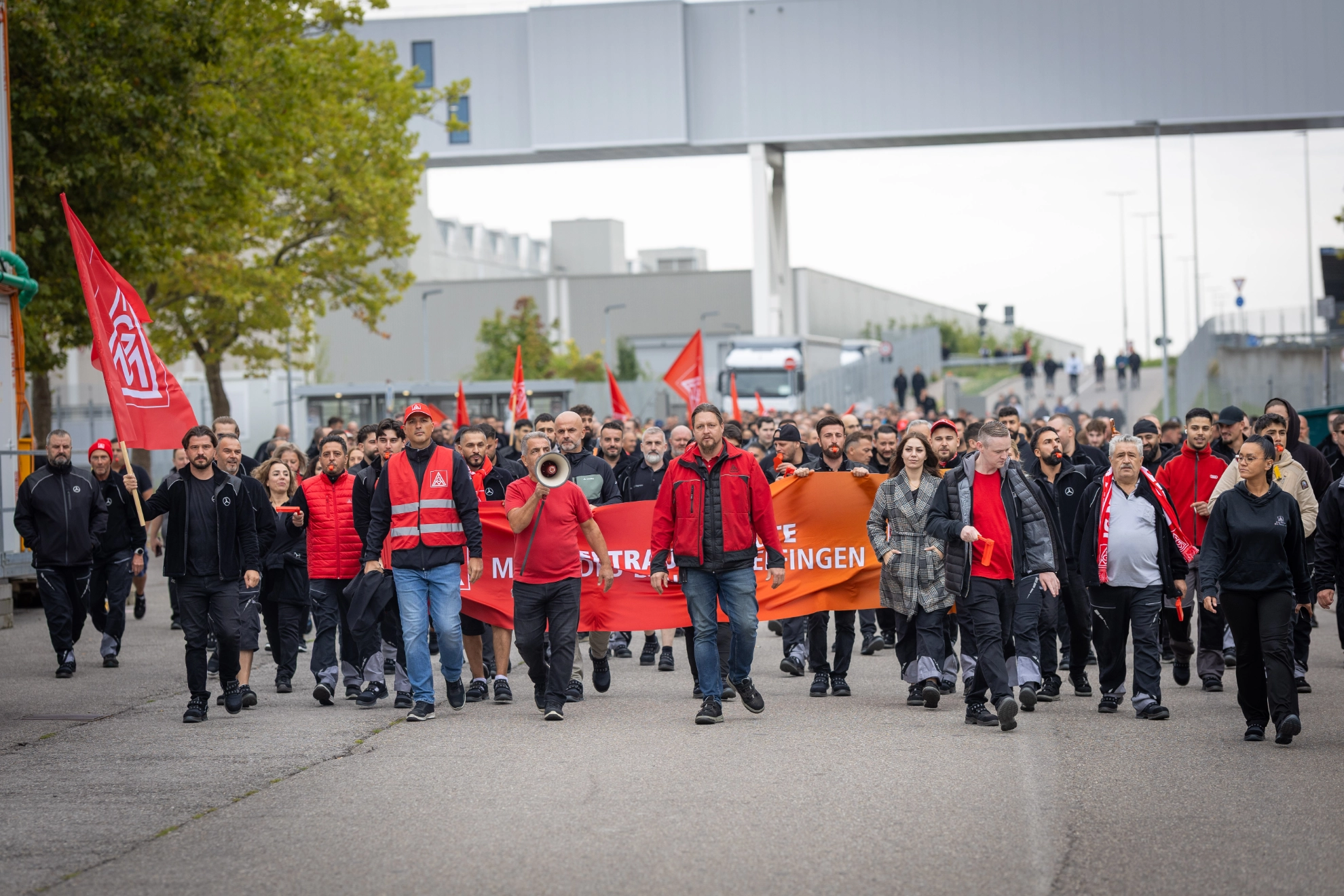
Am 21. September werden die Beschäftigten der Automobilindustrie ein deutliches Zeichen setzen – bundesweit bei unzähligen betrieblichen Aktionen, bei unzähligen Zulieferbetrieben und Herstellern. Nicht länger werden sie sich zu Sündenböcken machen lassen für eine Krise, die sie nicht verursacht haben. Nicht länger werden sie die Zeche für Managementfehler und die Folgen geopolitischer Konflikte zahlen. Damit ist jetzt Schluss! Die Beschäftigten sagen: Jetzt reicht’s!

23 September 2026 23 September 2026 |
Updated on 1 October 2026 1 October 2026


Collective bargaining negotiations in the metal and electrical industry will begin on October 7. The situation in the workplaces varies greatly: some companies are in crisis, while others are booming. IG Metall aims to strengthen purchasing power and protect jobs. Following the decision by the IG Metall bargaining committees on Tuesday, the IG Metall Executive Board therefore adopted a comprehensive package of demands on Wednesday:

  • A 5 percent pay increase. Employees in lower pay grades should see their compensation improved. 

  • A collective bargaining-based profit-sharing plan for booming companies 

 “We’re entering the negotiations with a combative yet realistic approach,” says Christiane Benner, President of IG Metall. “Making concessions gets us nowhere. Instead of crisis rhetoric, attacks on social standards, and doom-and-gloom predictions, workers expect secure jobs, compensation for rising prices, and a fair share of corporate profits. We will not accept threats of relocation as a diversionary tactic to cover up management failures.”


Grafik Forderung Tarif TRME TBME 2026 Forderungsgrafik

According to the union’s surveys, the order backlog is good or very good in two-thirds of companies. The majority also expects a good or very good outlook in the near future. At the same time, IG Metall observes varying, individual situations across the various sub-sectors. For example, orders are booming, particularly among manufacturers of ships, rail vehicles, medical technology, aerospace, and defense equipment. For one-third of companies—particularly in the automotive industry and mechanical engineering—the order situation is poor to very poor. 
 

Collective bargaining solutions for all company situations 

IG Metall’s collective bargaining director, Nadine Boguslawski, emphasizes: “Our package of demands is responsible, fair, and tailored to the situation. We offer—and demand from employers—collective bargaining solutions for a wide range of economic situations: from companies in crisis to those experiencing a boom.”  

“If you want an economic upswing, you need purchasing power,” said Nadine Boguslawski. “Workers are feeling the rise in the cost of living, housing, and healthcare. That’s why a tangible 5 percent wage increase is needed. The domestic economy also needs this support.” In addition, IG Metall intends to review the collective bargaining toolkit to determine whether the instruments for job security and future investments are sufficient in companies facing crises. Boguslawski emphasized: “Employees there are already foregoing collective bargaining benefits to facilitate change and secure jobs.”  

Explained: What We’re Demanding in the Metal Industry Wage Negotiations

Collective Bargaining Profit Sharing in Booming Companies

As a new issue, IG Metall is demanding profit-sharing for employees in companies with a strong economic position as part of the regional collective bargaining agreement. Boguslawski: “Those who achieve extraordinary success should also share in that success.” 

Union President Benner is offering employers constructive collective bargaining. “Our automotive action day on September 21 showed that workers are ready to fight when it comes to their demands and their future. This allows us to enter the collective bargaining round with confidence, because we are prepared to escalate.” 

The collective bargaining negotiations for the metal and electrical industries, led regionally by the IG Metall districts, will begin on October 7. The peace obligation ends on October 31; warning strikes are possible starting November 1. Over 3.7 million people are employed in the industry.
 

Mixed Economic Situation – Upward Trend

The economic situation in companies is mixed: crisis here, boom there. But overall, the situation is improving—in nearly all IG Metall sectors. This is according to the union’s latest works council survey. While job cuts are still ongoing, there are also signs of improvement in this area.  

Sixty-three percent of works councils in IG Metall’s sectors report good or very good capacity utilization—six percentage points more than in the fall of 2025. Fifty-eight percent report good to very good prospects for the next three to six months.  

It is striking that even one in six companies with good or very good business prospects is still cutting its permanent workforce. Three years ago, that figure was only 5 percent. Now, contrary to economic necessity, 15 percent of companies are exploiting the situation to cut jobs. 

The IG Metall employee survey conducted this summer among 267,000 employees at 2,287 companies also revealed a highly varied but improved perception of the economic situation: Half describe the situation at their workplace as very good (14.5%) or good (31.7%). One-third (32.2%) rate their own employer as “so-so.” One in five perceives the situation as bad (16.9%) or very bad (4.7%). 

This positive economic outlook is driven by companies in the aerospace, defense, shipbuilding, and energy sectors. In contrast, employees in the automotive industry and the service sector take a more critical view of their companies’ performance. 
  

Here’s what’s next in the 2026 metal industry collective bargaining round 

  • October 7: Start of collective bargaining negotiations
  • October 31: Wage collective bargaining agreements expire—end of the peace obligation at midnight
  • November 1, starting at 12:00 a.m.: Warning strikes possible


Please note: Volkswagen AG is not covered by the regional collective bargaining agreement for the metal and electrical industry but has its own in-house collective bargaining agreement. You can find the latest information on VW here. 

5 good Reasons to Join IG Metall

Working together for good jobs and a good life.

Beschäftigte machen zur Metall-Tarifrunde 2024 Druck für ihre Forderungen

Collective bargaining agreements—our strongest service

Our collective bargaining agreements set standards. They regulate wages, working hours, vacation time, and overtime pay, as well as the right to permanent employment after completing an apprenticeship. We are committed to ensuring that employees share in the success of their companies.
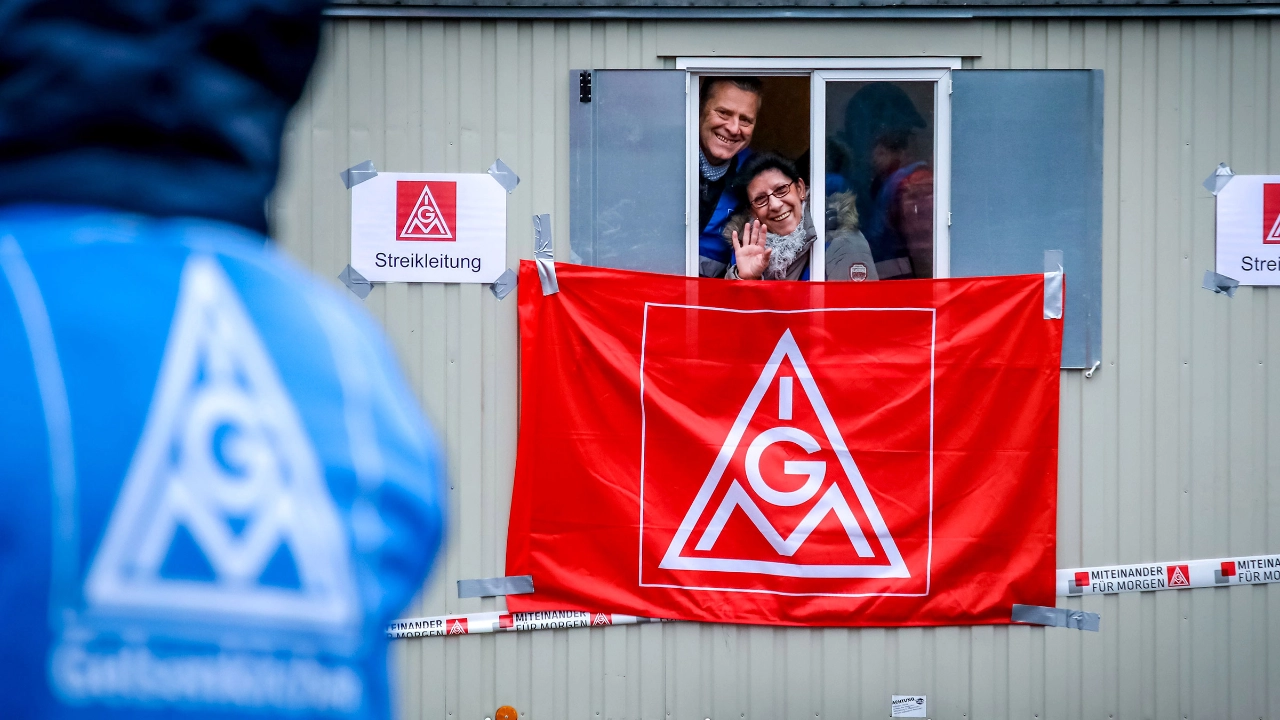
Eine Frau und ein Mann winken aus einem Bauwagen an dem eine IG Metall-Fahne hängt.

There for you locally

Dedicated works councils and shop stewards in the workplaces, along with around 150 local offices across Germany: We provide our members with knowledgeable contacts right where they work. Anyone who joins IG Metall can count on effective support and excellent service.
Metaller mit roter IG Metall-Kappe, Regencape und Lautsprecher.

Have a say and make a difference

Anyone affected by regulations and working conditions should also have a say in shaping them. IG Metall helps establish works councils and supports its members—including financially—when collective bargaining disputes lead to strikes.
Eine Statue der Justitia wird von der Sonne angestrahlt.

Our legal protection

When it comes to proper job classification or reviewing employment contracts and pension notices, we’re here to offer advice and assistance. In the event of disputes, we provide our members with free legal advice and representation in court—through all levels of the judicial system if necessary.
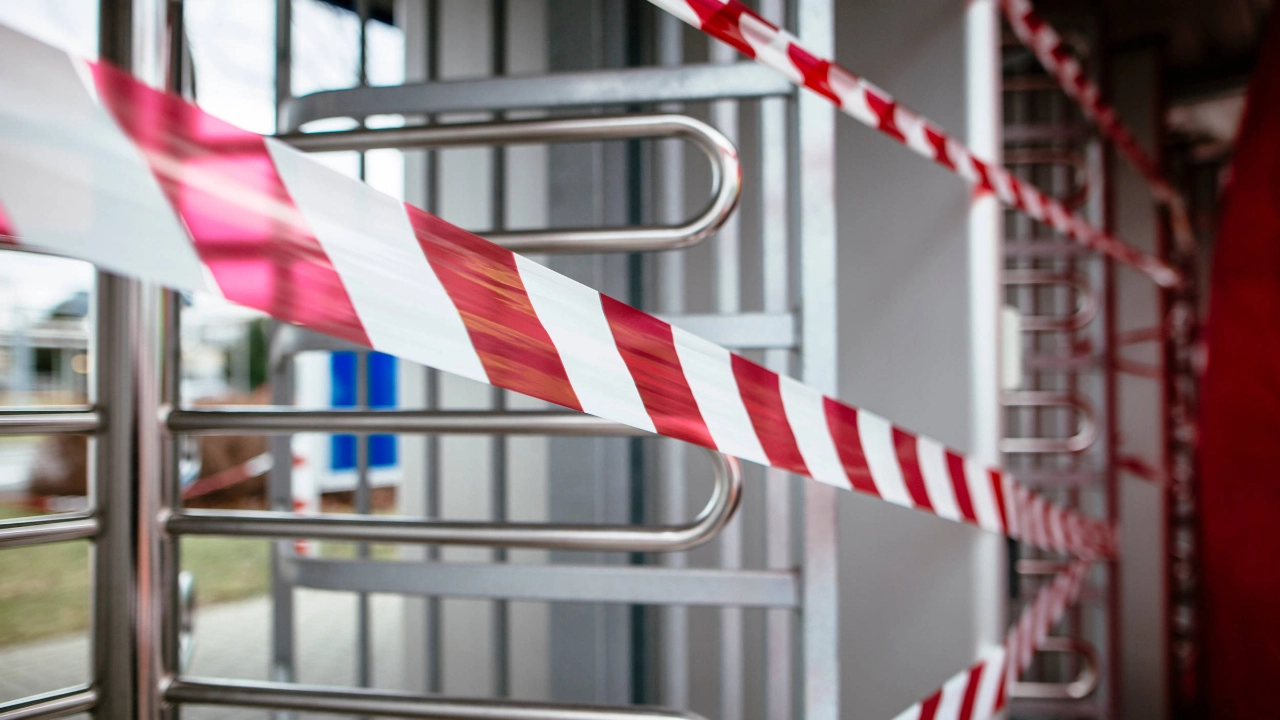
Mit Flatterband abgesperrtes Werkstor.

Support during strikes

Strikes are not an end in themselves, but they are sometimes unavoidable. In such cases, IG Metall also provides financial support to its members. The amount of strike support is based on the length of membership and the amount of membership dues paid.
Beschäftigte stehen zu einem großen Herz zusammen
Become a member
Become part of a strong community

From legal protection in labor and social law matters to fair wages and salaries—we take personal and reliable care of our members.

New on igmetall.de

Subscribe to the newsletter