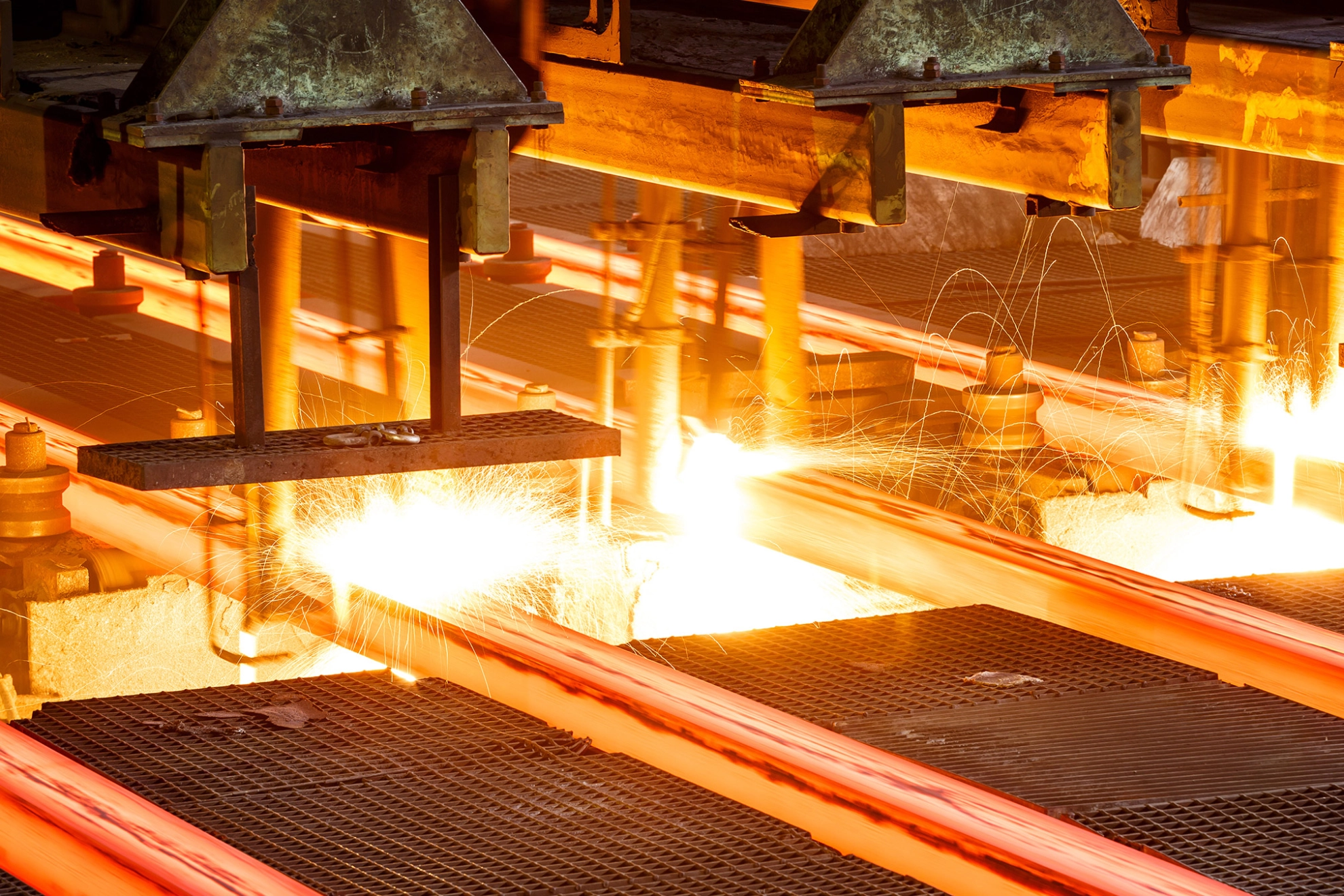
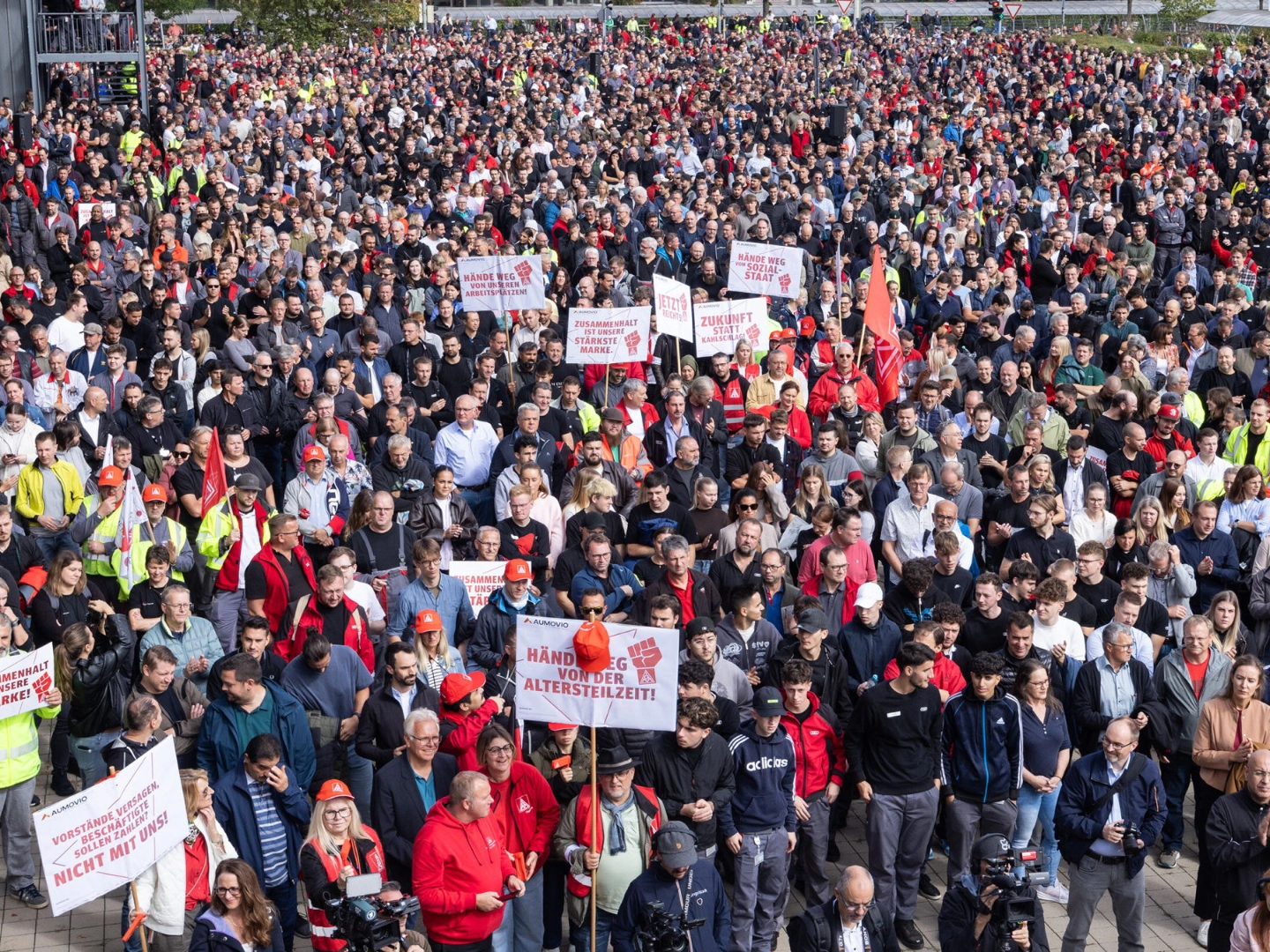
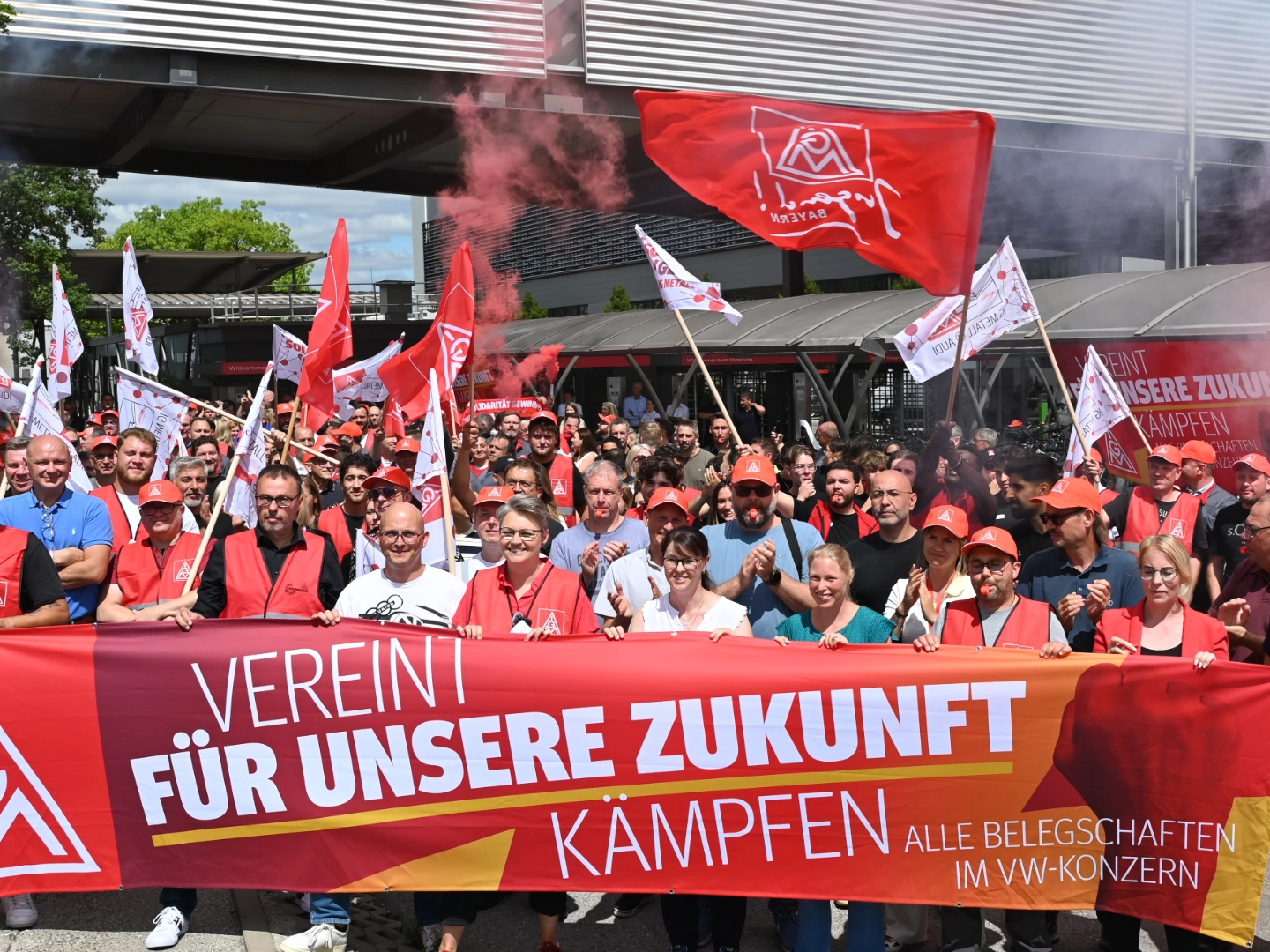
Union representatives from Saarstahl in Völklingen welded together a large “heart of fire” to show just how passionately steelworkers’ hearts burn for their product—and how steel binds them together. Wearing protective suits, three union representatives stood in front of the Saarlandhalle with their flaming heart to welcome the approximately 2,700 people who had come to Saarbrücken yesterday for the “1st National Steel Summit.”
One of the visitors bravely leaped through the heart-shaped frame of fire: Federal Foreign Minister Heiko Maas (SPD). A good sign? Because what steelworkers need now are politicians who will stand up courageously and energetically for their cause: for the future of steel and, with it, for the 85,000 jobs in the industry. To make that clear, the steelworkers were invited to the Steel Summit. Saarland’s Minister of Economic Affairs, Anke Rehlinger (SPD), along with IG Metall and the German Steel Association, had issued the invitation to bring together the federal states with steel production sites—namely North Rhine-Westphalia, Saarland, Lower Saxony, Brandenburg, Hamburg, and Bremen. Together, they are to champion the industry in Berlin and Brussels.
After all, there are no longer “problems” in the modern economy, only “challenges.” But the steel industry has quite a few of those to overcome.
Trump’s tariffs:
One challenge is the import tariffs imposed by Donald Trump. They make steel from Europe 25 percent more expensive. Although German manufacturers primarily supply the U.S. with specialty steels that are not produced anywhere else, the price increases have nonetheless caused exports to the U.S. to decline. The main concern for steel companies, however, is the risk of trade diversion: the danger that other countries will flood European markets with steel they can no longer sell in the U.S. This puts additional pressure on the steel markets. The EU has responded with “safeguards”: Punitive tariffs are now also imposed on imports into the EU if they exceed the import levels of previous years.
China’s cheap steel:
Fair and free competition, however, has not only been threatened by Trump’s protectionist policies, but—as has been evident for years—also by state-subsidized Chinese dumped steel.
Overcapacity:
All of this is hitting the industry at a time when it is already suffering from overcapacity. The situation is, however, nuanced. German steel mills are operating at over 90 percent capacity. Globally, however, they are operating at only 70 percent.
Costly Climate Protection: The biggest challenge, however, is climate protection. For several years now, steel companies and their employees have been fighting against the rules of the emissions trading system. The European Union (EU) in Brussels has set the standards for free allowances so high that even the most environmentally sound steel mills can barely meet them. Starting in 2020, costs running into the billions are looming because the plants will have to purchase additional pollution allowances. “Politicians should finally be realistic and base their benchmarks on what is technically feasible,” said Klaus Hering, a works council member at ArcelorMittal in Bremen, yesterday—with quite a bit of anger in his voice. He compared the problems in the steel industry to the discussions in the European Union regarding emission limits for the automotive industry. Since only European companies are subject to such expensive environmental regulations, they feel at a disadvantage in international competition.
False Image:
Steelworkers are particularly annoyed by their industry’s reputation. While “green” sectors are celebrated as industries of the future, steelworkers see their industry as a dirty, outdated sector being pilloried. Completely unjustly, they believe. Steel is greener than its reputation suggests. Steelworkers proudly point out that German steel is the most environmentally friendly in the world and that it provides the raw material for countless other products that are needed now and will continue to be needed in the future—including many green-tech products. For example, 85 percent of wind turbines are made of steel. An unbeatable advantage is that steel is 100 percent recyclable, making it a prime example of a circular economy and sustainability.
“German steel is top quality,” said Jörg Hofmann, the IG Metall chairman, yesterday in Saarbrücken. “Every day, 3.7 million people in Germany’s manufacturing industry make something out of this material.” So much for it being an outdated industry. “Steel is not a thing of the past,” Federal Minister of Economics Peter Altmeier (CDU) also asserted at the Steel Summit. “It is essential for ensuring that German industry has a future.”
Climate-Friendly Steel:
The opportunities to become more climate-friendly are far from exhausted. IG Metall, in particular, has long been pushing for greater investment in environmentally friendly technologies, in part to improve the steel industry’s future prospects. Jörg Hofmann called on companies to form research consortia. “They are the fastest and most successful way to drive innovation.” There are already several ambitious projects underway. For example, Thyssen-Krupp and other industrial companies are working with universities and research organizations on a process to convert exhaust gases from blast furnaces into precursors for fuels, plastics, and fertilizers. The project is called “Carbon2Chem.” The goal is to ensure that the 20 million metric tons of CO2 that the steel industry “produces” each year will no longer harm the environment but will instead be put to use. The Salzgitter Group is working on another process called “Salcos.” The goal is to no longer convert iron ore into pig iron in a blast furnace using carbon, such as coke—a process that produces the climate-damaging greenhouse gas CO₂—but to use hydrogen instead.
Time and Money:
But the steel industry needs time. It will be years before these technologies are ready for industrial use. And they cost money—a lot of money. The investment costs run into the billions. In a document signed yesterday by the economic ministers of the six German states with steel production sites, they committed to providing more government financial support for investments in new processes that reduce carbon dioxide emissions.
Involving Employees:
Jörg Hofmann emphasized that it is important to involve employees in the upcoming change processes. They are the drivers of innovation. After all, they have a dual interest in ensuring that climate protection goals can be met: as citizens who want to live in a healthy environment, and as workers who want a future in their industry. Works councils need more rights to take the initiative and participate in decision-making in order to drive change and to ensure that the continuing education required of employees during these processes is implemented in a binding manner.
Action Now:
Anyone who asked steelworkers after yesterday’s summit how they viewed the new major alliance heard this comment time and again: “It’s a good thing. But hopefully the politicians’ words will now be followed by action.”