Once again, it’s all about money—a lot of money: The CDU/SPD federal government has set out to implement a tax reform. The goal of the reform: to provide relief for low- and middle-income earners. Taxes are set to go down for them.
This plan is now taking shape. The Federal Cabinet has already approved a draft bill. In the coming weeks, the bill must pass through the Bundestag. The tax relief is set to take effect starting in 2027.
One thing is already clear: The current plans are socially unbalanced. And for many people in the working middle class, the relief will be barely noticeable.
Who will benefit, and how?
Key points of the planned tax reform are:
- Higher child benefits: will increase in two stages from 259 euros to 272 euros (2028) per child per month.
- Higher child tax credits: 10,056 euros (2027) and 10,236 euros (2028).
- Higher basic exemption: 12,564 euros (2027) and 12,900 euros (2028).
- Higher employee flat-rate deduction of 1,430 euros.
- The threshold above which the top tax rate applies to each additional euro is to increase by one percent on a one-time basis, starting from the current taxable income threshold of 69,879 euros.
The impact of these measures is modest. The most positive aspect is the increase in the employee tax allowance.
As for the top tax rate, the outlook is bleak: “Given expected inflation and wage increases, this modest increase will mean that, in real terms, even more income—which is by no means top-tier earnings—will be subject to the top tax rate,” according to an analysis by the German Trade Union Federation (DGB).
The higher child tax credit exacerbates an existing injustice: The tax credit provides greater relief to top earners than child benefits do for average earners.
Taxes Must Be More Equitable
The planned tax reform represents the lowest common denominator between the CDU/CSU and the SPD. However, much more is possible.
Ideas for a fair and solidarity-based tax reform have long been on the table. IG Metall and the DGB have presented concrete proposals and calculations on this issue.
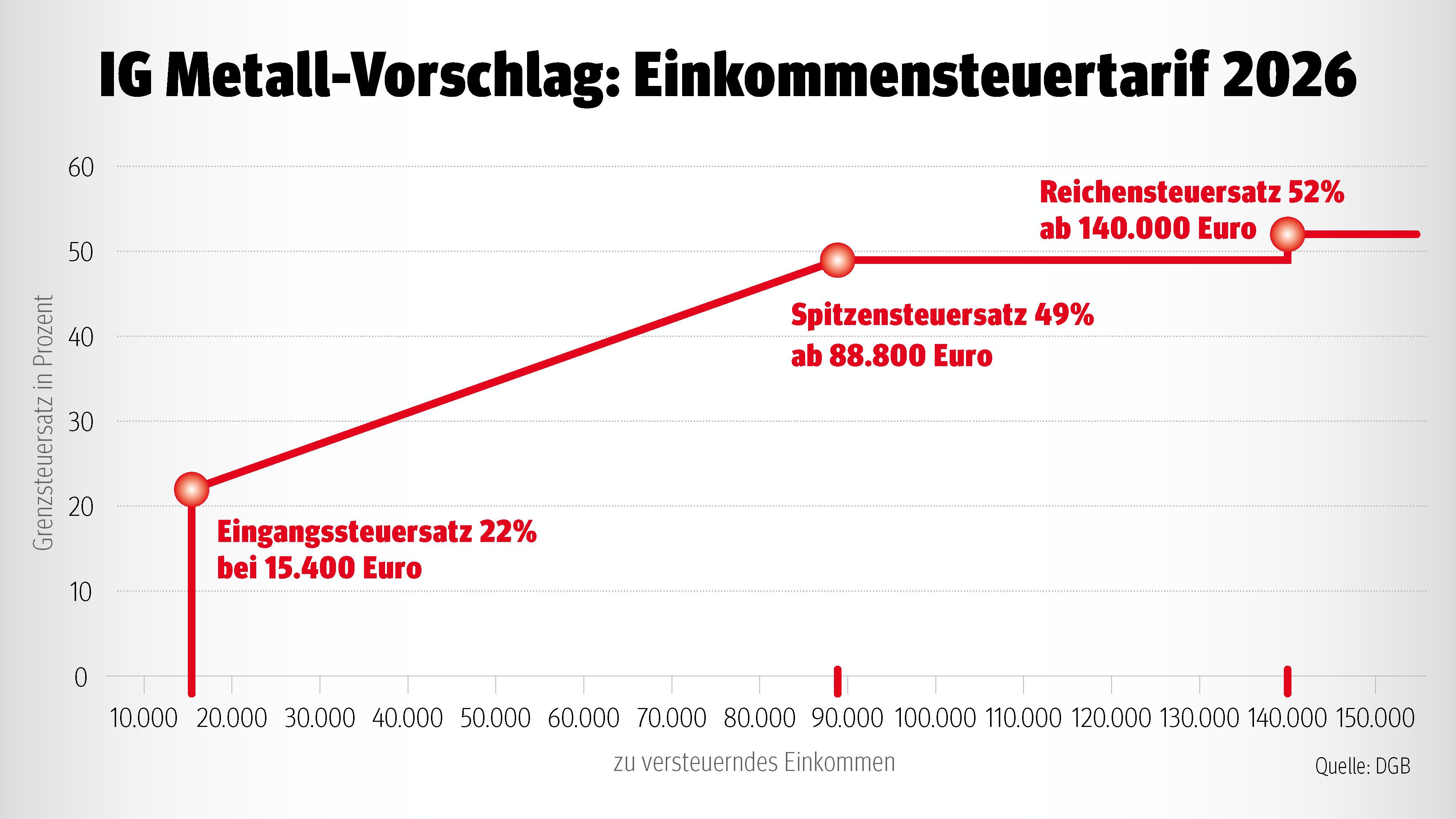
The plan would provide tax relief to 95 percent of workers while imposing a tax burden on the wealthiest five percent (see chart).
Specifically, IG Metall and the DGB propose:
- Raise the basic exemption —which is tax-free for everyone— by approximately 3,000 euros to 15,400 euros (for the 2026 tax year).
- Raise the top tax rate from the current 42 percent to 49 percent, but apply it only to taxable income of around 89,000 euros or more (approximately 104,000 euros gross).
- Raise the tax rate for the wealthy to 52 percent (currently 45 percent) and apply it starting at 140,000 euros instead of the current threshold of around 278,000 euros.
Such a tax reform would indeed focus on low and middle incomes—as announced in the coalition agreement.
A working couple with an average income would see their tax burden reduced by about 2,000 euros per year. A high-earning couple with an annual income of over 200,000 euros would pay about 2,000 euros more.
Overall, employees with gross annual earnings of up to around 105,000 euros (single individuals) would see their tax burden reduced. For low incomes—up to 15,400 euros—that were previously subject to tax, single individuals would no longer owe any income tax at all.
The government would thus correct the tax cuts for top earners that have taken place over the past three decades. As a reminder: Under Chancellor Helmut Kohl (CDU), the top tax rate was 53 percent. Even back then, the wealthy did not become poor.
Inequality Is Rising
There is broad support for a tax reform based on solidarity. In surveys , nearly two-thirds of people say that conditions in Germany are “somewhat unfair.” The gap between rich and poor—and the resulting social disparities—is cited as the greatest injustice.
Tax policy is a crucial lever here. Intherepresentative“Deutschlandtrend” survey, 65 percent of people supported higher taxes on top incomes. In a survey of IG Metall members, as many as 87 percent demanded that high earners and the wealthy contribute more to financing the welfare state.
The respondents’ assessment is well-founded: income inequality in Germany hasrisen significantly since 2010, particularly since 2018. Tax rates on fortunes worth billions have fallen drastically since the mid-1990s. Social equality, as ensured by the welfare state and the tax system, has declined.
This growing inequality is not only unjust; it also harms the economyand poses a threat to democracy. Trust in democratic institutions is strongly dependent on income, as the Böckler Foundation’s latest distribution report shows.
Involving Heirs and the Wealthy
To reduce inequality again, policymakers should not limit themselves to reforming the income tax. Inheritance tax and wealth tax are also key areas for reform.
The wealth tax is currently suspended. IG Metall is calling for those with very high net worth to contribute more toward financing the public good—especially compared to workers who pay high tax rates on their earned income.
In addition to the wealth tax, the DGB is calling for a wealth levy on the richest 0.1 percent (“the super-rich”). This is the only way to prevent wealth growth among the super-rich from becoming completely decoupled from trends in the broader society.
In the short term, however , reforming the inheritance tax is more urgent. The problem: Very large inheritances are often taxed at only low rates. This is due to numerous tax loopholes, such as exemptions for so-called business assets—that is, assets tied up in a business.
Important: In the future,inheritance tax must not be allowed to put healthy businesses in financial distress. And the hard-earned wealth of the working middle class must continue to be passed down to families tax-free—for example, the family home. Yet currently, fortunes worth millions can be inherited almost tax-free—while workers pay high taxes on their hard-earned wages.
It is now crucial that the federal government takes a socially responsible approach to tax policy.