Automatic translation
This article has been translated automatically using computer technology. While we strive for accuracy, some wording or details may differ from those in the original article.
This translation was not manually reviewed. For important facts, quotations or legally sensitive information, please consult the German original. Individual selections, images, embedded media or technical terms may have been translated differently or incompletely.

Working Hours Legendary Strike: How Fierce the Fight for the 35-Hour Workweek Was

Seven weeks of labor disputes, plus a lockout and a court case: The strike for the 35-hour workweek was one of the toughest in IG Metall’s history. And in the end, it was successful. We take a look back at the turbulent year of 1984.

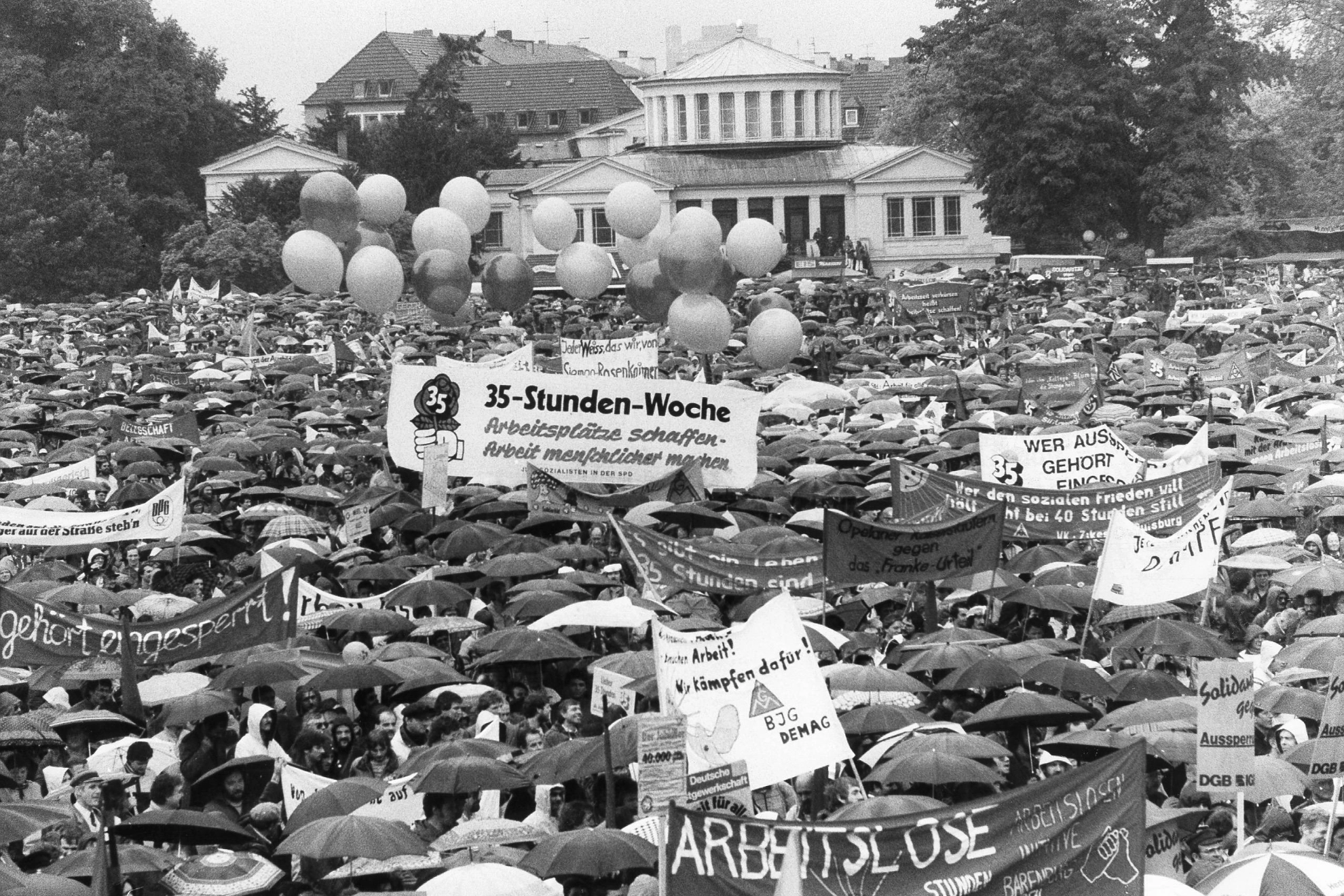
250 000 Arbeitnehmer demonstrieren am 28.05.1984 in Bonn, um den Forderungen der streikenden Metallarbeiter Nachdruck zu verleihen.


In 1984, workers in the West German metal industry went on strike for nearly seven weeks. Their goal: to reduce the workweek from 40 to 35 hours. Work was to become more humane.

In addition, IG Metall hoped that the reduced number of hours would create jobs for the 2.5 million unemployed. “More time to live, love, and laugh”—that was the strike’s motto.

Just as they do today, employers are strictly opposed to shorter working hours. “Not a minute less than 40 hours,” is their stance. The black-and-yellow federal government and the media are on their side. The greatest social showdown of the postwar era is looming.


Kickoff in the Southwest

The strike begins on May 14, 1984, in the North Württemberg/North Baden collective bargaining region, and a week later in Hesse. 57,500 workers at 23 companies walk off the job and gather in front of the factory gates. Strike days turn into strike festivals, featuring performances by bands and dance groups of all nationalities.

“We sang a lot at our site. People from other companies and organizations would stop by regularly,” recalls Doris Werder, who went on strike for six and a half weeks at Honeywell in Maintal, Hesse, at the time. “We had long discussions at the plant beforehand and knew: If we approach this with confidence, we can do it.”

500,000 workers are locked out

And they held out. Even though they often had a hard time in public. Doris Werder handed out flyers at information booths in Hanau and had to put up with quite a bit: “There were a few people who shouted things at us like, ‘You lazy bums, go get a job’ or similar remarks. You had to have nerves of steel. But once we got into a conversation with people, they understood our arguments.”

Employers are responding to the strike with an iron fist: a lockout. They’re locking employees out without pay. First, 155,000 in the contested collective bargaining regions of North Württemberg/North Baden and Hesse, where IG Metall is paying strike pay. Then, employees outside the conflict zones as well—even though this“cold lockout”is legally controversial.

Strike-related production losses—that’s the official justification. Soon, half a million locked-out workers are standing at the gates, ten times as many as the strikers.


Those subject to a “cold lockout” are not to receive any money

And the lockout organizers have allies: Normally, the employment office pays short-time work benefits in the event of production losses. But the head of the Federal Employment Agency, Heinrich Franke, issues a surprise decree: “To shorten the labor dispute,” there will be no money for those subject to a ‘cold lockout.’

IG Metall filed a lawsuit against the so-called “Franke Decree.” Strike pay for half a million locked-out workers—that would have quickly bled the union dry.

“The employers wanted to destroy IG Metall. And Franke helped them,” says Ernst Rau, who was then works council chairman at the auto supplier Roth in Gaggenau, Baden. For five weeks, he and 900 colleagues were locked out without pay.

It was doubly tough: The Roth workers, who belonged to the South Baden collective bargaining region, shared their strike headquarters in Gaggenau’s Merkurhalle with the metalworkers from the Mercedes plant in Gaggenau, which belonged to the North Württemberg/North Baden bargaining region. “We could watch as the Mercedes workers were paid in cash,” Rau recounts. “But the people trusted me to find a solution. And they were furious at Franke.”


“They quickly locked the office doors”

Across the country, thousands take to the streets to protest the lockout. On May 28, 250,000 people arrive in the federal capital of Bonn on 3,300 buses and 51 special trains and demonstrate in the pouring rain. The Roth workers from Gaggenau are among them.

In many cities, locked-out workers protested in front of factory gates, some also inside the plants and in front of employment offices. The Roth workers also marched to the employment office in Gaggenau. “They quickly locked the office doors as we came up the stairs,” Rau recounts. “The head of the employment office then spoke with us and explained, ‘I can’t pay you anything.’”

Rau is on his feet around the clock, just like thousands of other works council members and metalworkers: they write flyers and informational letters, organize actions, negotiate with landlords and banks, and distribute donations. Union members from all over Europe show solidarity with the struggling metalworkers.

On June 21, the courts finally rule the Franke decree unlawful. The employment office must pay out the short-time work benefits. Five days later, an agreement is finally reached in the collective bargaining dispute, through mediation by former Defense Minister Georg Leber (SPD).

The result: a reduction in the workweek to 38.5 hours, in exchange for more flexible working hours. The 40-hour barrier has been broken, against all odds. By 1995, the workweek in the West German metal industry had gradually dropped to 35 hours.

The “legendary strike”—it was worth it.
Collective Bargaining Rounds - Metal and Electrical Industries
New on igmetall.de
Aktionstag bei Mercedes Benz, Daimler, in Sindelfingen gegen die Angriffe auf Beschäftigten in der Automobilindustrie.
Resistance to Attempts at Drastic Cuts Auto industry workers issue a warning
Sie wollen doch nur dein Bestes
Redistribution Making Germany more equitable: We need this tax reform now
Der Streik bei Kelvion in Nobitz-Wilchwitz begann am 4. August 2026. Die Geschäftsleitung will nach Sarstedt/Niedersachsen verlagern - obwohl die Produktion in Wilchwitz profitabel und bis ins nächste Jahr ausgelastet ist.
"It’s worth fighting for!" Kelvion workers strike for a social collective bargaining agreement
Ruhrpott Rebellion am 07.07.2026
Welfare State September 26: Nationwide Day of Action for Social Policy
Beschäftigter arbeitet an einem Getriebe in einer Fabrik
Working Hours Why working longer doesn’t help—and actually does more harm than good
Ein männlicher Land- & Baumaschinenmechatroniker prüft einen Traktor mit einem Tablet
2026 Collective Bargaining Agreement for the Metalworking and Agricultural Engineering Sectors Greater Flexibility in the Metalworking and Agricultural Engineering Sectors in Lower Saxony and Bremen
Elektronikerin prüft die Spannung an einem Schaltschrank.
2026 Collective Bargaining Round for the Electrical Trades Wage Increase in the Electrical Trades in Berlin-Brandenburg
Benjamin Heine ist Mitarbeiter der BMA in Braunschweig
2026 Collective Bargaining Round for Metal Fabrication and Precision Engineering Higher Wages in the Metal Fabrication and Precision Engineering Sectors in Southwest Germany
Metall-Arbeiter beim Schleifen
2026 Collective Bargaining Round for the Metalworking Trade Employees in the Berlin-Brandenburg metalworking sector will receive higher pay
Beschäftigte von Thyssenkrupp demonstrieren in Essen am 23. Mai 2024 gegen das Vorgehen der Geschäftsführung beim geplanten Teilverkauf des Unternehmens.
Defend the welfare state All dates for nationwide actions against cuts to social services
IGM Aktion VW Wolfsburg
On September 21, things will get loud Nationwide Day of Action: Auto Industry Workers Fight Back Against Mass Layoffs
Auszubildender in einer Schreinerei
Apprenticeship Wages Questions and Answers About Apprenticeship Wages
Beschäftigte stehen zu einem großen Herz zusammen
Become a Member
Become part of a strong community

From legal protection in labor and social security matters to fair wages and salaries—we provide personalized and reliable support to our members.

Subscribe to the newsletter