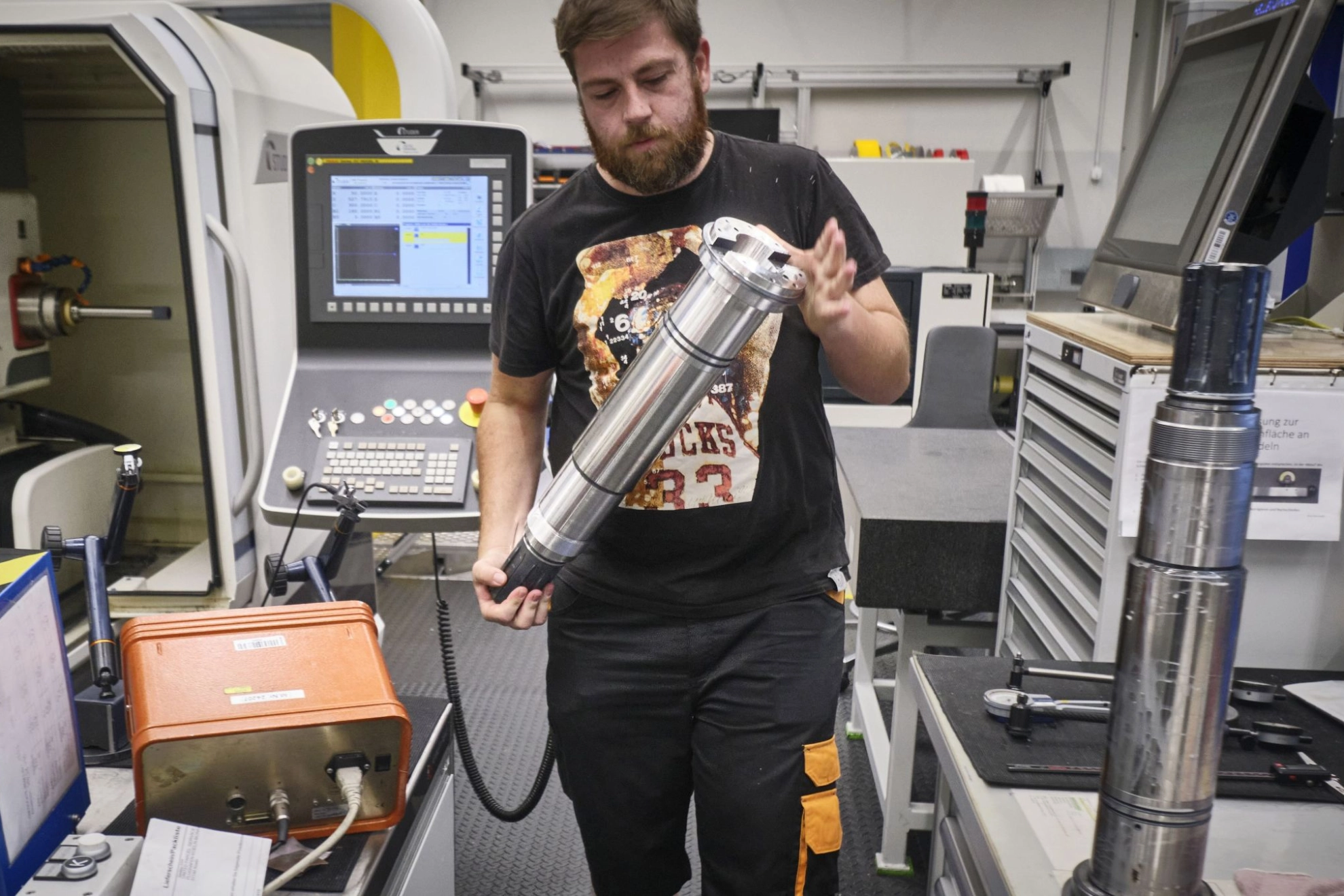
Machine tool manufacturer Heller in Nürtingen posted record revenue of 680 million euros in 2019. Then came the crash to 300 million euros in 2020. The writing was on the wall: Among other things, Heller manufactures machines for machining internal combustion engines, which account for about 40 percent of its previous revenue. But those are phasing out. The auto industry is barely investing any money in traditional internal combustion engines anymore.
“The company—but also we as the works council—didn’t anticipate the transformation would happen with this kind of momentum,” says Bernd Haußmann, chairman of the works council at Heller Maschinenfabrik, self-critically. “And then COVID-19 hit, too.”
Suddenly, there was no more work for 600 of the 1,700 employees. To save as many jobs as possible, the works council agreed with the employer on short-time work and a reduction in working hours to a 4-day week. IG Metall agreed to waive vacation pay and Christmas bonuses. As a result, Heller employees will lose up to one month’s salary per year.
In addition, it was agreed that Heller in Nürtingen would cut up to 250 of the approximately 1,700 jobs—through severance packages and early retirement offers. Layoffs for operational reasons are ruled out until the end of May 2022. “Still, these are tough cuts,” Haußmann admits. But they saved what they could.
And Heller is using the crisis as an opportunity: To avoid finding themselves in such a dire situation again, the works council and IG Metall have secured a forward-looking collective bargaining agreement after months of negotiations with management.
Collective Bargaining Agreement Secures the Site’s Future
The site’s future is now secured by the collective bargaining agreement. It states in black and white: Heller’s main plant in Nürtingen will remain the development center for all Heller products as well as a leading production and assembly site with its own training program. None of this can now be relocated for cost reasons—for example, to Heller’s sites in the United Kingdom, the United States, or China. Not a vague promise, but firmly secured by the collective bargaining agreement
In addition, the future agreement stipulates investments in the site. Heller is launching an innovation initiative that specifically defines new products to secure jobs at Heller well into the future. In the collective bargaining agreement, IG Metall agreed to “continuous organizational and personnel development across all organizational units with the goal of continuously improving competitiveness.”
This means: developing products and processes—rather than simply cutting costs. Innovative and better—rather than cheaper.
Ideas for further development should come from the employees. The works council and management are currently preparing a systematic approach to idea generation that goes far beyond existing programs and standard continuous improvement processes (CIP). Employees’ ideas will be heard, evaluated, and implemented.
More Training – Strategic Workforce Planning
Employees are receiving extensive training for the transformation, primarily during short-time work. Heller offers employees training and continuing education through part-time study programs as well as scholarships, even spanning several years—with full rights to return to work. Even apprentices, for example, for whom there is no job available after completing their training, can be placed on 100 percent short-time work and continue their education during that time. Funding for this comes from the company and—where possible—from government grants.
“We had been seeing for some time that work was slowing down and started planning early on. We were also able to draw on our experience from the 2008–2009 crisis,” explains Thomas Fruhstuck, works council chair at Heller Services at the same location in Nürtingen and head of the Heller Academy.
“In 2020, we decided to pursue certification for our training programs. Nevertheless, it took nearly a year from the decision to the implementation of the first training program. The entire project nearly fell through several times because the bureaucratic hurdles were set incredibly high and changed repeatedly even this year.”
Since January 2021, Heller has been conducting training programs itself as a certified provider. However, the eligibility requirements for funding are more difficult today than they were back then, says Fruhstuck. “Hopefully, the effort will be worth it. The pandemic isn’t making the certification process any easier either.”
Employers and the works council decide jointly who will receive training, how they will be trained, and which training programs will be used. This is stipulated in the new collective bargaining agreement, which significantly expands the works council’s right to co-determination in personnel planning compared to the Works Constitution Act: The works council and the employer jointly develop personnel and training plans. They are supported in this by experts from the IG Metall Baden-Württemberg transformation project—including in organizing funding and coordinating with the employment agency.
The results are reviewed regularly, and any necessary adjustments are made.
IG Metall members participated in the discussions and voted
During the negotiations, the members of the elected IG Metall bargaining committee repeatedly discussed the next steps with IG Metall members at the company and put them to a vote.
“We openly discussed our approach in virtual member meetings,” reports Works Council Chair Bernd Haußmann. “Our IG Metall members then gave us a mandate to negotiate, allowing us to make concessions at the collective bargaining level if, in return, we could secure jobs and the company’s future.”
By August 2020, the initial key points were in place; through December, the works council and IG Metall continued to negotiate the details with the employer. The collective bargaining agreement has now been signed, and employees were informed via meetings, letters, and video messages.
“Now it comes down to implementing the agreed-upon collective bargaining agreements and company agreements, the willingness of older colleagues to accept early retirement offers, but also to economic stabilization in the markets and further positive developments regarding the effects of the pandemic,” says Bernd Haußmann. “We, as works council members of the two Heller companies, are very confident that the number 250 can be significantly reduced and that we will achieve this goal through early retirement programs.”
For the at least 1,450 employees who remain, the future is secure—legally binding under the collective bargaining agreement.
“Our goal was to get through the crisis with all employees. And we wanted job security for the employees and prospects for the future. We achieved this in particular through agreements on skills development, guaranteed training, and the hiring of apprentices and dual-track students,” says Gerhard Wick, representative of IG Metall Esslingen.
“The negotiations and the outcome at Heller have shown that our collective bargaining crisis provisions are effective and that it is possible to conclude tailored supplementary collective bargaining agreements. The demands made by the employers’ association Südwestmetall in the current metal industry collective bargaining round are therefore a slap in the face to all our members who were willing to accept temporary concessions in exchange for job security during the crisis.”