Automatic translation
This article has been translated automatically using computer technology. While we strive for accuracy, some wording or details may differ from those in the original article.
This translation was not manually reviewed. For important facts, quotations or legally sensitive information, please consult the German original. Individual selections, images, embedded media or technical terms may have been translated differently or incompletely.

Vacation Request The most important questions and answers about vacation requests

When do I have to request my vacation? Can my employer deny it? Labor lawyer Dr. Till Bender answers the most important questions about vacation—and explains what employees need to keep in mind.

Wanderer macht eine Pause

1 July 2022 1 July 2022 |
Updated on 16 September 2024 16 September 2024


How much vacation time am I entitled to?

"It depends," says the lawyer. By law, employees in Germany are entitled to 24 working days of paid annual leave—though this is calculated based on a six-day workweek, amounting to a total of four weeks. However, employees are typically entitled to significantly more vacation time on average. This so-called “extra-statutory” vacation time may be provided for in the employment contract, a company agreement (BV), or a collective bargaining agreement (TV). Our collective bargaining agreements for the metal and electrical industries, for example, guarantee 30 days—or six weeks—of vacation.


Dr. Till Bender, Jurist bei der DGB Rechtsschutz GmbH

Dr. Till Bender, attorney at DGB Rechtsschutz GmbH


When do I need to request vacation time?

There are no legal regulations regarding this. Since the employer still has to approve the vacation, it naturally makes sense to request it as early as possible to ensure a certain degree of planning certainty. However, notification deadlines may also be specified in an employment contract, a company agreement, or a collective bargaining agreement.


Can the employer deny the vacation request?

In principle, the employer is required to grant the requested vacation. However, the employer may deny the vacation if urgent operational needs (such as a sudden surge in workload) or vacation requests from other employees that deserve priority for social reasons (such as employees with large families and several school-age children who can only take vacation during school breaks) conflict with the request.


By when must the vacation be taken?

Vacation must generally be taken during the calendar year in which the vacation entitlement arises. Carrying over vacation to the next calendar year is permitted only if urgent operational reasons or reasons specific to the employee justify it. If vacation is carried over, it must be taken within the first three months of the following year. Of course, exceptions may apply here as well if the employment contract, a company agreement, or a collective bargaining agreement provides otherwise.


What happens if I get sick while on vacation?

This does not cause the vacation to be forfeited. However, this is contingent on my providing the employer with a doctor’s note as proof of my inability to work.


I’m new to the job—when will I finally get vacation time?

You earn your full vacation entitlement after six months of employment. Until then, you earn a pro-rated vacation entitlement calculated on a monthly basis.


I can do whatever I want on vacation, right?

Unfortunately, it’s not quite that simple. Vacation is meant for rest and relaxation. As such, employees are required, for example, not to engage in any paid work during their vacation that conflicts with the purpose of the vacation.


Can my employer revoke approved vacation time?

No, that’s not possible. Once vacation has been granted, the employer cannot revoke it. This cannot happen even if the employer faces serious problems as a result. The employer must take precautions to ensure that this situation does not arise.

If the employee has already begun their vacation, the employer generally has no right to recall them from vacation—even if, from the employer’s perspective, there are compelling or urgent operational reasons to do so. Employees are therefore not required to provide their vacation address.
 

Can I cancel my approved vacation?

Employees are not permitted to cancel or reschedule approved vacation on their own. Anyone who takes time off without the employer’s consent risks termination. If vacation plans change due to unforeseeable circumstances, employees must discuss the matter with their employer and hope that the employer agrees to reschedule the approved vacation.


I’m not being granted vacation—what should I do?

Employees can sue to enforce their right to vacation. However, if time is of the essence and a court decision regarding the vacation cannot be awaited due to the length of the litigation process, it is also possible to take the faster route via a so-called preliminary injunction.


I’m switching to a different employer—what happens to my vacation time?

That depends. Any remaining vacation time with your former employer can be taken there, or, if that is no longer possible, compensated in cash. If this happens, you obviously cannot take the same amount of vacation again with your new employer. A so-called double entitlement is not permitted.


IG Metall members are represented free of charge by attorneys from DGB Rechtsschutz GmbH in labor and social courts, if necessary. The first point of contact is your local IG Metall office. More information is available here.


Guide

Beschäftigte stehen zu einem großen Herz zusammen
Become a Member
Become part of a strong community

From legal protection in labor and social security matters to fair wages and salaries—we provide personalized and reliable support to our members.

New on igmetall.de
Aktionstag bei Mercedes Benz, Daimler, in Sindelfingen gegen die Angriffe auf Beschäftigten in der Automobilindustrie.
Resistance to Attempts at Drastic Cuts Auto industry workers issue a warning
Sie wollen doch nur dein Bestes
Redistribution Making Germany more equitable: We need this tax reform now
Der Streik bei Kelvion in Nobitz-Wilchwitz begann am 4. August 2026. Die Geschäftsleitung will nach Sarstedt/Niedersachsen verlagern - obwohl die Produktion in Wilchwitz profitabel und bis ins nächste Jahr ausgelastet ist.
"It’s worth fighting for!" Kelvion workers strike for a social collective bargaining agreement
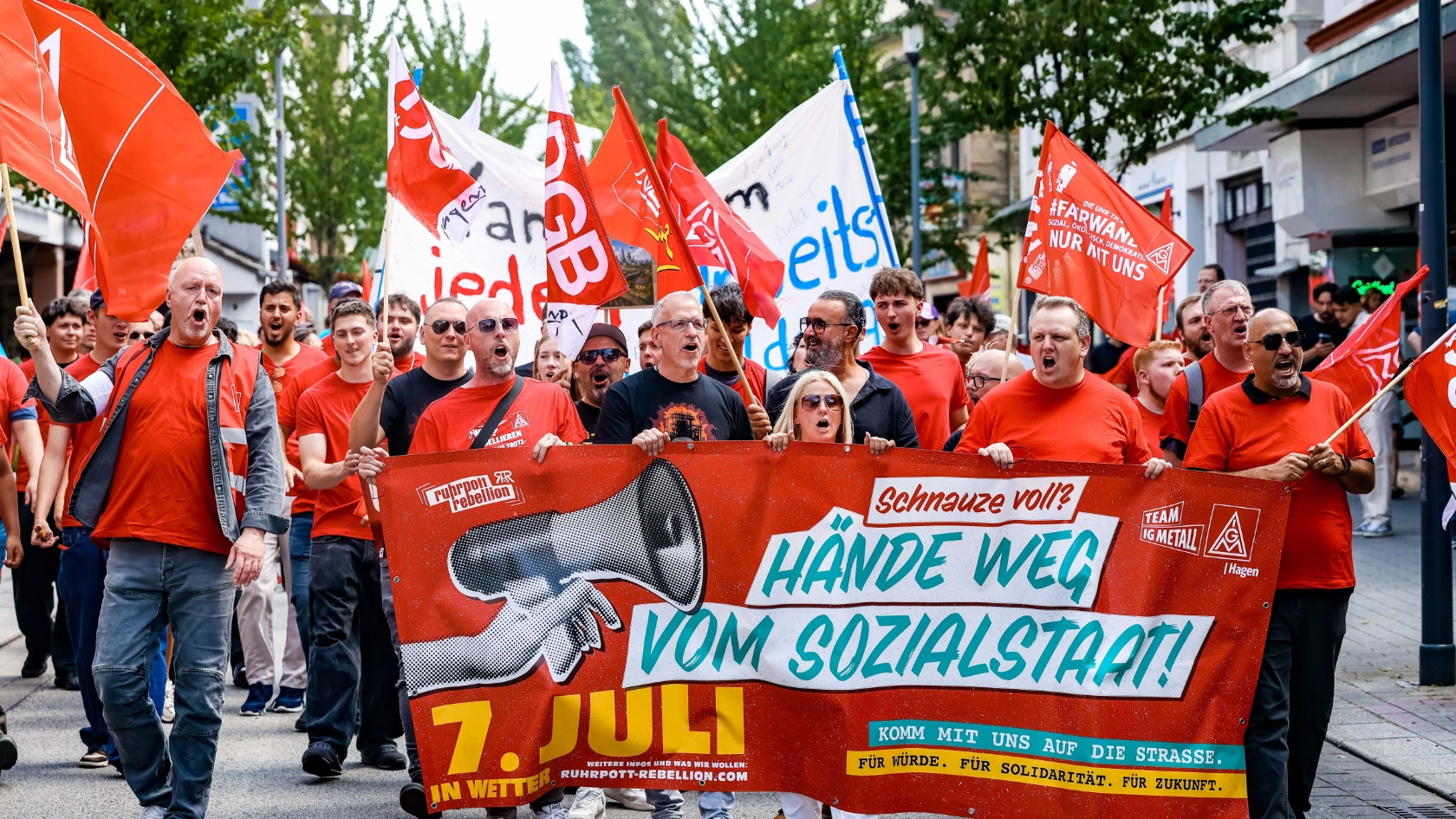
Ruhrpott Rebellion am 07.07.2026
Welfare State September 26: Nationwide Day of Action for Social Policy
Beschäftigter arbeitet an einem Getriebe in einer Fabrik
Working Hours Why working longer doesn’t help—and actually does more harm than good
Ein männlicher Land- & Baumaschinenmechatroniker prüft einen Traktor mit einem Tablet
2026 Collective Bargaining Agreement for the Metalworking and Agricultural Engineering Sectors Greater Flexibility in the Metalworking and Agricultural Engineering Sectors in Lower Saxony and Bremen
Elektronikerin prüft die Spannung an einem Schaltschrank.
2026 Collective Bargaining Round for the Electrical Trades Wage Increase in the Electrical Trades in Berlin-Brandenburg
Benjamin Heine ist Mitarbeiter der BMA in Braunschweig
2026 Collective Bargaining Round for Metal Fabrication and Precision Engineering Higher Wages in the Metal Fabrication and Precision Engineering Sectors in Southwest Germany
Metall-Arbeiter beim Schleifen
2026 Collective Bargaining Round for the Metalworking Trade Employees in the Berlin-Brandenburg metalworking sector will receive higher pay
Beschäftigte von Thyssenkrupp demonstrieren in Essen am 23. Mai 2024 gegen das Vorgehen der Geschäftsführung beim geplanten Teilverkauf des Unternehmens.
Defend the welfare state All dates for nationwide actions against cuts to social services
IGM Aktion VW Wolfsburg
On September 21, things will get loud Nationwide Day of Action: Auto Industry Workers Fight Back Against Mass Layoffs
Auszubildender in einer Schreinerei
Apprenticeship Wages Questions and Answers About Apprenticeship Wages

Subscribe to the newsletter