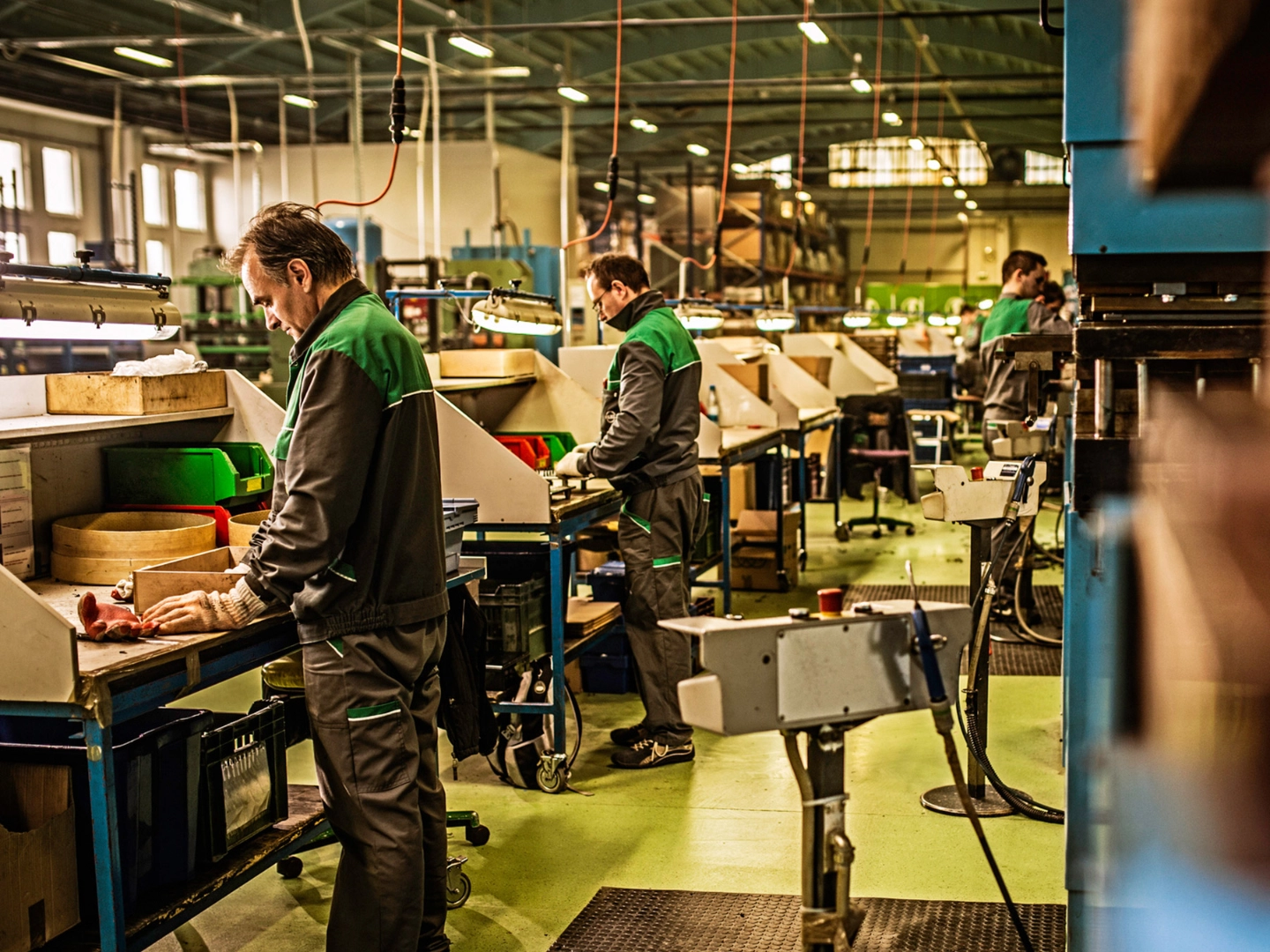
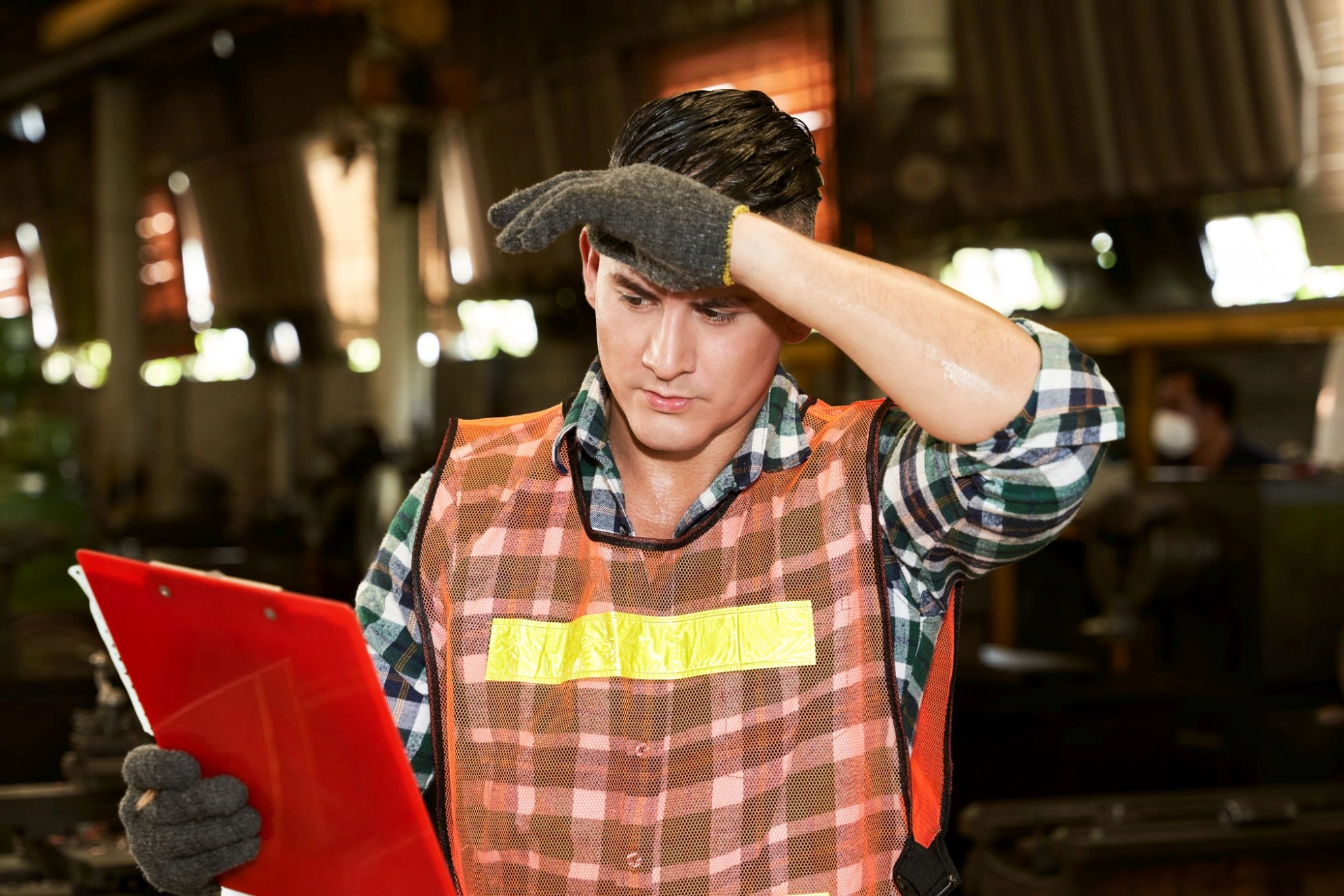
As lovely as it is to enjoy summer weather at the lake or in your own backyard, working in high temperatures can be grueling. Heat waves are becoming increasingly common, with significant impacts on workplaces both indoors and outdoors. The increased heat stress poses a risk of health problems and illness. Heat in the workplace can not only be unbearable but also take a toll on your health. Concentration and productivity decline, often resulting in headaches and nausea. The risk of accidents and injuries also increases. Employees report rising stress levels due to heat in the workplace. Works councils are increasingly turning to IG Metall with questions about heat-related issues.
It is therefore high time not only to talk about the annual summer heat but to take action, explains Ralf Reinstädtler, the responsible member of the IG Metall Executive Board. Employers and regulatory authorities must step up. This is because the employer’s legal obligation to avoid health hazards to employees as much as possible also extends to protection against high temperatures. Measures to prevent heat-related health problems are therefore among the central tasks of occupational health and safety and will continue to gain importance in the coming years.
What the “Workplace Ordinance” Says
Section 3(1) of the Workplace Ordinance (ArbStättVO), in conjunction with Section 3.5 of the Technical Rules for Workplaces ( ASR), regulates the conditions under which sweating is permitted at work. According to these provisions, a temperature conducive to good health must prevail in work areas. ASR A3.5 distinguishes between two types of temperature:
Room temperature isthe temperature as perceived by humans and is determined, among other things, by the air temperature—but also by the temperature of the surrounding surfaces (windows, walls, ceiling, and floor). Air temperature is the temperature of the air surrounding people without the influence of thermal radiation.
As a general rule, the temperature in work areas should not exceed 26 degrees. A room temperature of more than 26 degrees is permissible only if factories and offices are well insulated against summer heat, windows and glass walls are equipped with sun protection, and the outside temperature exceeds 26 degrees.
Three Thresholds: 26, 30, and 35 degrees
ASR A3.5 specifies three temperature thresholds for air temperature: 26, 30, and 35 degrees. If these thresholds are exceeded, the employer must take measures. Despite these regulations, employees have no direct legal right to air-conditioned rooms or time off due to heat. However, the employer is obligated to organize work in such a way that life and health are not endangered as far as possible and that any remaining hazards are kept to a minimum.
Even when temperatures exceed 26 degrees, the employer must provide cooling measures. If the thermometer climbs above 30 degrees, the employer must further reduce thermal stress. This includes measures such as effectively managing sun protection—for example, keeping blinds closed even after working hours, running ventilation systems overnight, or ventilating the space in the early morning hours. In addition: Remove heat sources such as printers and copiers from the rooms or limit their use; extend the flex-time policy; relax the dress code; and provide beverages.
Work cannot be performed in rooms where the temperature exceeds 35 degrees. Exception: The employer provides mitigating measures. These include, among other things, air showers and heat breaks, as are required at so-called high-heat workplaces, such as blast furnaces. However, a lack of such measures does not automatically mean that employees can simply go home; it only means that work is not permitted in certain rooms.
Ventilate Rooms Well
In enclosed spaces, the number of virus-laden droplets or aerosols in the air can rise particularly quickly. Due to droplet transmission, adequate ventilation in workspaces is therefore of particular importance as part of infection control measures.
The goal is to reduce the concentration of droplets or aerosols as much as possible. This can be achieved in particular through ventilation. Ventilation quality can be assessed, for example, by measuring CO₂ levels, whereby the target value specified in ASR A3.6 for ventilation—1,000 ppm (parts per million)—should be kept below as much as possible (for example, by setting a target of 400 ppm). Measures to achieve this goal include both ventilation through windows and the use of mechanical ventilation systems, or RLT for short.
When ventilating through windows, the standard ventilation interval of 3 to 10 minutes per full hour in offices should be increased. Occupational safety experts at IG Metall recommend ventilating offices every 20 minutes for at least 5 to 10 minutes. The entire window area should be used for intensive ventilation. This can be supported by a ventilation schedule and regular reminders.
Manufacturing and production areas are generally much larger spaces that tend to have relatively fewer people present. Due to the larger room volume, pollutants and airborne particles can disperse more effectively. Nevertheless, these areas should also be ventilated at least four times a day for 5 to 10 minutes.
Caution with Fans
A fan (e.g., table, floor, tower, or ceiling fan) promotes cooling through sweat evaporation, but not everyone can tolerate the drafts this may cause. Operating a fan can also stir up dust or pollen (a hazard for people with allergies!). Portable air conditioners can also cause noise pollution, and there is a risk of drafts at the air outlets. Possible consequences include catching a cold or developing a stiff neck.
Individual, portable air circulation devices such as fans or portable air conditioners should only be used when employees are working in private offices. The reason: These devices merely circulate the air but do not increase the proportion of outdoor air. This means that if several people are present in a work area, not only are potentially contaminated aerosols distributed, but droplets can also be carried over distances greater than, for example, 1.5 meters to other people. This would increase the risk of transmission of SARS-CoV-2, for instance.
When using so-called mechanical ventilation systems, the use of suitable filters (such as HEPA filters) and the highest possible proportion of outdoor air are crucial for minimizing the risk of viral transmission. In addition, these systems should be kept running continuously during operating hours and should be used beyond this period (for example, by operating at rated capacity for two hours before and after operating hours). The use of HVAC systems in recirculation mode without suitable filters should be avoided as much as possible.
Climate Change Demands Action
Climate change is causing heat waves to become more frequent, more intense, and longer-lasting. As a result, protection against heat in the workplace is becoming an ongoing task in work design. It is therefore no longer a matter of simply mitigating the effects of a single hot summer. Rather, measures are needed that provide effective solutions for high temperatures.
Employers are obligated to address heat-related hazards “proactively”—that is, as early as the planning and organizational phase of workplaces, work schedules, and work processes. If they determine during the assessment that a hazard exists, appropriate measures must be implemented to eliminate or reduce it.
Effective measures for proactive heat protection include, in particular, structural measures for thermal insulation: such as shading provided by sunshades located outside workstations, insulation, greenery, and the installation of mechanical cooling or ventilation systems. It is also essential to define clear responsibilities and decision-making processes to ensure the involvement of the works council as early as the planning and setup phase. In addition, prepared company action plans—so-called heat protection plans—should be in place.
With the Works Council and IG Metall
Whether on the factory floor or at a desk: If the company has a works council, it has a say in occupational safety matters and can negotiate arrangements regarding the scheduling and distribution of working hours with management. If there is no works council, employees should seek a discussion with the employer. If certain departments or teams are suffering from poor indoor climate conditions, it’s best for them to approach their supervisor as a group. Before the meeting, the group should come up with a joint solution and then propose it.
In cases of inadequate occupational safety and health conditions at work, we recommend that our members inform their local IG Metall chapter. We advise those affected and can take appropriate action. We, of course, treat all information confidentially.
What Employees Can Do
- Wear light-colored, breathable, moisture-wicking, lightweight, and comfortable clothing, as well as breathable shoes. This attire facilitates sweating and reduces heat stress.
- The body loses a lot of fluid through sweating. Two liters at a room temperature of 24 degrees; at higher temperatures, about three liters or more, especially during heavy physical work.
- Wet your wrists with cold water. This provides temporary relief.
- Turn off electrical devices in rooms: unplug unnecessary heat sources such as printers or monitors when not in use.
- Take regular short breaks. When working in heat at room temperatures up to 45 degrees and a maximum humidity of 40 percent, cooling-off periods of 15 minutes per hour should be taken.
- Not everyone tolerates heat equally well. Therefore, pay attention to your body’s signals and seek out cooler areas if you feel unwell.
- The indoor temperature should not differ by more than six degrees from the outdoor temperature.
Good Work in a Nutshell: Summer Heat – When the Workplace Turns into a Sauna (PDF)
 IG Metall on Site