A step forward or a step backward? Reasonable or not ambitious enough? Reactions to the CDU/CSU and SPD coalition agreement vary widely.
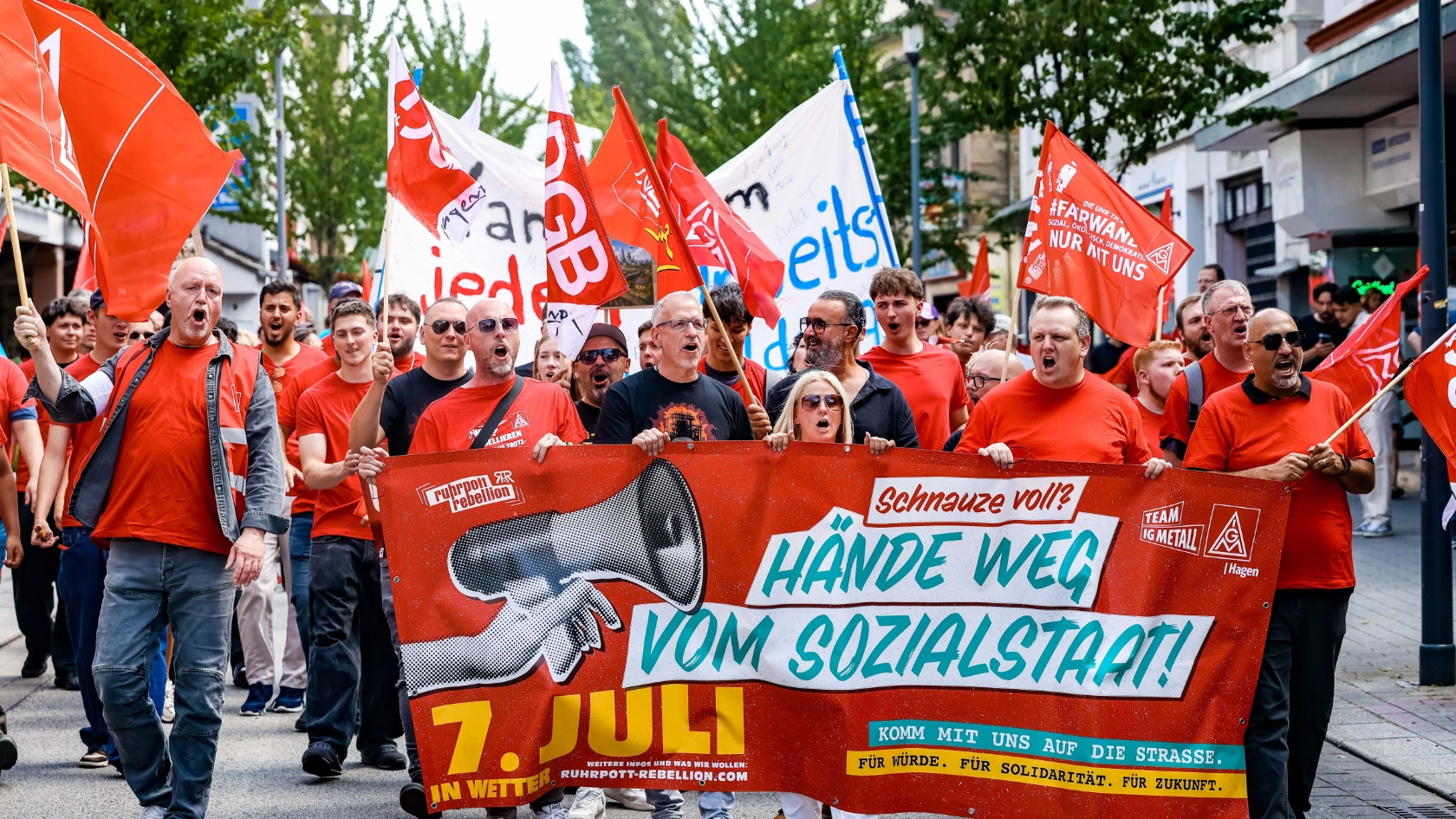
From IG Metall’s perspective, one thing is clear: The agreement contains many points that unions have been advocating for—in some cases for years. Most recently, this included a nationwide day of action in mid-March, when over 80,000 metalworkers took to the streets to fight for the future of their jobs.
However, the coalition agreement also includes provisions that are cause for concern from a workers’ perspective—or are simply wrong.
“Our colleagues need a clear roadmap, which the coalition agreement provides in many areas,” says Christiane Benner, President of IG Metall. The measures to secure jobs in the automotive industry must now be “implemented quickly.”
And Jürgen Kerner, Second Chair of IG Metall, adds: “The coalition agreement now describes IG Metall’s key industrial policy demands as planned initiatives. That is an important step.”
Here is an overview of the key points:
On the positive side:
Industrial electricity rates
The CDU/CSU and SPD want to introduce a reduced industrial electricity price for energy-intensive sectors. IG Metall has been advocating for this for years. That’s because many companies—such as foundries and aluminum smelters—are struggling under high electricity prices that are hardly competitive on the international market. This jeopardizes jobs, and hopefully that will now change.
Reduction of electricity tax and grid fees
These components of the electricity price have also been driving up energy costs for consumers and businesses for years. Remedial action is urgently needed.
Promoting e-mobility
The future of the global automotive industry is electric. However, the “traffic light” coalition government’s abrupt halt to subsidies has caused sales in this country to plummet. Now, the goal is to boost sales again. In addition, the future CDU-SPD government plans to expand the network of charging stations and promote battery cell production. All of this will help domestic automakers and the workers employed there.
Reform of the Debt Brake
The debt brake enshrined in the Basic Law has become a brake on the future. Its strict rules prevent urgently needed investments in roads, railways, bridges, and digital networks. A reform is planned. As a result, Germany could experience a surge in modernization that all citizens would feel in their daily lives.
Reduction of Income Tax
The coalition agreement states: “We will lower income tax for low- and middle-income earners by the middle of the legislative term.” This is essentially in line with a demand made by the labor unions. However, the coalition agreement does not provide any concrete details.
Strengthening the Labor Market
Because technology and professions are changing rapidly, workers need opportunities for continuing education. The CDU/CSU and SPD coalition plans to provide more funding and launch a skills development initiative for young people. The minimum wage is set to rise—so that low-wage earners can make a better living from their often hard work.
Greater Adherence to Collective Bargaining Agreements
The government is one of the economy’s largest clients. It should use this power to strengthen collective bargaining agreements. This means that federal government contracts should only go to companies that pay wages in accordance with collective bargaining agreements. To this end, the CDU/CSU and SPD are planning a federal law on compliance with collective bargaining agreements, as proposed by IG Metall and the DGB.
Negative:
No wealth tax
Greater solidarity in financing the state: This could be achieved, for example, through a wealth tax. Unfortunately, this is a gap in the coalition agreement.
Maximum weekly working hours instead of daily
The future government intends to shift from a maximum daily working time (typically eight hours) to a maximum weekly working time. Yet the eight-hour workday is a historic achievement—and, in times of ever-increasing work intensity, an important safeguard against overwork. Excessively long working hours are associated with a wide range of health problems.
Tax incentives for overtime
In the future, there are to be incentives for overtime. From the unions’ perspective, this is a bizarre discussion: After all, people in Germany have never worked as much as they do today. Of the approximately 1.2 billion hours of overtime worked in 2024, more than half went unpaid. Overtime poses a health risk and should not be encouraged.
A Step Backward on the Basic Income
When it comes to the citizen’s income, the clock is being turned back. In the future, there will once again be a so-called “priority on job placement.” The goal, then, is to place people in (any) new job as quickly as possible. A better approach would be to focus on skills development and a job search oriented toward the long term.
No Local Content Strategy
IG Metall is advocating for companies to take responsibility for jobs in Europe if they view Europe as a market. For example, if a Chinese or U.S. manufacturer wants to sell cars in Europe, there should be an obligation to manufacture them in Europe using European components. The future government has no plans for such a “local content” regulation.
Unresolved:
Pension levels secured only through 2031
Sufficient pensions in the long term: An absolute must for workers. According to the coalition agreement, the pension level—a metric for pension trends—is secured only through 2031. A commission is tasked with proposing what happens after that. A solidarity-based restructuring of the pension insurance system—keyword: employment-based insurance— is not planned.
Health and Long-Term Care: A Commission and Working Group Are to Address the Issue
How the gap between revenue and expenditures in health insurance is to be closed remains unclear. A commission is tasked with resolving the issue. There is no mention of a universal health insurance system based on solidarity. A major reform is announced for long-term care. A federal-state working group at the ministerial level, with the participation of leading municipal associations, is to develop the framework for this.
Investment Initiative
For years, industrial companies have been underinvesting in German locations. The coalition agreement therefore provides for an “investment booster”: Companies that, for example, purchase new machinery or modernize a production line should be able to defer their tax liability. However, no investment premium is planned. It is questionable whether this will truly stimulate large-scale investment.