Building bridges, renovating schools, purchasing government vehicles: Every year, the German government awards contracts worth many billions of euros. This funding gives the government significant market power. And it should now make greater use of this power.
In the future, federal contracts are to be awarded only to companies that pay their employees according to collective bargaining agreements and offer working conditions in line with those agreements. Federal Labor Minister Hubertus Heil (SPD) wants to introduce a so-called “Collective Bargaining Compliance Act” —something IG Metall has long been calling for.
The idea behind this is that if the government requires companies to adhere to collective bargaining agreements, it will create an incentive for greater collective bargaining coverage.
Cheap Over Social
Until now, public procurement has mostly followed the motto “cheap is king”: Social or environmental criteria played a role in only about 12 percent of reported contract awards most recently. This is shown by the latest available data from the Federal Ministry for Economic Affairs for the second half of 2021.
Whether a collective bargaining compliance law would quickly lead more companies to sign collective bargaining agreements is a matter of debate. “But at the very least, it would eliminate the competitive disadvantage that companies adhering to collective bargaining agreements sometimes face today when they have to compete with companies that undercut prices for public contracts,” says Thorsten Schulten, a collective bargaining expert at the Hans Böckler Foundation (HBS).
Another effect: The federal government would not be using taxpayers’ money to support dubious business models that may be based on low wages or poor working conditions. Furthermore, as collective bargaining coverage increases, so do the incomes of many workers. This strengthens the social security system and generates tax revenue.
Overall, the government could steer the economy in a direction that is more oriented toward the common good. IG Metall therefore supports the proposed law: “Adherence to collective bargaining agreements means a bit more fairness and better prospects,” says Christiane Benner, President of IG Metall. “Federal contracts must no longer go to low-cost bidders.”
Adherence to Collective Bargaining Agreements in the Federal States
Many federal states already have laws requiring compliance with collective bargaining agreements. And more are on the way: In November 2023, for example, the state parliament in Mecklenburg-Western Pomerania passed such a law. So there are models for the planned federal law. However, a look at the federal states also reveals what is essential for a good law requiring compliance with collective bargaining agreements—and where problems arise.
In practice, many questions arise: Which collective bargaining agreement is decisive for a company to be considered compliant? Who decides this? How and where do public contracting authorities—such as the building department of a small town—learn what criteria they must apply when awarding contracts? And who oversees all of this?
A law must answer such practical questions. Otherwise, it remains ineffective.
Thuringia serves as a negative example. Although a collective bargaining compliance law has been in place there since 2019, it remained unclear for years which collective bargaining agreements were to be applied. In the meantime, at least one collective bargaining agreement has been designated for the construction industry.
Berlin has handled this better: There, the state government has created an online registry . It lists the relevant collective bargaining agreements, organized by industry. The so-called contracting authorities can refer to this list when awarding contracts.
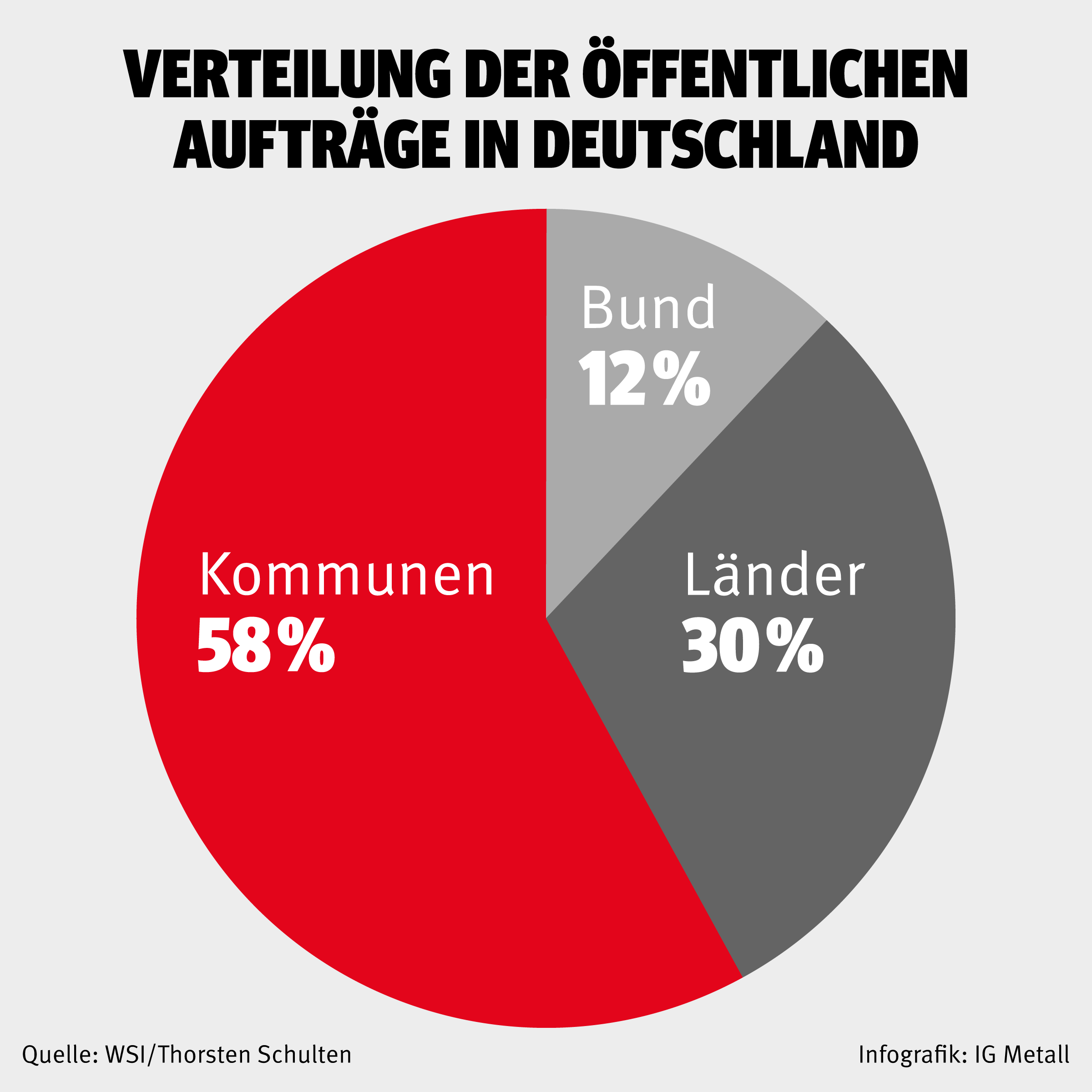
Cities and municipalities award more than half of all public contracts. The federal government ranks third—but its actions send a strong signal.
Plenty of Room for Improvement
State laws are important. About one-third of public contracts are awarded by the federal states. Only cities and municipalities spend even more money. They account for more than half of the total volume of public contracts. The federal states’ collective bargaining compliance laws should therefore also cover municipalities. This is not the case everywhere.
Collective bargaining expert Schulten therefore draws a sobering conclusion: “No federal state has yet satisfactorily resolved the issue of practicably implementing comprehensive collective bargaining compliance rules.”
But there are also positive examples: Starting in the 1990s, there was a wave of privatization in public transit. The result: a departure from collective bargaining agreements and wage suppression. The states have reversed this trend—through collective bargaining compliance regulations.
The government is therefore quite capable of using its market power for the benefit of the general public. It just has to be willing to do so and implement it skillfully.