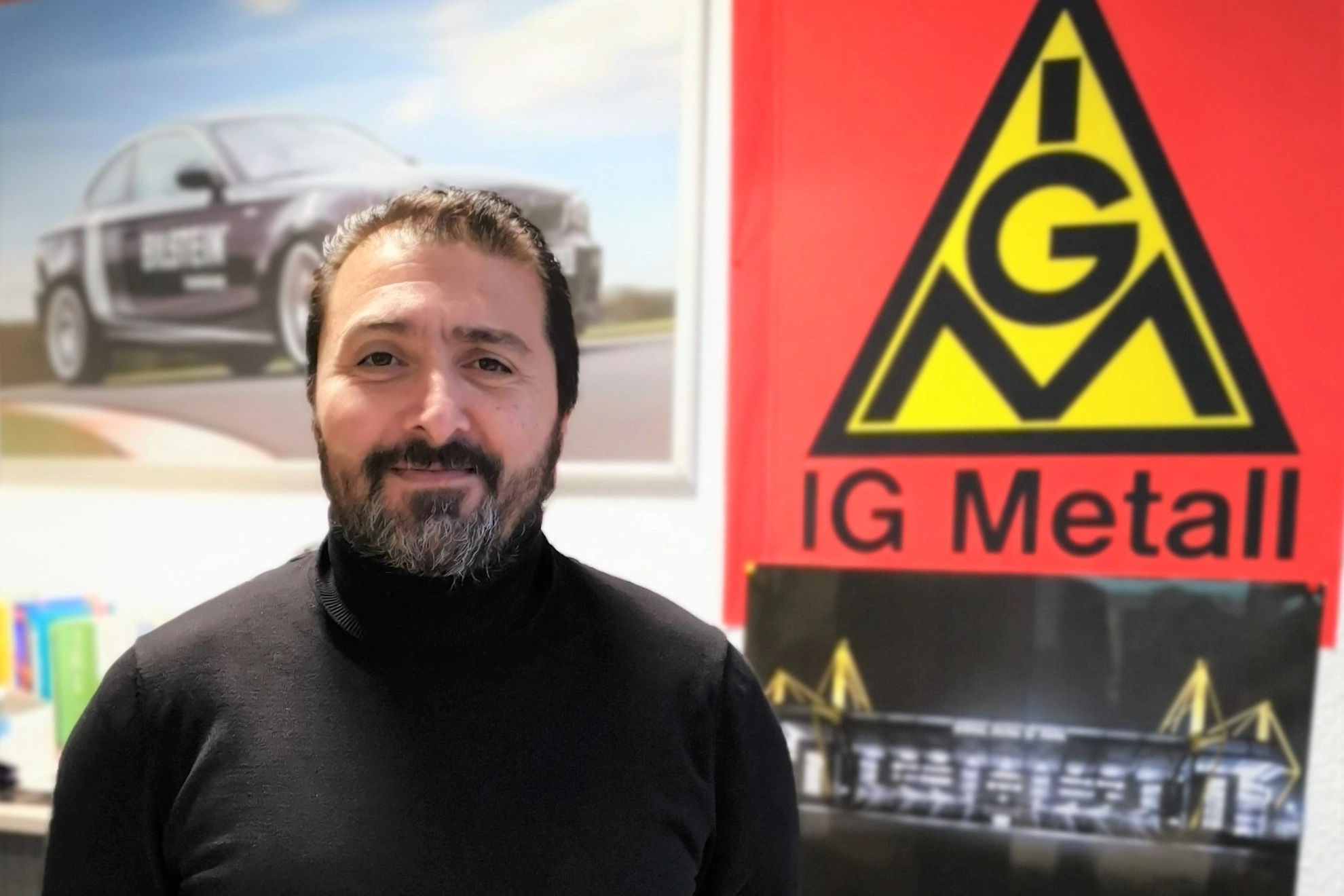
Binali Ateser was speechless when he received an anonymous letter from a female colleague in which she described sexual assaults she had experienced at work. The works council chair at Thyssenkrupp Bilstein in Ennepetal, North Rhine-Westphalia (manufacturer of shock absorbers and other suspension components) went to management. They negotiated a company agreement against discrimination and set up a counseling and complaints office at the plant.
The trained industrial mechanic has often experienced discrimination himself—for example, remarks at work such as “carpet salesman” and “long-haired bomber.” Or when looking for an apartment: “First, my German wife called—and got the approval,” Binali recounts. “But when they found out my name, they turned us down: ‘We don’t want foreigners in the building.’”
Bilstein Trains Refugees
Even when they hired three refugees as apprentices at Bilstein in 2016, there were snide remarks. But all three completed their apprenticeships and now work as skilled workers at Bilstein.
“The works council stood up for me even during my internship. I didn’t speak a word of German back then,” says Temesshen “Timo” Russom Seyum, who fled to Germany from Eritrea. After a year of introductory training—during which he also took a German course in the evenings at the adult education center—the trained carpenter landed an apprenticeship at Bilstein. “My trainer also helped me a lot. I was allowed to call him anytime,” Timo reports.
Timo then completed his apprenticeship with a grade of 2+ and now works as a machine operator in production.
Over 90 percent of temporary workers are hired permanently
Binali Ateser started at Bilstein as a temporary worker in 1991, joined IG Metall, became a shop steward, and has been on the works council since 2004.
The works council advocates for temporary workers. Over 90 percent are hired directly by Bilstein’s production department after 18 months of work—five or six every year.
Helena Hering now works directly for Bilstein as well, currently still on a fixed-term contract. Before that, she worked here as a temporary agency worker for 16 months. “The works council visits us several times a week. They ask us if anything is wrong—and what we need. And we can turn to the works council at any time,” she reports. “It was already like that when I was still a temporary worker. Everyone is treated equally here at the company.”
“In IG Metall, I can help shape things”
Binali is also active in IG Metall outside the workplace. He is a member of the local executive board of IG Metall Ennepe-Ruhr-Wupper and serves on the metalworkers’ collective bargaining committee for North Rhine-Westphalia—and he was also a delegate at the union convention in October 2023.
“On the local executive board, I can help make decisions and shape our direction. And on the collective bargaining committee, I can directly represent our workplace’s perspective,” explains Binali. “For me, IG Metall stands for democracy and solidarity. From the very beginning, IG Metall has been like family to me, and it will always remain a family.”
You, too, can help shape the future of IG Metall as a shop steward. Ask your shop stewards at work, your IG Metall works council, or your local IG Metall chapter. You can find more information about the work of shop stewards here