Employers Can Afford an 8 Percent Increase
Bankruptcies, closures, layoffs, recession—according to employers, all of this looms if they were to pay 8 percent more in wages. In reality, things are looking good at most companies. In the metal and electrical industries, according to a recent IG Metall survey of works councils, fewer than 2 percent of companies are at risk of bankruptcy.
There is no cause for panic or doom and gloom. There is no shortage of work (view chart). On average, the order backlog is sufficient for half a year. Many companies are booming like never before—and employees have long been working at their limits. In three-quarters of companies, works councils report good to very good order backlogs and capacity utilization. More than two-thirds of companies are able to pass on their price increases to customers, at least in part. Many companies are even reporting record profits despite the war in Ukraine.
Furthermore, the share of personnel costs is much lower than many believe: In the manufacturing sector, the share of compensation, wages, and salaries is just over 20 percent of revenue. This means that an 8 percent increase in compensation corresponds, mathematically, to an increase in total costs of only 1.6 percent.
When purchasing power declines, a recession looms
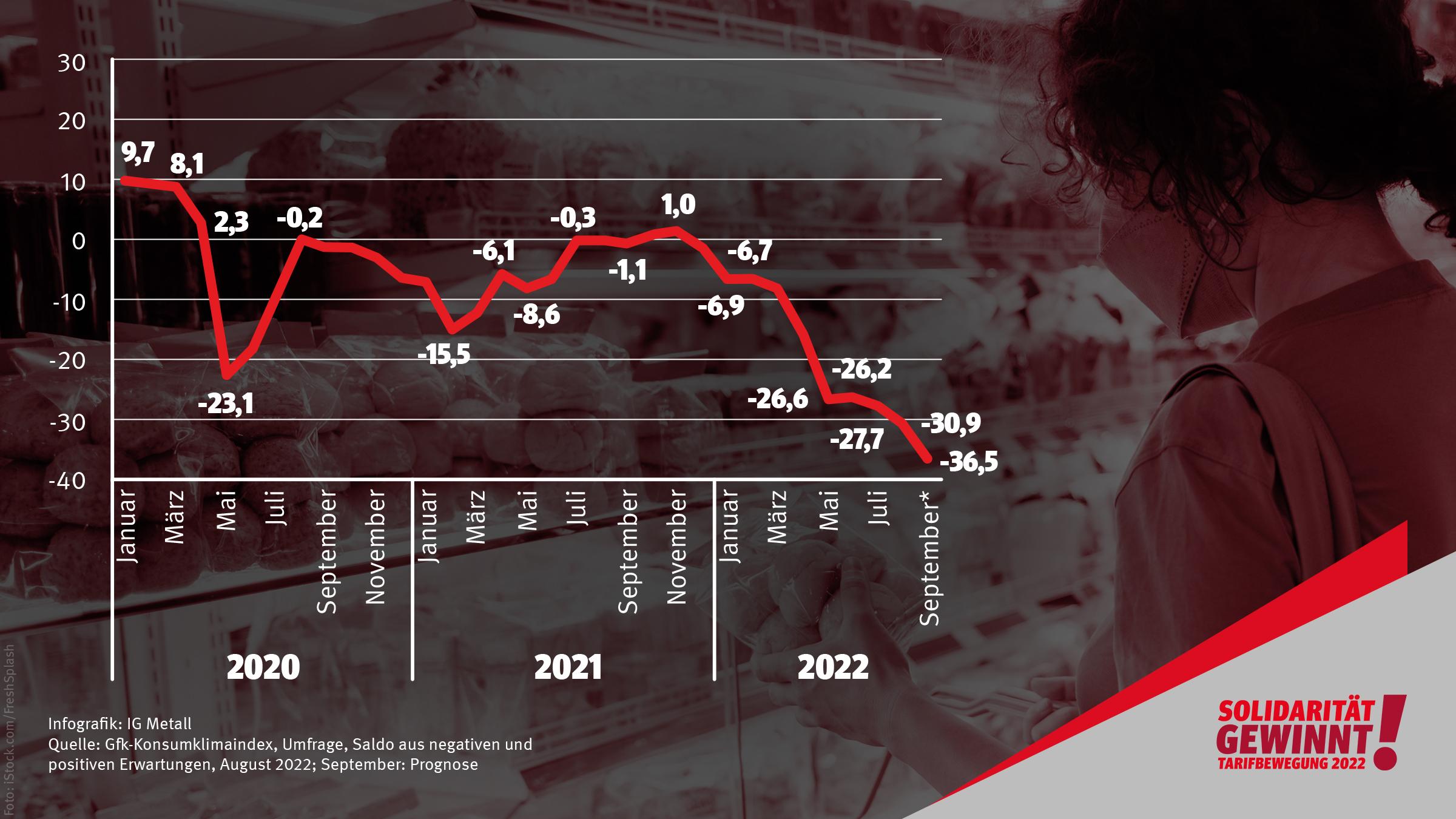
A recession—a contraction of the economy—is more likely to occur because consumers can no longer afford to buy enough due to high inflation. At minus 36.5 points, the GfK Consumer Climate Index fell to a new all-time low in September 2022 (chart).
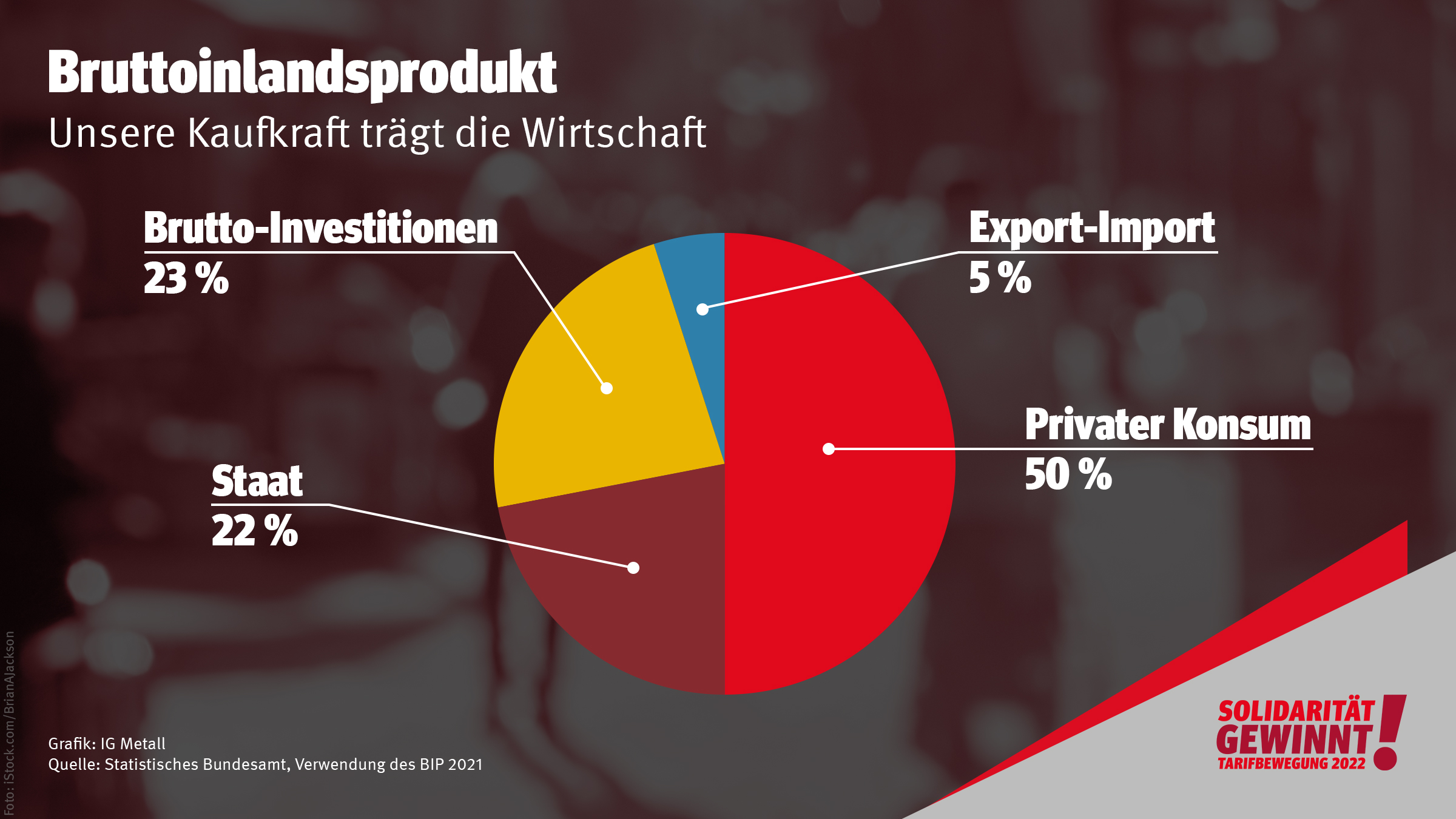
The decline in demand also increases the risk of a recession. This is because private consumption accounts for about 50 percent of gross domestic product (GDP) (view chart). Our purchasing power—our demand—is therefore the main pillar of our economy.
Economic researchers have therefore already significantly lowered their economic forecasts for this year and next. In their joint fall report, they now anticipate lower consumption and, consequently, a slight decline in GDP in the second half of 2022 and throughout 2023. Back in the summer, economic researchers had still predicted growth, primarily because they had anticipated a significant uptick in private consumption. We must therefore absolutely stimulate consumption through higher wages and greater purchasing power.
8 percent – “Why so little?”
Yes, according to economists’ forecasts, inflation will continue to drive up prices in 2023 as well. So why is IG Metall demanding only 8 percent? “Not enough,” many workers criticize. And in the collective bargaining committees as well, works council members and IG Metall shop stewards—especially those from large companies—brought higher demands from discussions within their workplaces to the table.
But not all companies are doing so well. Surveys by IG Metall also show this: In just over a third of companies, works councils report a less favorable or even poor profit and earnings situation. Some companies, especially suppliers, simply cannot push through price increases to offset rising costs. In some small and medium-sized companies where energy costs account for a large share of expenses, the situation is indeed serious. In addition, there are shortages of parts and raw materials, particularly semiconductor chips and metals.
Overall, the metal and electrical industry is booming—but not all companies are doing well. Even the collective bargaining committee members from the companies that are doing well recognize this. That is why the collective bargaining committees ultimately agreed on a joint, solidarity-based demand that even the companies that are not doing as well can support: 8 percent.
Wage Increase Plus Relief from Berlin
Collective bargaining policy alone cannot offset the current war-driven inflation. That is why IG Metall, together with the other DGB unions in Berlin, is advocating for relief measures from policymakers—we were the first to call for a cap on electricity and gas prices—and has already achieved quite a bit. The two relief packages introduced so far are providing significant help to workers. Among other things, starting January 1, 2023, employers will be able to make additional payments of up to 3,000 euros per year, tax- and contribution-free, including in monthly installments.
Now, the federal government has also approved a cap on electricity and gas prices. IG Metall has been calling for this since the spring and has even launched its own campaign on the issue. This is intended to be part of Scholz’s new 200-billion-euro “Double Boost” package. This will provide effective relief to businesses and households.
Details, particularly regarding electricity, still need to be clarified. However, according to initial preliminary calculations on the gas price cap, this could save private households between 1,200 and 2,500 euros per year. For companies in the metal and electrical industries, the employers’ association Gesamtmetall estimates relief of around 5 billion euros from the gas price cap alone.
IG Metall continues to press for the electricity and gas price brakes to be implemented quickly.
“We need energy cost subsidies for all households as well as for energy-intensive businesses,” explains Jörg Hofmann, Chairman of IG Metall. “It will be crucial to ensure stability through purchasing power by means of decent wage growth, government relief, and the containment of price increases.”
8 percent, permanent, monthly, reflected in the pay scales
IG Metall is demanding an 8 percent increase in monthly wages under collective bargaining agreements. The union also specifies that the wage increase must be “reflected in the pay scales.” This means that wages in the pay scales for the individual bargaining regions of the metal and electrical industries must be raised—that is, on a permanent basis.
Why? The last pay scale-effective increase in monthly wages took place in April 2018. In the 2020 and 2021 metal industry collective bargaining rounds, IG Metall prioritized job security due to the COVID-19 crisis and industry transformation. Nevertheless, there were permanent pay increases—namely, two new annual collective bargaining-based special payments: In 2019, theCollective Bargaining Supplement (T-ZUG) was introduced for the first time, paid out in July. In 2022, the newTransformation Allowance (T-Geld, Trafo-Baustein)was added, paid out in February. Both special payments—especially the T-Geld—can also be converted into time off to reduce working hours, unlike short-time work, for up to three years, in order to bridge even longer crises and transformation phases. Inflation was very low from 2019 to 2021.
But now prices are continuing to rise. This means that new special payments are not enough—and certainly not one-time payments. Employees need a permanent increase in their monthly pay.
Demand from the workplace
Higher monthly wages: This was already the top result from a survey conducted in workplaces this spring, in which around 200,000 employees participated. And as always, there were discussions in the workplaces and at local IG Metall offices.
The discussion regarding the demands for this year’s collective bargaining round in the metal and electrical industries began as early as the spring. Works council members and shop stewards brought the results of these discussions to the bargaining committees. It quickly became clear: The main focus is on monthly wages and maintaining purchasing power. The regional bargaining committees coordinated their discussions through the IG Metall Executive Board, which issued a recommendation on the demand on June 20 based on the discussions to date. On June 30, all regional bargaining committees simultaneously adopted their demands—which the IG Metall Executive Board confirmed on July 11: 8 percent.
No word yet from the employers
Collective bargaining negotiations in the metal and electrical industries have been underway since September 12. There have been two rounds of negotiations—with 22 negotiation sessions across the individual bargaining regions. And employers still have not presented an offer —and are even demanding “variable components” for the Christmas bonus and other special payments, which they intend to link to profits in the future and reduce without IG Metall’s consent.
The third round of negotiations begins on October 27. IG Metall expects an offer from the employers by then.
Solidarity Wins! – 2022 Collective Bargaining Round
“Solidarity Wins!” is our slogan for the 2022 metalworkers’ collective bargaining round. Because one thing is clear: This round of negotiations will be tough. Without pressure, the negotiations with employers will not move forward. We need a genuine collective bargaining movement in 2022.
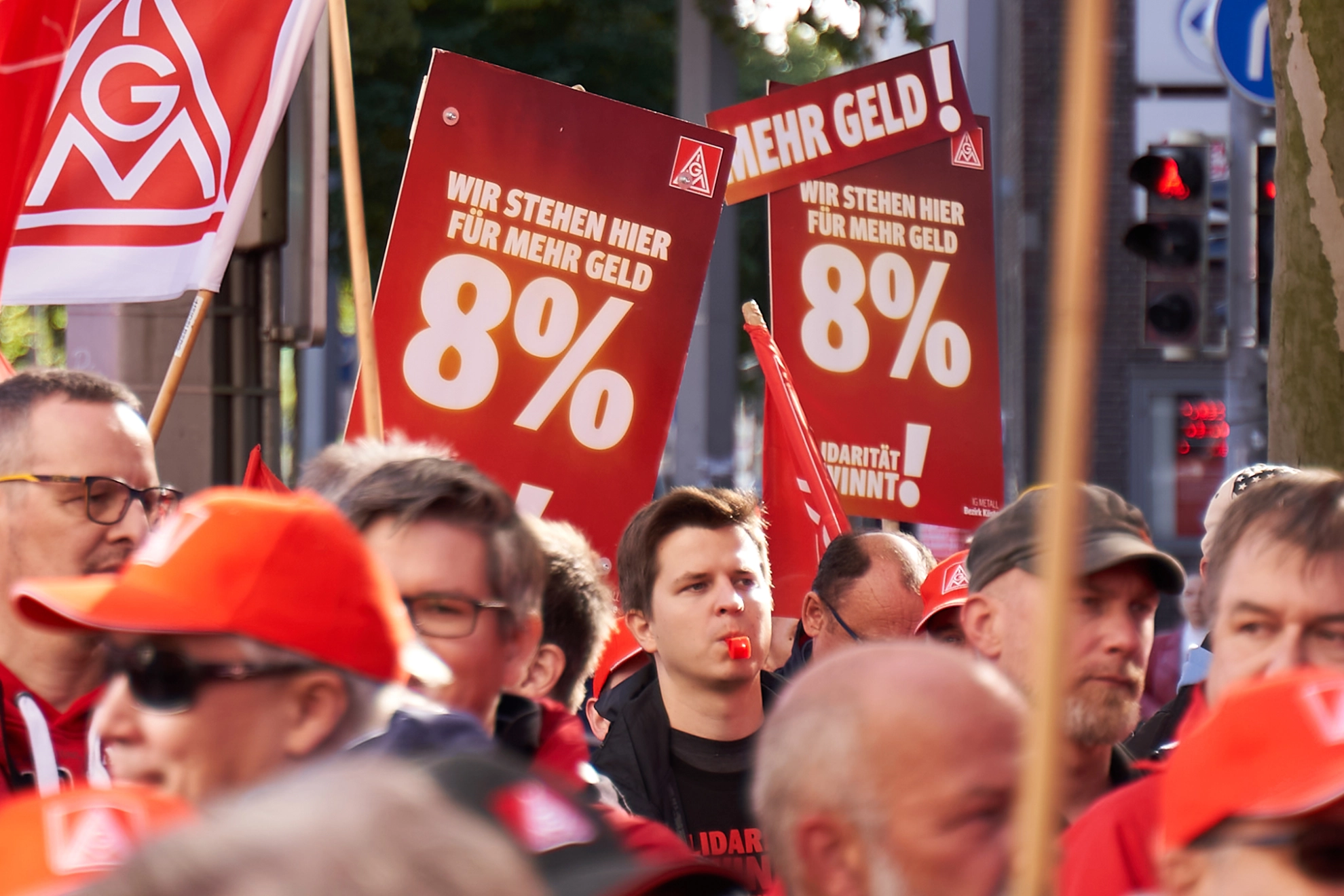
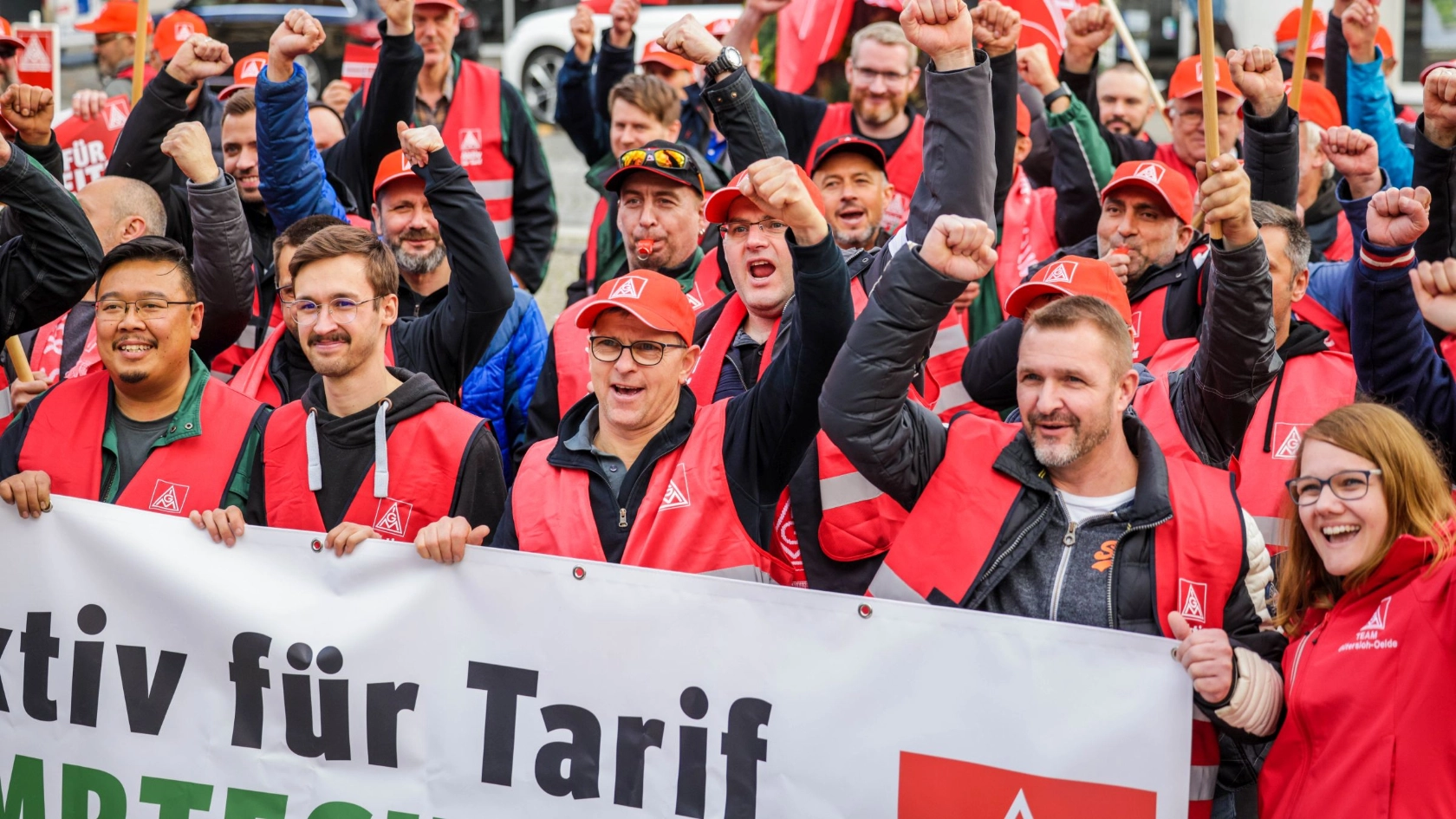
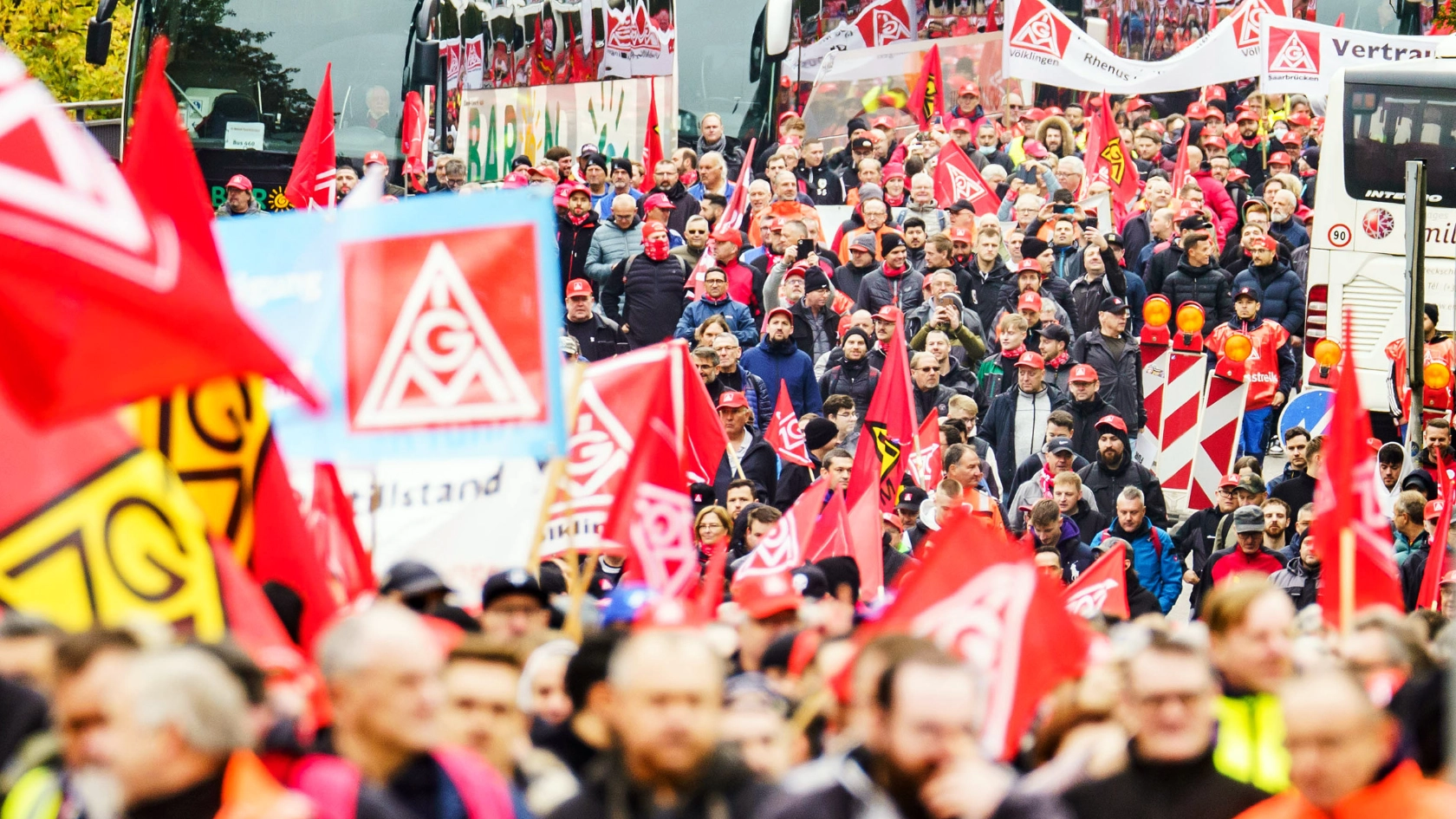
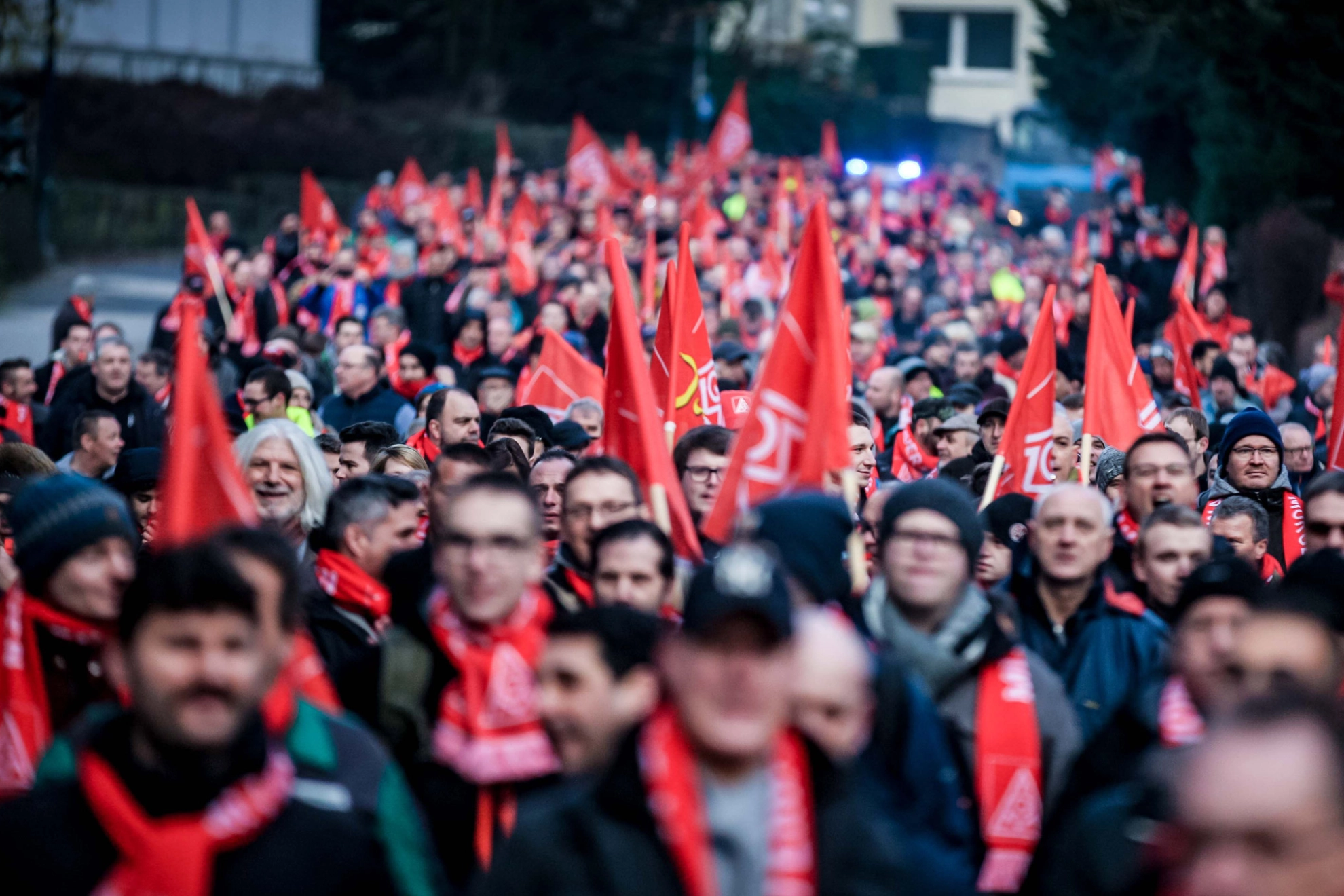
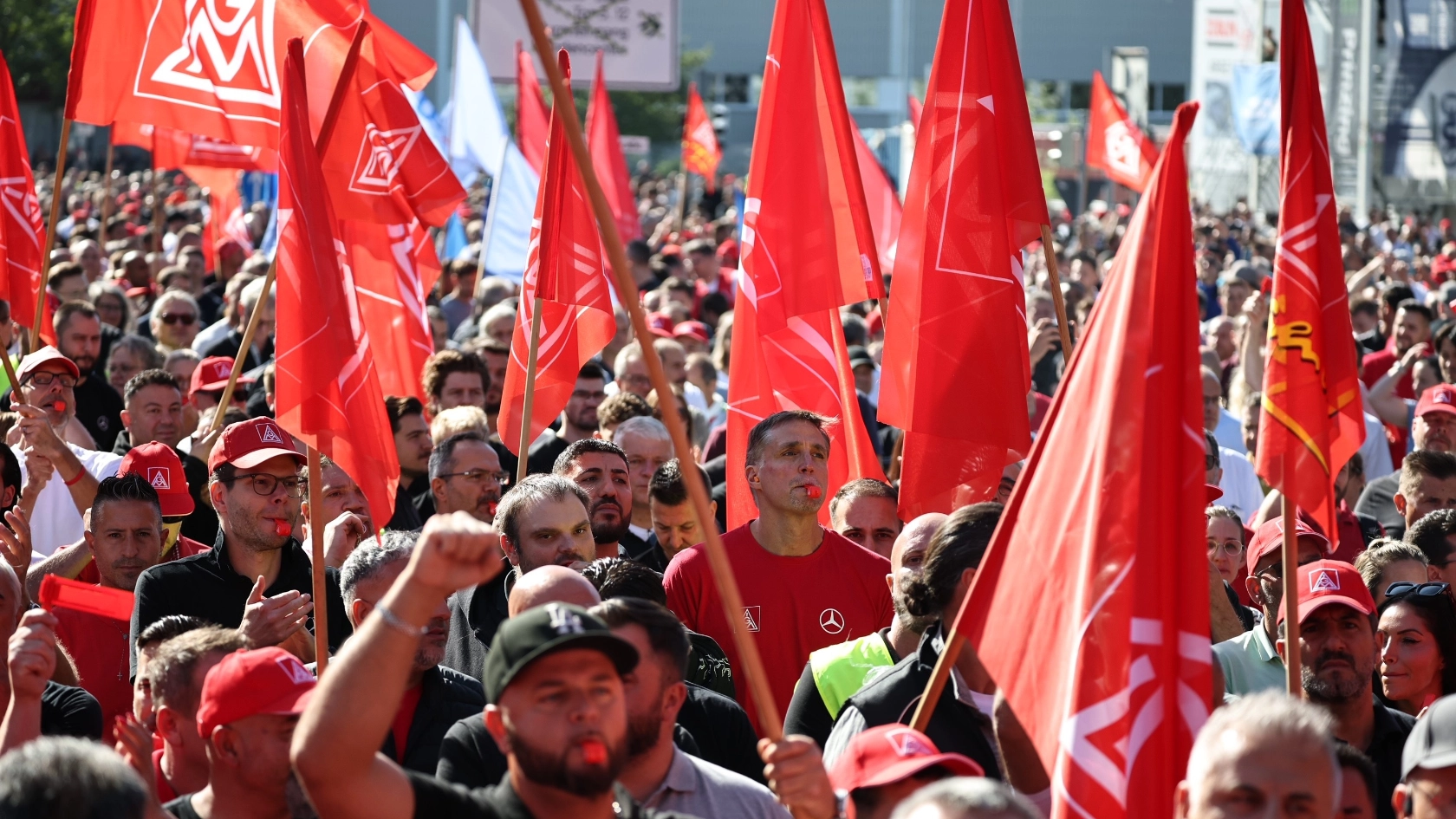
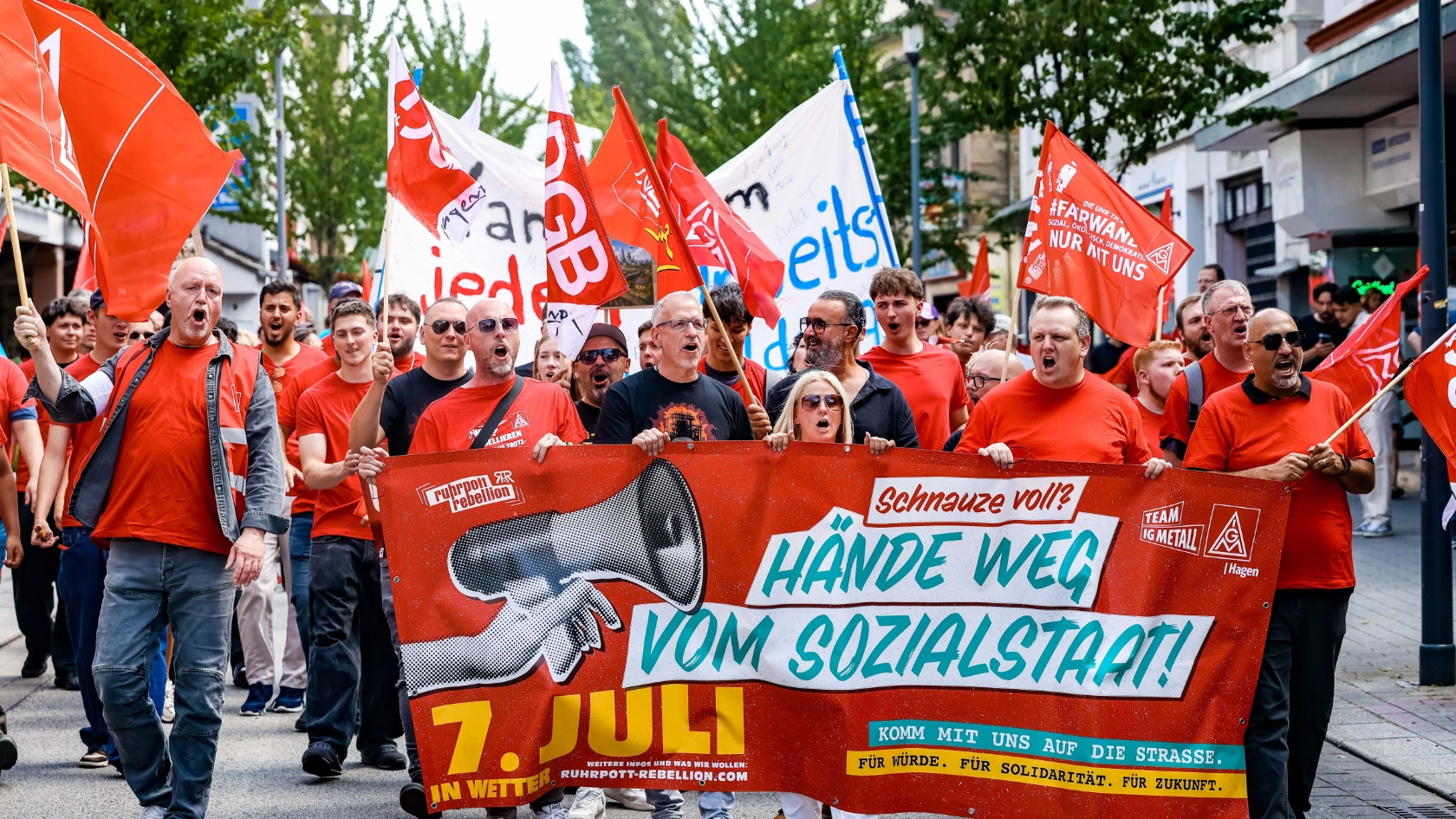
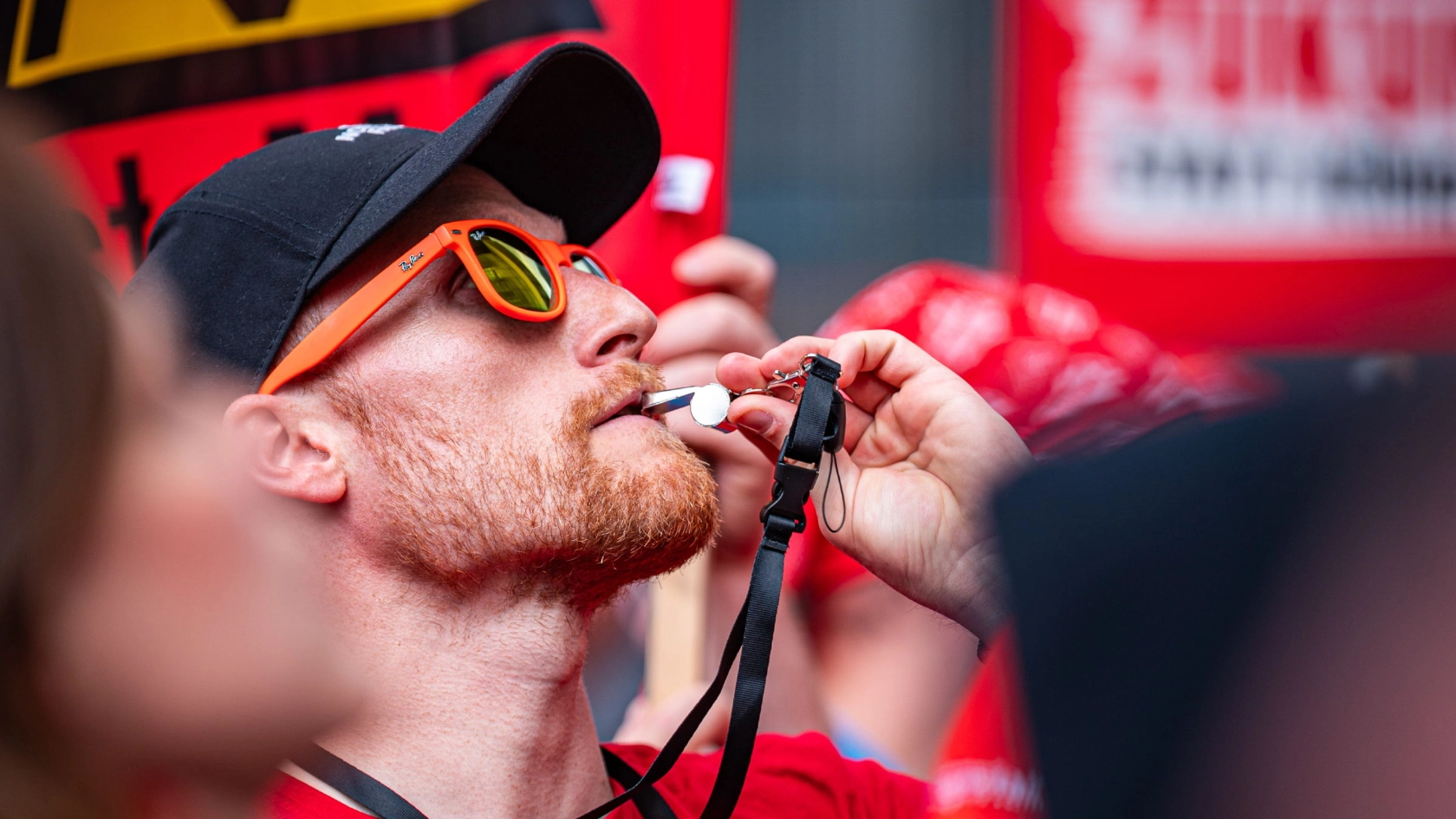
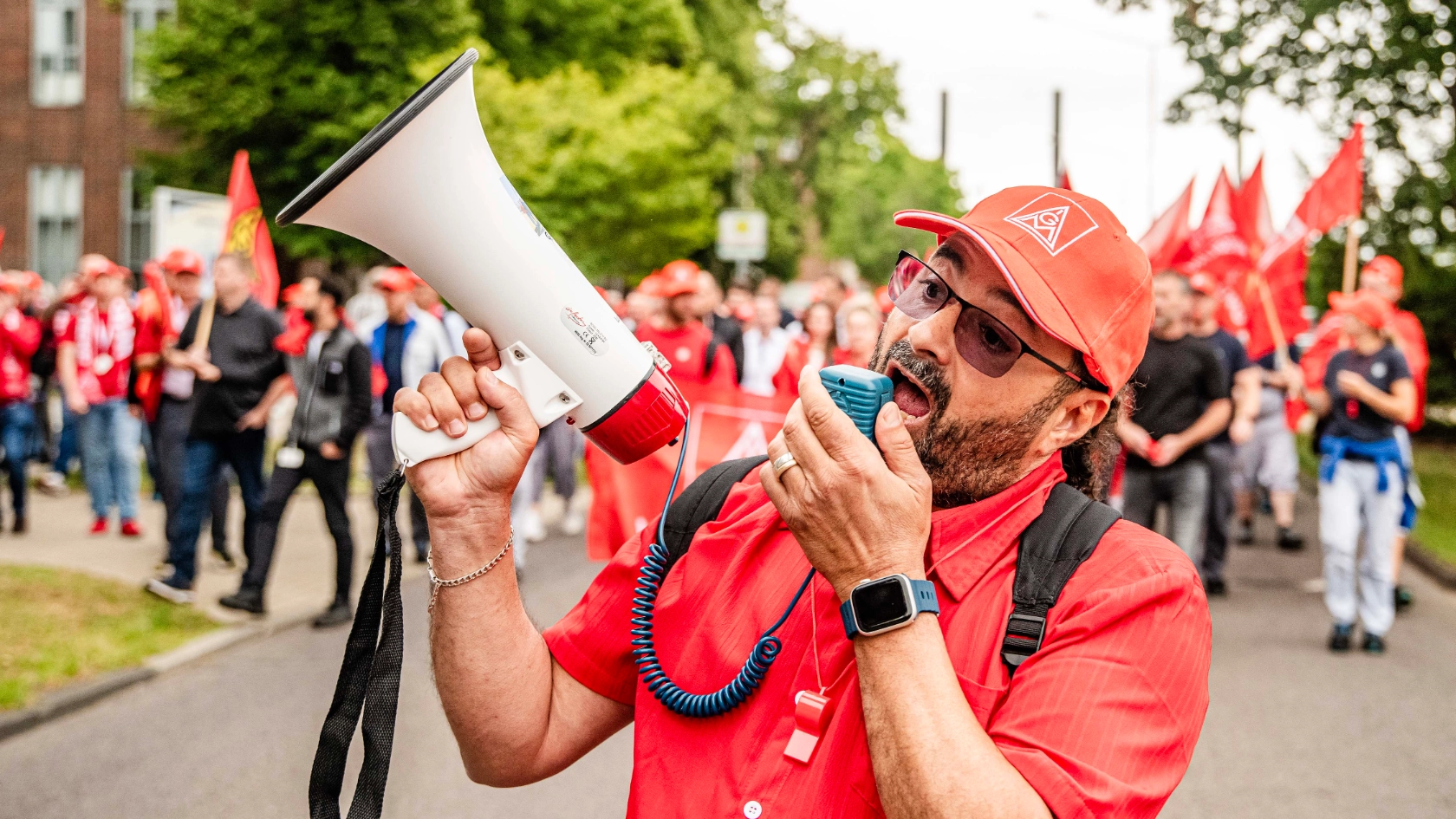
Thousands of metalworkers have already demonstrated for the 8 percent increase over the past six weeks.
As early as September 1, when the notice of termination of the collective bargaining agreements was delivered, hundreds of metalworkers gathered outside the offices of regional employers’ associations to stage protests accompanying the handover. Thousands then took part in the demonstrations outside the negotiation venues.
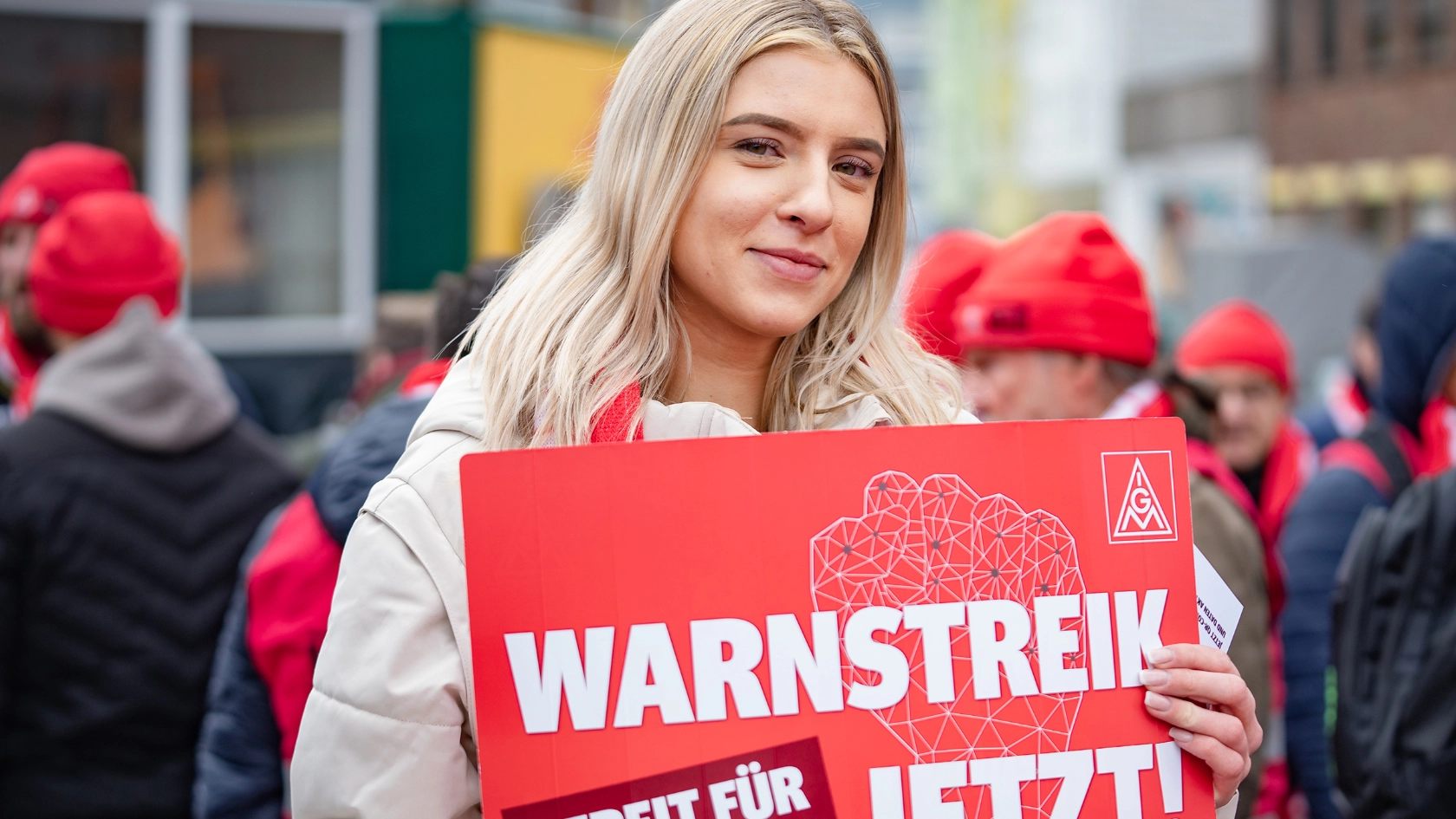
Preparations for warning strikes are now underway.
On October 28—four weeks after the collective bargaining agreements on wages expire—the so-called “duty of peace” will end. Starting October 29, IG Metall will then be able to call for warning strikes in order to exert economic pressure on employers.




To load this video, you must enable YouTube cookies and thereby agree to the YouTube privacy policy.