It’s that time of year again: tax return season is here. It’s worth taking action. Anyone required to file a tax return must submit their return for the year 2025 by July 31, 2026.
Those who have their income tax return prepared by an income tax assistance association or a tax advisor have until February 28, 2027, to file their return.
Basic Exemption
For the 2025 tax return, the basic exemption amount is 12,096 euros for single filers and 24,192 euros for married couples. Taxpayers whose taxable income and wage replacement benefits fall below the basic exemption amount do not have to pay taxes. Taxable income is reduced by any amounts taxpayers can claim as income-related expenses, special expenses,household-related services, or extraordinary burdens.
Employee Flat-Rate Allowance and Income-Related Expenses
If a taxpayer does not provide evidence of higher income-related expenses in their tax return, the tax office automatically applies an annual flat-rate deduction of 1,230 euros; for retirees, the amount is 102 euros. Employees may claim as income-related expenses costs incurred in the course of their employment. Anyone wishing to deduct expenses exceeding the flat-rate allowance—such as for work-related materials like professional literature, writing and office supplies, continuing education, or travel expenses—must be able to provide proof of these expenses or demonstrate their validity.
Retirement Savings Expenses
Expenses for retirement savings are 100 percent deductible as special expenses when calculating income tax. For employees, this primarily applies to employee contributions to the statutory pension insurance. The legislature’s aim is to ease the financial burden on citizens during the contribution phase and to prevent double taxation of pensions in the future. Private retirement savings expenses, such as life insurance policies and investments, are not deductible.
Retirement Relief Amount
The retirement relief amount is a tax exemption that the tax office automatically applies if taxpayers have reached the age of 64 before the tax assessment period. It is calculated as a percentage of income other than pensions and retirement benefits. Special rules also apply to investment income. However, the amount of the senior relief allowance is capped and will be a maximum of 627 euros in 2025 (13.2 percent of eligible income). The tax office automatically calculates this amount based on the taxpayer’s date of birth, and it does not need to be claimed on the tax return.
Commuting Allowance
Among the most important income-related expenses are trips to the workplace. The tax office recognizes 30 cents per workday and kilometer traveled; from the 21st kilometer onward, the rate is 38 cents. This applies regardless of the mode of transportation chosen, whether the journey is made by car, train, bicycle, or on foot. The total number of kilometers traveled must be reported in the tax return. The tax office calculates the breakdown among the various flat-rate allowances.
Without supporting documentation and further explanations, commuters can only claim the maximum rate of 4,500 euros. Trips between home and the primary place of work must be entered in the tax form in Appendix N, starting with line 30.
Most employees travel to work and back home on the same day. According to the Income Tax Act, the mileage allowance covers both the trip to work and the trip home. Only the one-way distance counts, not the round trip. The order of the work-related trips is irrelevant. Night shift workers who first go to their residence in the morning and then return to their workplace that same evening can also claim the full deduction.
For those who use public transportation, it’s worth keeping your receipts. That’s because you can also claim a tax refund for tickets. Expenses for local public transportation tickets purchased for the commute to work (such as monthly or annual passes) are deductible if the total amount exceeds the mileage allowance.
Different rules apply to work-related travel (travel expenses). For these costs, 30 cents per kilometer traveled can still be reimbursed by the employer or claimed by the employee as income-related expenses. Travel expenses must be entered in Schedule N starting on line 68.
Mobility Bonus
For low-income long-distance commuters whose taxable income in 2024 was below the basic exemption of 11,784 euros per year and who therefore do not have to pay taxes, the legislature has introduced the so-called mobility bonus, which will remain in effect until 2026. Low-income workers whose one-way commute to work is longer than 20 kilometers will receive 14 percent of the increased commuter allowance starting at the 21st kilometer, or 5.32 cents per kilometer.
Normally, low-income earners do not have to file a tax return with the tax office, since their income is below the basic exemption threshold and they therefore do not have to pay taxes. However, anyone who wishes to receive the mobility bonus must file a tax return. This is mandatory in order to qualify for this financial assistance.
Apprentices are also often considered low-income earners and can apply for the mobility bonus if the commute to their apprenticeship is at least 21 kilometers and the travel expenses cause the employee’s flat-rate allowance of 1,230 euros to be exceeded.
Anyone who meets the requirements for the mobility bonus but has never filed a tax return with the tax office should seek advice from the experts at the income tax assistance associations (see below) if they have any questions.
Union Dues
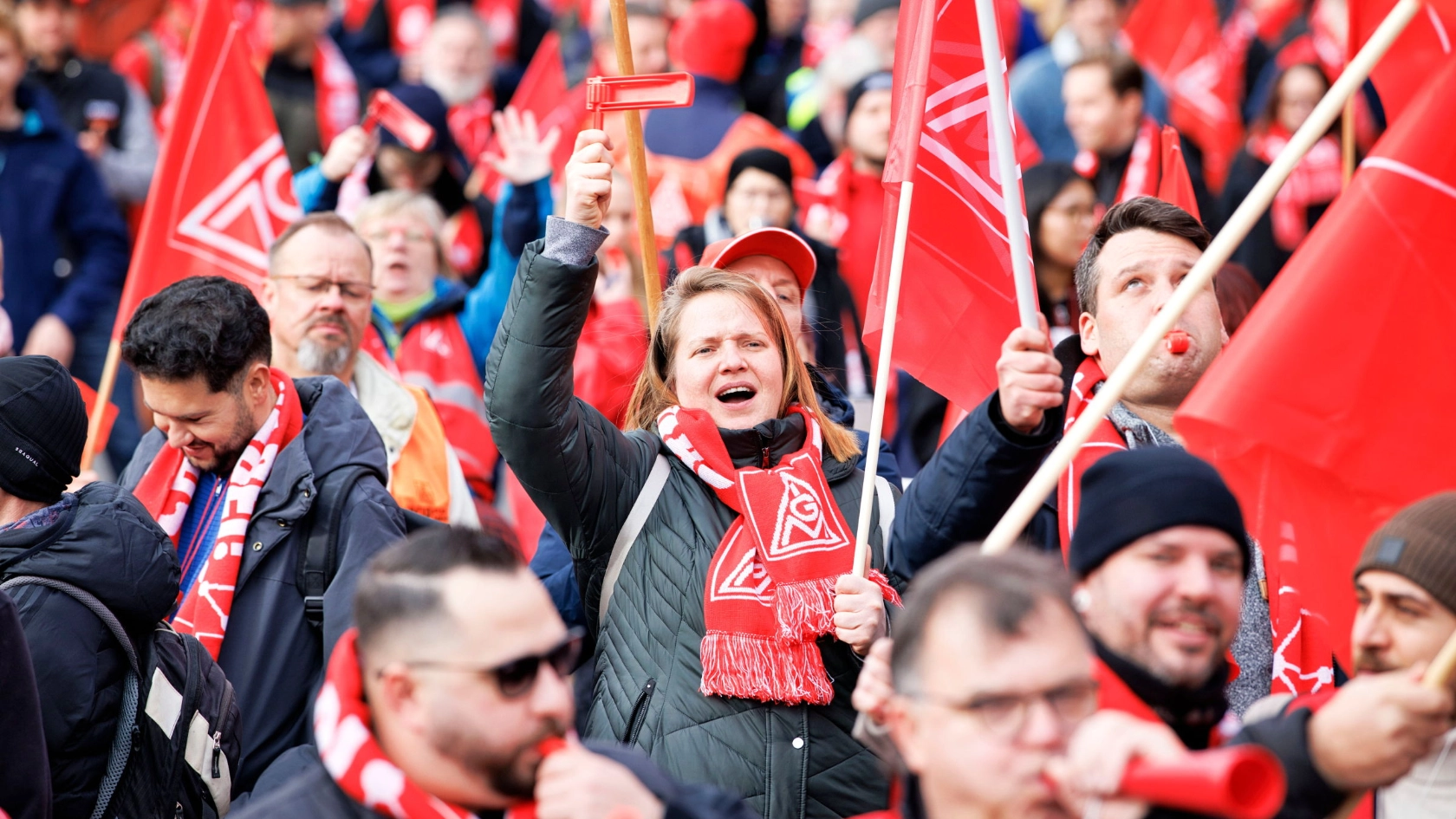
Union dues are also deductible as income-related expenses. This also applies to taxpayers who are retirees, employees in partial retirement, and those in early retirement. The Frankfurt am Main Regional Finance Office issued a ruling on this matter as early as September 18, 2002 (S 2212 A – 2 – St II 27), which metalworkers should cite.
Employees should enter their union dues on Line 56 of Schedule N. This also includes dues paid to other professional associations. Retirees can use Lines 25 and 26 on Schedule R for this purpose.
Child and Education Allowance
The child allowance, including the allowance for childcare, upbringing, or educational expenses, amounts to 9,600 euros (figure for 2025); for a single parent, it is 4,800 euros. As part of the income tax assessment, the tax office determines whether claiming child benefits or deducting the allowances is more advantageous in each individual case and automatically applies the more favorable option.
Flat Rate for Working from Home
Anyone who works from home without having a dedicated home office can claim a flat-rate allowance of 6 euros per day, up to a maximum of 1,260 euros per year (equivalent to 210 working days), for tax purposes. The same applies if a dedicated home office is available but does not serve as the center of all business and professional activities.
Good to know:
- The home office allowance of 1,260 euros does not increase the income-related expenses allowance of 1,230 euros.
- For a day worked from home, in addition to the daily flat rate, travel expenses for hourly work performed off-site may also be claimed. Example: An employed engineer drives to a construction site and then returns to work from home. However, the time spent working from home must account for more than half of the total working hours for that day.
- If no other workspace is available at the primary workplace, on days when work is performed both at home and at the primary workplace, the mileage allowance for the trip to the primary workplace may be claimed in addition to the daily flat rate.
- Costs for work equipment (computers, office furniture, etc.) can be claimed as income-related expenses in addition to the daily allowance.
Income Replacement Benefits and Taxes
Short-time work compensation (KuG) is a wage replacement benefit and is generally tax-free. However, it increases the percentage of your remaining taxable income. This is known as the “progression clause.” It means that, when filing your tax return—i.e., retroactively—short-time work allowance is added to your regular wages to determine your individual tax rate. It thus increases the taxable income base and the tax rate for your regularly paid wages and all other taxable income.
The result: Anyone who receives wage replacement benefits such as short-time work benefits, unemployment benefits, or sick pay in a calendar year must expect additional tax assessments. This also applies to benefits such as maternity, transitional, injury, or parental benefits, as well as transitional retirement and early retirement benefits.
Employees receiving wage replacement benefits are required to file a tax return if these benefits exceed 410 euros per year. Whether a back tax payment is due at all—and how much it will ultimately amount to—depends on the income situation in the year the short-time work allowance was paid. If there is no other taxable income—for example, because the spouse has no income—there is generally no additional tax liability.
The Bavarian State Tax Office’s “Progression Clause” calculator determines the income tax liability (excluding the solidarity surcharge and church tax) while taking the progression clause into account.
IG Metall Servicegesellschaft offers affordable tax counseling for members in cooperation with approximately 3,000 income tax counseling offices. All counselors possess the professional qualifications required by law and are registered with the supervisory authority. IG Metall members are exempt from the registration fee and pay a socially graded fee based on their income.
The income tax advisory services provided by these partners are also available at many IG Metall branch offices. Registered members can find more information on the Servicegesellschaft’s website.
Income Tax ABC Brochure
The DGB guide “Basic Concepts of Income Tax 2026” provides information on tax benefits and offers useful tips and assistance for filing the 2025 tax return. The brochure is available in digital form. It can be downloaded here as a PDF:
Income Tax ABC 2026 – Useful Tips and Guidance for Filling Out Your Income Tax Return