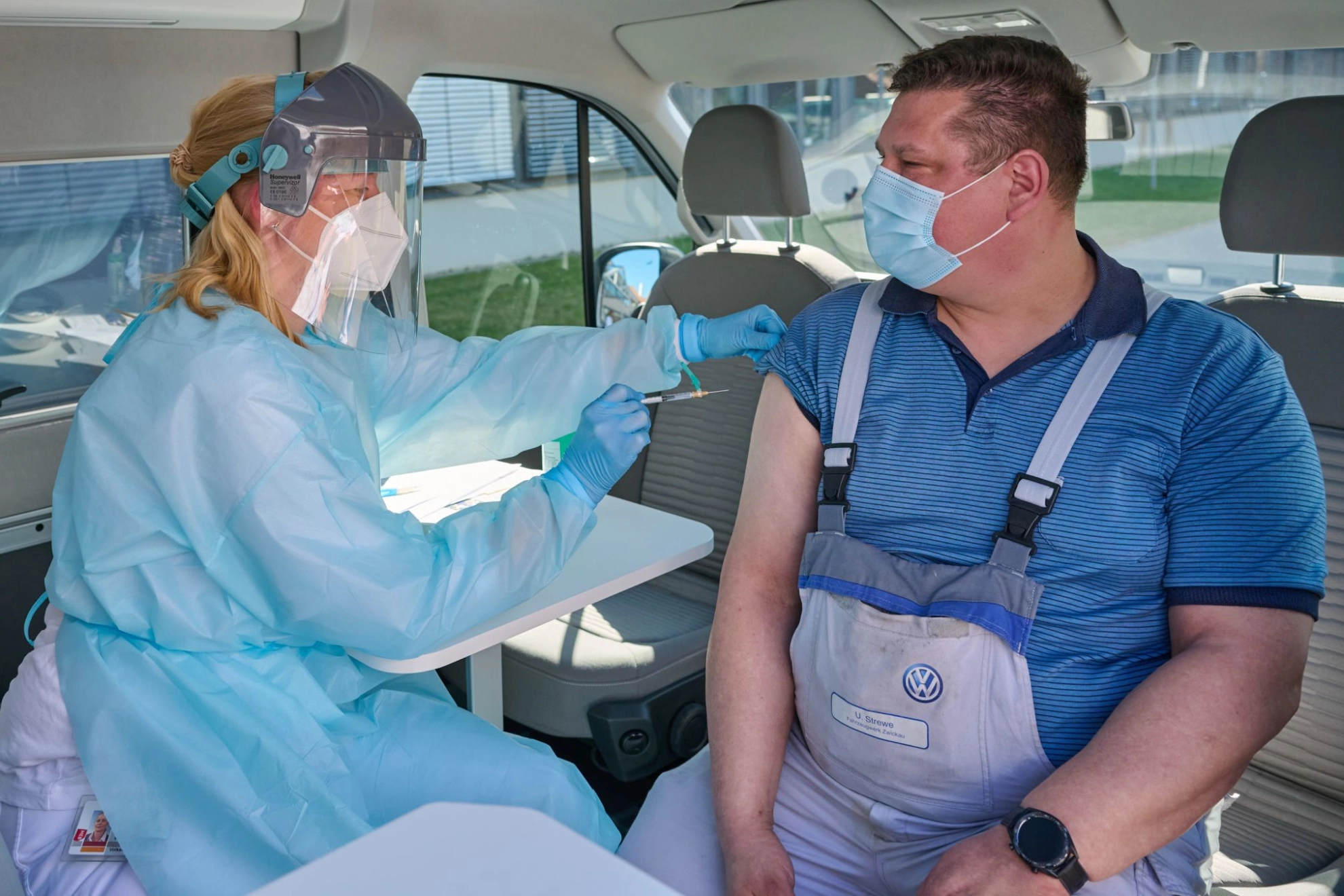
Who arranges the vaccination appointment at work?
Employees are typically informed about the vaccination offer through a letter from their employer. Appointments are scheduled and vaccinations administered by company doctors.
Who can get vaccinated by the company physician?
If a vaccination program is offered at the workplace, all employees of that company can get vaccinated by the company physician. This includes all company employees, regardless of their place of residence or usual place of stay—including cross-border commuters and seasonal workers.
How exactly does the pre-vaccination counseling process work?
Doctors are always required to provide information on all circumstances essential for consenting to a vaccination. This includes, in particular, the nature, scope, administration, expected outcomes, and risks of the procedure. This also applies to occupational physicians.
A consultation is required during which the doctor must verify that the employee has read and understood the written information. The employee’s individual concerns must be addressed. In addition, employees must be given the opportunity to ask questions and receive answers.
Can I get vaccinated during work hours?
Yes. According to Section 5(1) of the SARS-CoV-2 Occupational Safety and Health Regulation, as amended and effective as of September 10, 2021, the employer must allow employees to get vaccinated during working hours. The specific vaccination appointment must be coordinated with the employer.
What about pay during this time?
Whether the employer is required to compensate for this time off depends primarily on the relevant provisions in applicable collective bargaining agreements, and, where applicable, company agreements or the employment contract.
If this issue is not addressed, Section 616 of the German Civil Code (BGB) may grant a right to continued payment of compensation. However, this provision is often excluded or modified, rendering it inapplicable. The question of the obligation to pay compensation can therefore only be answered definitively by considering the circumstances of each individual case.
To what extent are doctors administering vaccines liable for vaccine-related injuries?
For all health damages that have occurred in connection with COVID-19 vaccinations administered since December 27, 2020, pursuant to the Coronavirus Vaccination Ordinance, a nationwide right to compensation underSection 60 of the Infection Protection Act has been in effect since June 1, 2021.
May or must an employer treat vaccinated or recovered employees differently from unvaccinated or unrecovered employees?
Under the SARS-CoV-2 Occupational Safety and Health Ordinance, employers must assess which workplace infection control measures can be implemented. When adjusting these measures, it should be possible to take into account an employee’s so-called immunization status (vaccinated or recovered). However, medical findings regarding the potential for transmission—including by vaccinated individuals—as well as rising infection rates make it necessary to continue maintaining a high level of protection.
The works council’s participation rights must be observed in the event of any adjustments to protective measures.
What happens if I contract COVID-19 and am unvaccinated?
Employees who contract COVID-19 and are consequentlyunable to workgenerally receivecontinued payduring sick leave from their employer for an initial period ofsix weeks, followed by sick pay from their health insurance provider. This applies even if an employee contracts COVID-19 despite having had the opportunity to get vaccinated.
Employees may, under certain circumstances, lose their entitlement to continued pay during sick leave if they are at fault for their illness. However, this requires that they have recklessly or intentionally exposed themselves to risks that seriously violate “the behavior expected of a reasonable person acting in their own best interest.” The mere fact that a recommended vaccination was not received does not constitute such a violation—the same applies to other diseases for which vaccinations are available and recommended.
Is vaccination mandatory?
There is currently no general mandatory vaccination requirement against COVID-19. The principle of voluntary participation applies.
Can an employer require employees to get vaccinated against COVID-19?
As long as there is no legal requirement to get vaccinated, employers generally cannot force their employees to get vaccinated—not even through corresponding clauses in the employment contract.
Can a mandatory vaccination policy be introduced in the workplace based on a company agreement?
Under theWorks Constitution Act, the parties to the works agreement must respect and protect employees’ personal rights in their regulations. It follows that an infringement on physical integrity in the form of a mandatory vaccination requirement cannot be justified, even through a works agreement. A mandatory vaccination requirement established by a works agreement cannot therefore be effectively implemented.
Guide: COVID-19 Rules in the Workplace
FAQ on the COVID-19 Occupational Safety and Health Regulation: Effective infection control remains the focus