Automatic translation
This article has been translated automatically using computer technology. While we strive for accuracy, some wording or details may differ from those in the original article.
This translation was not manually reviewed. For important facts, quotations or legally sensitive information, please consult the German original. Individual selections, images, embedded media or technical terms may have been translated differently or incompletely.

Employment Contract Guide All Answers About Employment Contracts

Most employees don’t sign an employment contract very often. We explain what it must include, how to terminate it, and which clauses should raise red flags. We answer the most important questions.

Ein Arbeitsvertrag liegt auf einem Schreibtisch, darauf liegt eine Brille, daneben steht ein Laptop, an dem jemand arbeitet

16 January 2025 16 January 2025


The employment contract is a key document for employees: It sets out the rights and obligations governing the employment relationship—from working hours to compensation. You should not sign an employment contract lightly. Sometimes employment contracts contain formal defects. Or employers slip invalid clauses into the contract.

Collective bargaining agreements simplify matters: Since pay and working conditions are already regulated in them, the employment contract can be brief.


1. How is an employment contract entered into? Is there a specific form that must be followed?

Entering into an employment contract can be very simple. Not even the proverbial handshake is required. It is sufficient if the parties’ conduct makes it clear that they agree that one party—namely, the employee—undertakes to make their labor available to the other party—that is, the employer—and that the employer, for its part, undertakes to pay compensation to the employee. An explicit agreement on the amount of compensation is not required. If the parties have not specified this, the statutory provision of Section 612(2) of the Civil Code applies, and the employee may demand the “customary compensation.”

The law therefore does not prescribe any specific form for the conclusion of an employment contract. Nevertheless, the vast majority of employment contracts are concluded in writing. The text of such a contract typically contains a wide range of provisions. In particular, the nature of the work, the working hours, and the amount of compensation are expressly specified therein.

2. Are there special provisions for fixed-term contracts?

It is sometimes claimed that an employment contract intended to be for a fixed term must be in writing to be legally valid. However, this is not correct. The correct interpretation is that, while Section 14(4) of the Part-Time and Fixed-Term Employment Act (TzBfG) does stipulate that the fixed-term nature of the employment relationship must be in writing, this applies only to the duration of the contract. The employment contract itself remains legally valid even without being in writing.

Thus, if, for example, the applicant and the employer agree verbally that the applicant is to work for the employer as a production assistant for a period of one year, then a corresponding employment contract has been validly concluded in and of itself. Only the contractual provision stipulating that the employment relationship is to end automatically after one year—that is, the fixed term—is not legally valid. The employee then has an employment contract for an indefinite term.

However, it is important to note: An employee who wishes to invoke the legal invalidity of the fixed-term agreement must, in the event of a dispute, do so in accordance with Section 17 of the German Part-Time and Fixed-Term Employment Act (TzBfG) by filing a lawsuit in labor court, which must generally be filed no later than three weeks after the end of the fixed term. If this filing deadline is missed, the fixed-term agreement is deemed to have been legally validly concluded after all.

3. The fine print in an employment contract—is that legal?

Contract clauses printed in extra-small font are rarely found in employment contracts today. However, even if the wording in the contract document is clearly legible, that does not necessarily mean it is easy to understand. An employer cannot rely on clauses that are worded in such a way as to mislead the employee regarding their rights and obligations under the employment relationship.

Example: A contract clause stipulating that claims arising from the employment relationship that have not been asserted against the other party no later than three months after they become due shall lapse is legally invalid. This contractual provision is, in fact, likely to mislead the employee into believing that certain claims cannot, by law, lapse within such a short period.

However, employment contract clauses must not only be transparent but must also strike a minimum balance; in other words, they must not unduly favor the employer.

But note: The legal limits on contract clauses discussed here apply exclusively to clauses that have been pre-formulated by the employer and that the employee must accept as is. In such cases, a so-called “standard terms and conditions review” under Sections 305 et seq. of the German Civil Code (BGB) takes place in the event of a dispute before the labor court. During this review, the general terms and conditions are examined to determine whether the party that does not individually negotiate the terms of the contract but instead simply presents its own terms for acceptance has remained “reasonably fair” in doing so.

Even minor differences in wording can be decisive in determining whether one clause withstands scrutiny while another, very similar clause is deemed unreasonable. To obtain certainty regarding one’s own contract clauses, seeking legal advice is generally essential.

4. How do collective bargaining agreements affect the employment relationship?

Individual employees generally do not have a bargaining position that allows them to negotiate on equal footing with the employer. This is often already the case when the employment contract is signed. But even sought-after skilled workers, who still hold the upper hand when signing the contract and are able to secure decent compensation, find that they have lost a significant amount of bargaining power over the course of the employment relationship—for example, during negotiations for a raise. The threat of leaving the company is often not very credible, and the employer may already be considering staff reductions anyway, so this announcement does not deter them.

In unions, employees band together and present a united front in negotiations with the employer, thereby securing a strong bargaining position. The ability to exert tangible economic pressure on the employer—including through strikes—and thus lend weight to their demands is crucial in this regard. The agreements reached in these negotiations between an employer and the union—or between an entire employers’ association and the union—constitute a contract: a collective bargaining agreement. Based on this collective bargaining agreement, members of the union that concluded the agreement can enforce the rights stipulated therein against the employer bound by that agreement. For example, they can demand a wage increase, additional vacation days, personally requested time off, and much more.

For union members, the collective bargaining agreement stands, so to speak, alongside their individual employment contract. According to Section 4(3) of the Collective Bargaining Act, the relationship between the two is governed by the rule that any deviation from the collective bargaining agreement is effective only if it has been expressly permitted in the collective bargaining agreement itself or if the deviation is more favorable to the employee.

Pursuant to Section 80(1)(1) of the Works Constitution Act, the works council ensures that the applicable collective bargaining agreements are implemented.

5. How do company agreements affect the employment relationship?

In Germany, cooperation between employers and employees within a company is primarily governed by the Works Constitution Act. Under this law, the employees of a company elect a works council to represent their interests vis-à-vis the employer. On many regulatory matters, the employer must reach an agreement with the works council if certain measures are to be implemented.

For example, pursuant to Section 87(1)(2) of the Works Constitution Act, the employer must agree with the works council on when the daily working hours at the company are to begin and end, when breaks are to be taken, and how working hours are distributed across the individual days of the week. However, even in cases where the law does not require the employer to reach an agreement with the works council, the employer may do so voluntarily. Provisions agreed upon between the employer and the works council and set forth in a works agreement are binding on all employees of the company.

Works agreements also stand, so to speak, alongside the employee’s individual employment contract. If the same matter is addressed in the employment contract in a manner more favorable to the employee than in the works agreement, the employee may invoke the terms of their employment contract.

But be aware: An employment contract may also contain provisions stating that the terms of a works agreement take precedence, even if they are less favorable. The term “openness to works agreements” is generally used to describe this. The problem is that labor courts often assume such “openness to works agreements” even when this is not expressly stated in the employment contract. Labor courts hold that many contracts are to be understood—or, in legal terms, interpreted—in this way based on the overall context.

6. How is an employment contract terminated?

An employment contract can end in various ways.

It may end automatically if it was originally entered into for a fixed term or if a condition was agreed upon that, upon its occurrence, would terminate the employment relationship.

As a general rule, an employment contract can also be terminated by either party through ordinary termination. The terminating party must observe the applicable notice period in each case. However, the option for ordinary termination may also be restricted or excluded. For example, many collective bargaining agreements of IG Metall contain provisions that exclude the employer from terminating older employees with long service through ordinary termination. Fixed-term employment contracts also cannot be terminated ordinarily, unless this option is expressly provided for—which, however, is the norm in practice.

Both parties to the contract always have the option to terminate the contract for cause—that is, without observing a notice period. However, there must be good cause for doing so. If good cause exists, the party entitled to terminate the contract for this reason must issue the notice of termination within two weeks of becoming aware of the circumstances justifying the termination. If this deadline is exceeded, the termination without notice is not valid. In addition, a legally valid termination for cause by the employer generally requires a prior written warning regarding the misconduct. However, the employee may also be required to first attempt to remedy the situation by issuing a written warning to the employer before—if the warning proves ineffective—the employee is entitled to terminate the employment relationship for cause.

Termination of the employment relationship—regardless of whether it is initiated by the employer or the employee—must be in writing.

Please note: If an employee wishes to assert that a written termination issued by the employer is legally invalid, they must file a lawsuit with the labor court, which must be filed within three weeks of receiving the notice of termination.

The parties to the contract may also terminate the employment relationship by mutual agreement at any time through a termination agreement. In doing so, they are not bound by the notice periods applicable to termination. However, the written form requirement applies here as well.

But be aware: Both the employee’s voluntary resignation and the conclusion of a termination agreement can have adverse consequences for the employee under social security law. Therefore, seeking legal advice before taking such a step is strongly recommended.

Of little practical relevance is the fact that, in very specific circumstances during a labor court dispute over termination, the employment relationship may also be terminated by the labor court at the request of one of the parties to the dispute. In such a case, Section 9(1) of the Unfair Dismissal Protection Act stipulates that the court must simultaneously order the employer to pay appropriate severance pay.

The fact that the employment relationship ultimately ends upon the employee’s death is important for the employee’s heirs, as they—unlike in many other contractual relationships of the deceased—do not step into this contractual relationship. However, the heirs are still entitled to any outstanding claims the deceased employee had against his or her employer. They may also pursue these claims in court before the competent labor court in the event of a dispute.


7. What does the Employment Evidence Act stipulate?

As noted above, employment contracts can come into effect without a written contract being drawn up. In particular, if a significant amount of time has passed since the employment contract was concluded, the likelihood increases that the contracting parties will have differing “recall” of what was originally agreed upon.

Since it is generally the employees who must sue the employer for contractually agreed-upon benefits in the event of a dispute, they are primarily affected by the problem of having to prove that such an agreement was in fact reached.

Therefore, the Evidence Act requires the employer to provide the employee with evidence of the essential terms of the contract (such as the workplace, working hours, the amount of compensation, the duration of annual leave, etc.) no later than one month after the agreed-upon start of the employment relationship.

Since January 1, 2025, the employer may also provide this proof to the employee in text form, for example via email. If employees request the proof in written form, the employer must make it available immediately.

8. How does this documentation benefit the employee?

In the event of a dispute, the employee—who, in principle, must prove that the claim they have raised is justified—may rely solely on the content of this documentation.

If, for example, the documentation states that the monthly gross pay is 3,500 euros, it is presumed that this is indeed the agreed-upon monthly pay. An employer who believes the information in the written documentation is incorrect—for example, because the parties actually agreed on 3,000 euros—must then prove this.

That is why it is always better to have written documentation that can be submitted as evidence in legal proceedings.

9. What happens if the employer violates its obligation to provide proof and fails to do so?

Employees can, of course, assert their legal right to this written statement and, if necessary, enforce it against their employer in court. In practice, however, this rarely happens. As long as the employment relationship proceeds without incident, there is no pressure to take action. Furthermore, many employees are not even aware of the Written Statement Act. Once the employment relationship is no longer harmonious, enforcing the right to receive the written statement often no longer takes high priority. For example, an employee who is in dispute with their employer over whether they are contractually entitled to a 13th month’s salary will not receive documentation from the employer listing this entitlement as an essential term of the contract. An employee seeking to resolve this issue will therefore typically sue directly to recover the money.

In this situation, the employee is entitled to certain relaxations of the burden of proof due to the employer’s breach of the duty to provide written confirmation. The employee may then satisfy the burden of proof through circumstantial evidence. In the example mentioned above, they could—if necessary—demonstrate that they received a 13th month’s salary in the previous year. It is then up to the employer to rebut this circumstantial evidence supporting the validity of the claim.

Ultimately, a breach of the duty to provide evidence may also give rise to the employee’s claims for damages against the employer. For example, if an employee fails to assert certain claims in a timely manner because he was unaware of a limitation period due to the failure to provide the essential terms of the contract, he may demand that the employer be placed in the same position they would have been in had they received the required information regarding the essential terms of the contract in a timely manner and, in accordance with their interests, had taken timely action to enforce the claim in question. Through the “indirect route” of a claim for damages, the employee can thus ultimately still achieve enforcement of the claim in question.

Pursuant to Section 80(1)(1) of the Works Constitution Act, the works council also monitors compliance with the Notice Act.

10. Disputes over the employment contract – IG Metall can help

Members can take advantage of IG Metall’s legal protection. This service is fully covered by the membership dues. No additional costs are incurred. The local office is the point of contact for questions regarding the employment contract or for assistance in disputes with the employer.


Guide

New on igmetall.de
Aktionstag bei Mercedes Benz, Daimler, in Sindelfingen gegen die Angriffe auf Beschäftigten in der Automobilindustrie.
Resistance to Attempts at Drastic Cuts Auto industry workers issue a warning
Sie wollen doch nur dein Bestes
Redistribution Making Germany more equitable: We need this tax reform now
Der Streik bei Kelvion in Nobitz-Wilchwitz begann am 4. August 2026. Die Geschäftsleitung will nach Sarstedt/Niedersachsen verlagern - obwohl die Produktion in Wilchwitz profitabel und bis ins nächste Jahr ausgelastet ist.
"It’s worth fighting for!" Kelvion workers strike for a social collective bargaining agreement
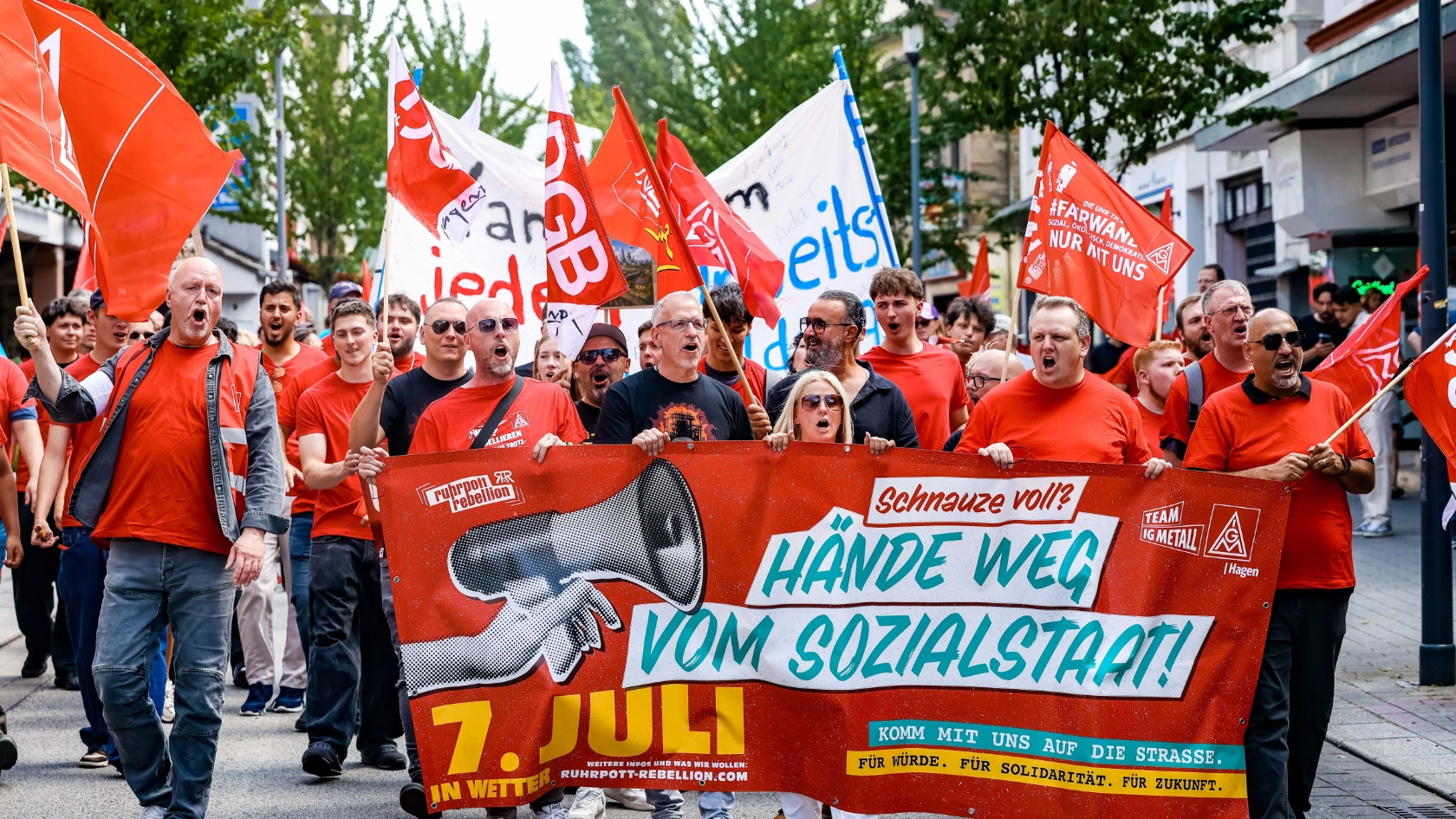
Ruhrpott Rebellion am 07.07.2026
Welfare State September 26: Nationwide Day of Action for Social Policy
Beschäftigter arbeitet an einem Getriebe in einer Fabrik
Working Hours Why working longer doesn’t help—and actually does more harm than good
Ein männlicher Land- & Baumaschinenmechatroniker prüft einen Traktor mit einem Tablet
2026 Collective Bargaining Agreement for the Metalworking and Agricultural Engineering Sectors Greater Flexibility in the Metalworking and Agricultural Engineering Sectors in Lower Saxony and Bremen
Elektronikerin prüft die Spannung an einem Schaltschrank.
2026 Collective Bargaining Round for the Electrical Trades Wage Increase in the Electrical Trades in Berlin-Brandenburg
Benjamin Heine ist Mitarbeiter der BMA in Braunschweig
2026 Collective Bargaining Round for Metal Fabrication and Precision Engineering Higher Wages in the Metal Fabrication and Precision Engineering Sectors in Southwest Germany
Metall-Arbeiter beim Schleifen
2026 Collective Bargaining Round for the Metalworking Trade Employees in the Berlin-Brandenburg metalworking sector will receive higher pay
Beschäftigte von Thyssenkrupp demonstrieren in Essen am 23. Mai 2024 gegen das Vorgehen der Geschäftsführung beim geplanten Teilverkauf des Unternehmens.
Defend the welfare state All dates for nationwide actions against cuts to social services
IGM Aktion VW Wolfsburg
On September 21, things will get loud Nationwide Day of Action: Auto Industry Workers Fight Back Against Mass Layoffs
Auszubildender in einer Schreinerei
Apprenticeship Wages Questions and Answers About Apprenticeship Wages

Subscribe to the newsletter