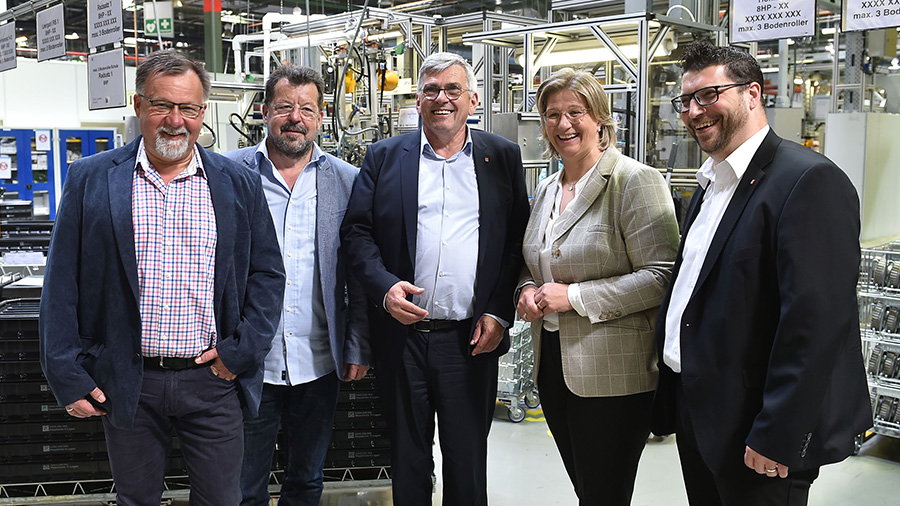
In good spirits during the plant tour: Jörg Hofmann, President of IG Metall (center), together with (from left to right): Mario Kläs, Vice Chair of the ZF Saarbrücken Works Council; Matthias Scherer, Chair of the ZF Saarbrücken Works Council; Anke Rehlinger, Saarland Minister of Economy, Labor, Energy, and Transportation; and Patrick Selzer, Chief Representative of IG Metall Saarbrücken. (Photo: BeckerBredel)
Employees and Companies Face Profound Change
The goal is ambitious: According to the company’s plans, 80 percent of the transmissions manufactured in Saarbrücken are to be hybrid variants within just ten years. “We currently produce around 2.5 million transmissions a year,” says Matthias Scherer, “which shows that the transition will require an enormous amount of effort.” The 8,500 employees currently working at the site are facing a profound transformation.
Jörg Hofmann wanted to get a firsthand look at what this transformation looks like, what it means, and above all, how it can be shaped in the best interests of the employees. “The company is investing in the future and has developed a new, promising product in its hybrid transmission,” said the First Chairman during his tour of the hybrid assembly line at ZF in Saarbrücken.
Call for Transformation Short-Time Work Benefits
However, this alone is not enough to overcome the challenges. “Job profiles will change significantly, and our colleagues will have to adapt to qualification requirements that are, in some cases, entirely new.” First and foremost, companies are obligated to address this. But policymakers are also called upon to support the transformation process. “An active labor market policy will also be necessary,” said Jörg Hofmann. “This also calls for new instruments, such as a transformation short-time work allowance.”
Shaping Transformation in the Interests of Workers
Political support is essential—because the coming change will be profound. “Society is facing fundamental upheavals,” said the president of IG Metall. The transformation will completely change the way we live and work. “Our goal is to shape the transformation in the interests of workers. And on June 29, thousands of metalworkers will make that clear in a loud and clear voice in front of the Brandenburg Gate,” says Jörg Hofmann, emphasizing: “Technological progress and ecological change must lead to social progress for all.” But in order to shape the future, it is essential to gain a detailed overview of the scope and nature of the change—with the Transformation Atlas, which is currently being compiled in hundreds of companies across Germany, IG Metall aims to identify the upheavals within companies and develop strategies for shaping the change.
At ZF in Saarbrücken—as became clear this morning—they are right in the middle of this process. The contours of the change are already visible. “These upheavals are hitting us twice,” explains Matthias Scherer. “First, there’s the mobility transition, which will lead to major changes for employees. Second, advancing digitalization will fundamentally change processes in the factory.” Both developments have concrete implications for the work of colleagues at the site, and both must be managed: “We must ensure that employees can acquire new skills and develop the competencies required,” says Matthias Scherer.
Employees Must Be Trained
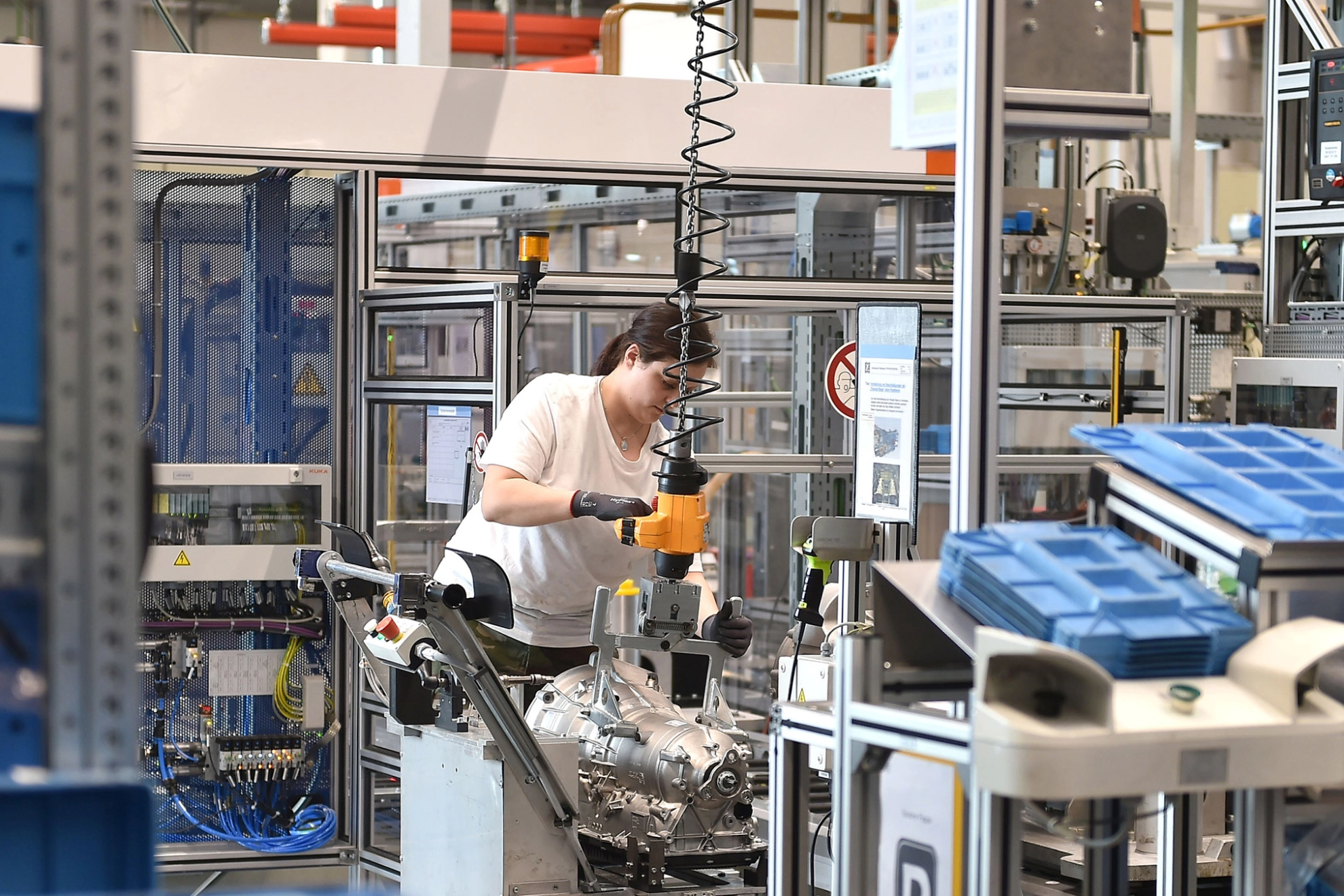
Expanding employees’ qualifications is of fundamental importance—this is the only way to successfully navigate the transition: 4,500 people work in transmission production at ZF in Saarbrücken; the hybrid transmission is currently being manufactured on two assembly lines, and additional assembly lines are already in the planning stages. In the future, the hope and the goal is that nearly the entire workforce will be deployed in the production of hybrid transmissions. However, this means that nearly the entire workforce must be trained for the new production process. “Hybrid engines require more complex assembly work,” says Matthias Scherer. “Our colleagues need to learn how to install the e-modules in the transmission. This creates new qualification requirements.”
Office work will also undergo fundamental changes
These changes won’t just affect employees on the assembly lines. “Digitalization is transforming processes throughout the entire factory, including indirect areas,” says Matthias Scherer. It is foreseeable that tasks in offices and in production-related areas—such as internal transportation—will also undergo fundamental changes in the coming years. “We therefore need forward-looking training concepts for all employees, including those with reduced work capacity, so that no one gets left behind.”
Jörg Hofmann also emphasizes the enormous importance of sustainable training programs. “Initial trends from our Transformation Atlas show that many companies are not even remotely prepared for the transformation,” said the chairman of IG Metall during his plant tour in Saarbrücken. “Companies urgently need to plan more strategically—both in terms of their workforce and their products.”