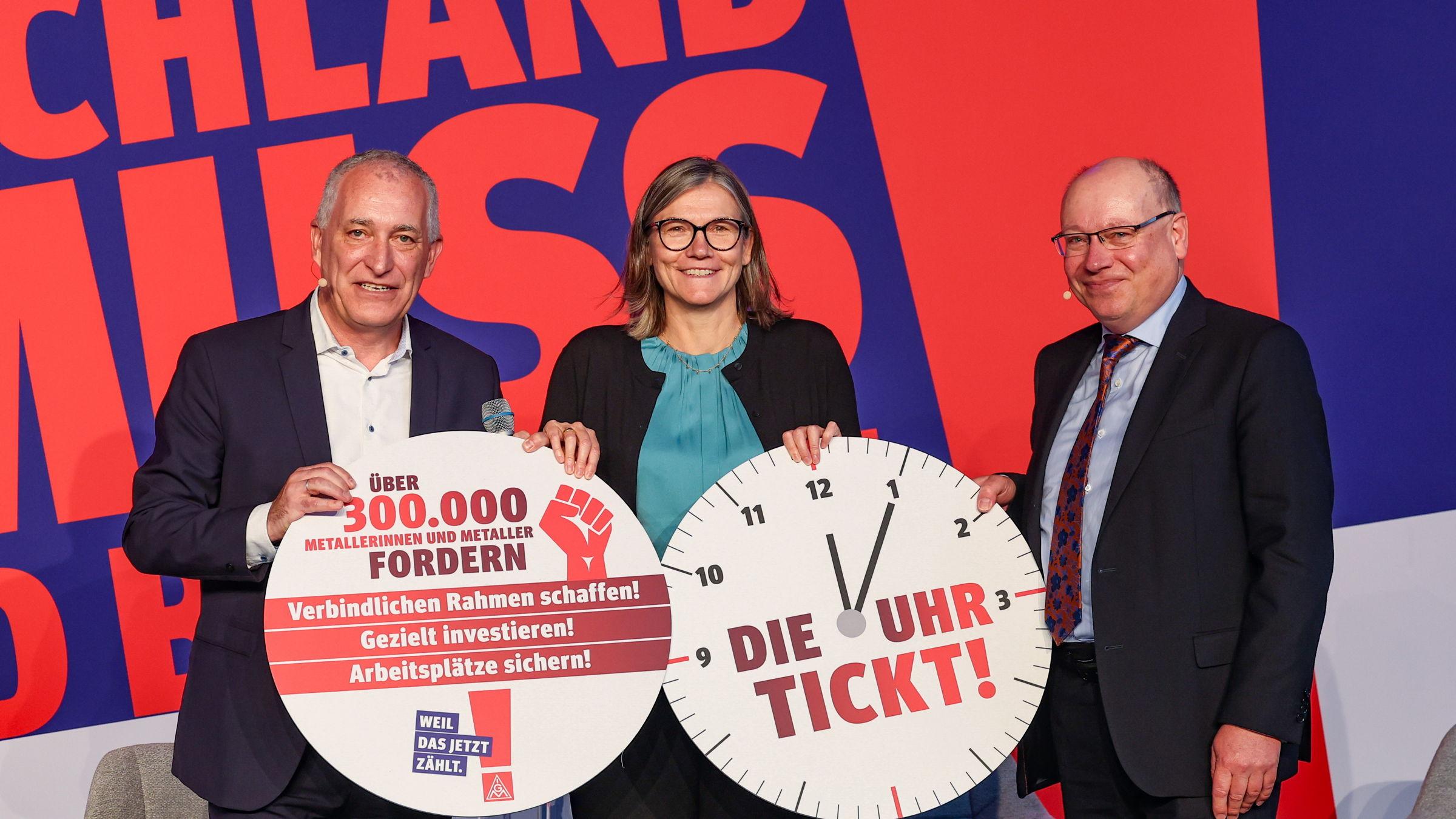
“It’s really five past midnight, so we’re giving you a clock as a gift,” says Christiane Benner, President of IG Metall, as she hands Frank Wetzel, State Secretary at the Federal Ministry for Economic Affairs and Energy, a giant cardboard clock—for the office of the Federal Minister for Economic Affairs. The hands are set to five past twelve. The dial reads: “The clock is ticking.” The clock is accompanied by a petition. Jürgen Kerner, Second Chair of IG Metall, explains what it’s all about: “We’ve collected over 300,000 signatures. We want to preserve this industrial location, and to do that, we need political support.”
From left: Jürgen Kerner, Second Chair of IG Metall; Christiane Benner, First Chair; Frank Wetzel, State Secretary at the Federal Ministry for Economic Affairs and Energy.
The event took place yesterday at the IG Metall industry conference in Berlin and underscores the gravity of the situation: The industrial hub is in danger, with 12,000 industrial jobs currently being cut each month. The federal government must now act quickly; it has failed to address many issues in recent months, and policymakers must now make up for lost time. State Secretary Wetzel promised that he would hand the clock over to Federal Minister of Economics Katherina Reiche. He sees the development of infrastructure, securing raw materials, reforming bureaucracy, ensuring a supply of skilled workers, and improving foreign trade relations as key measures to safeguard industry in Germany. But metalworkers have so far seen little evidence of the announced “Autumn of Reforms.” A petition by IG Metall, which has collected 300,000 signatures, highlights what the federal government must tackle first.
Policy Must Secure Industry and Thus Prosperity
The IG Metall petition is now increasing pressure on the Federal Ministry for Economic Affairs and the federal government. The petition is titled “My Job. Our Industrial Nation. Our Future!” and reminds the federal government of the situation facing workers and the country. As the petition and the metalworkers who signed it emphasize: “We develop machines that move the world. We create technologies that improve our lives. We work hard for the prosperity of this country. That prosperity is in danger. Factories are closing and jobs are being cut. This threatens livelihoods and social cohesion. Politicians have failed to deliver. Companies have missed the boat on change. We’re supposed to pay the price. That cannot be allowed to happen! We are ready to embrace change. But only on one condition: We want a future for all of us.”
Petition calls for: investment and job security
To get this industrial nation back on track, the 300,000 supporters of the IG Metall petition are calling for:
- Our industrial jobs must be secured—in a socially responsible, environmentally sound, and sustainable manner: A strong industry creates prosperity. We demand investments in future-proof jobs, new technologies, and renewable energy. For us, this also means that the government should only contract with and support companies that adhere to collective bargaining agreements, secure employment, and maintain their locations.
- Fair financing—distributing costs equitably: Change comes at a cost. But the burden should be distributed fairly among everyone. We call for higher taxes on the wealthy.
- Security for all—through good jobs and a strong welfare state: No one should be left behind; the welfare state must build bridges. We need secure, decent pensions, fair working hours, and a functioning healthcare system. Education must be promoted, and vocational training and continuing education must be strengthened. This is how we ensure that everyone can actively help shape the future.
The day of action was the first wake-up call
In support of these demands—and thus as a first wake-up call— 81,000 workers took to the streets in five cities during an IG Metall day of action back in March. Additionally, over 300,000 workers signed the petition “My Job. Our Industrial Nation. Our Future!” petition. IG Metall has now presented this to the federal government as a second wake-up call. It is now up to policymakers to implement these demands.
Employers Are Failing to Meet Their Responsibilities
The fact that Germany’s industrial base is in danger is also due to employers. Instead of responding to challenges with courage and investment in future-oriented sectors, they are responding with relocations and job cuts. On the day of action in mid-March, IG Metall therefore lit theflame of solidarity. Over the past few months, several torches have made their way to crisis hotspots throughout Germany. They are intended to urge employers to assume their social responsibility for Germany as a business location. They show both employees and employers that metalworkers stand together. Because that’s what matters now.