Automatic translation
This article has been translated automatically using computer technology. While we strive for accuracy, some wording or details may differ from those in the original article.
This translation was not manually reviewed. For important facts, quotations or legally sensitive information, please consult the German original. Individual selections, images, embedded media or technical terms may have been translated differently or incompletely.

IG Metall’s 11-Point Plan 11-Point Plan for the Future to Preserve Our Industrial Nation

Time is of the essence. To preserve our industrial nation, we must invest—in infrastructure and energy, in the transition to a low-carbon economy, in good jobs, education, and the welfare state. This will require 60 billion euros annually over the next ten years. This is what IG Metall is calling for in its 11-point plan.

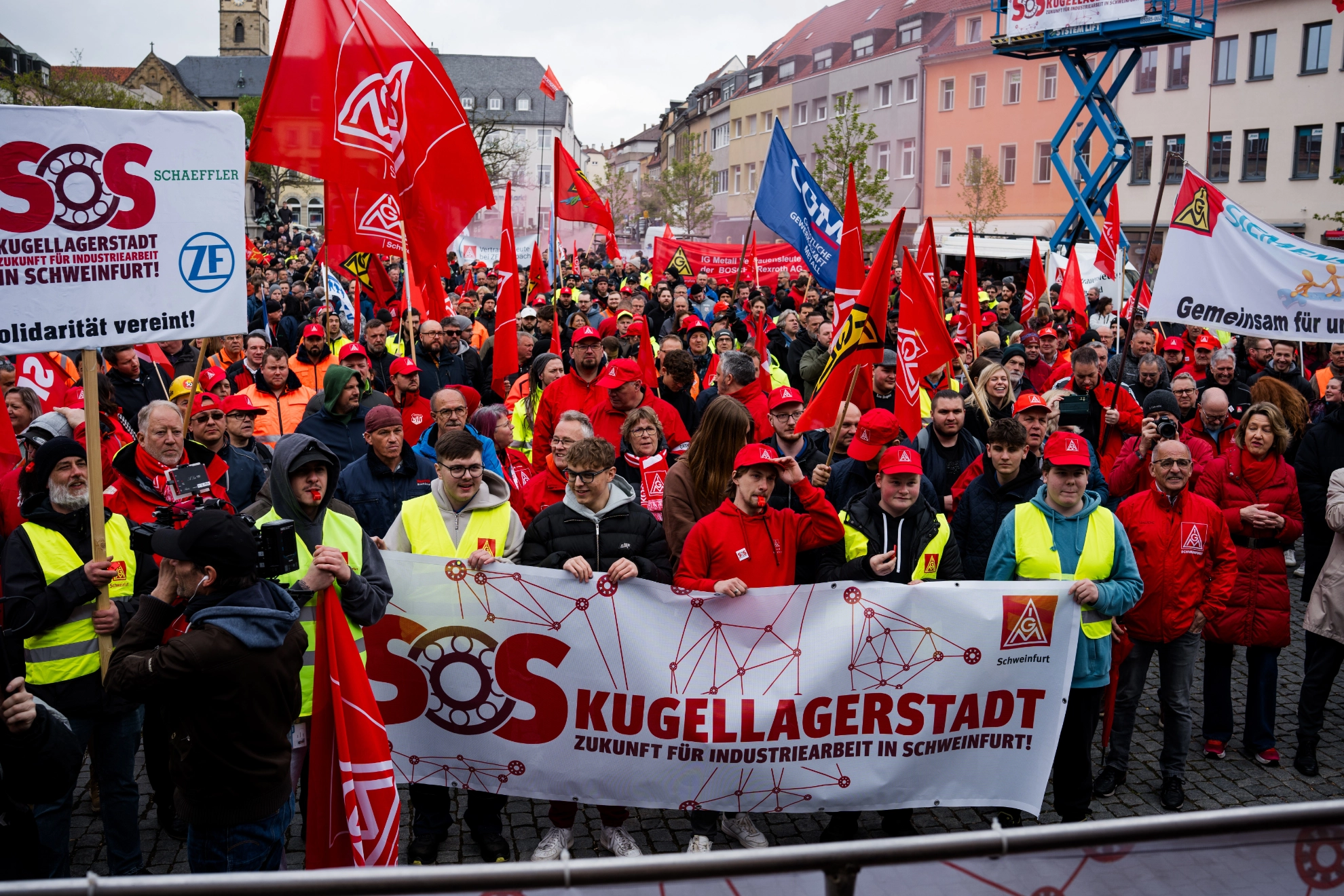
Beschäftigte von ZF, SKF, Bosch, Schaeffler und anderer Betriebe demonstrieren in Schweinfurt für den Erhalt ihrer Standorte.

10 October 2024 10 October 2024


Time is running out. More and more companies are cutting jobs. IG Metall wants to preserve Germany as an industrial nation—and has developed a plan for the future titled:“11 Points for a Modern, Innovative, and Just Industrial Nation.” To preserve our industrial nation, employers must commit to Germany as an industrial hub and invest. But the government must also invest: in energy supply, networks, roads, and railways; in promoting innovation and the production of new technologies; in good jobs and education; and in housing and a strong welfare state.

But that requires money. China and the U.S. are pumping hundreds of billions into their economies—yet Germany is tying its own hands with a debt brake that is unique on the international stage and is increasingly turning into an investment brake. Yet Germany’s debt is comparatively low at around 63 percent of gross domestic product—far less than China’s (89 percent) and the U.S.’s (127 percent). What good is it if we leave future generations with little debt—but in return, even more costly challenges and a country without a modern and competitive industrial sector?
 

Reforming the Debt Brake: Enabling Investment

To enable investment in the future of our industrial nation, IG Metall is calling for investments to be exempted from the debt brake. 60 billion euros should be allocated to infrastructure over the next ten years—and the limit on new borrowing should be raised from 0.35 to 1.5 percent of gross domestic product. And a fair tax system is needed, one that also taxes top incomes and wealth fairly.

IG Metall is not alone in its demands: Business associations and economists are also calling for a reform of the debt brake. The employers-funded German Economic Institute (iw), for example, echoes IG Metall’s callfor “600 milliaden euros for a future-proof economy,”which should be exempt from the debt brake. Over the next ten years, the money is to be invested in renewable energy and grids, public transportation and roads, municipalities and housing, as well as education. “The German economy faces enormous challenges,” says IW Director Michael Hüther. “We now need the courage to move beyond piecemeal solutions and make the country fit for the future.” 
 

IG Metall’s 11 points in detail

We want Germany to remain a successful industrial nation. Our goal: to take the lead in innovation and new technologies. We must shape the transition to a sustainable economy—socially, ecologically, and democratically.

We expect employers to commit to Germany as a business location and to invest here. The government, too, must invest all its resources in this transition. This is how we create lasting prosperity and good, secure jobs—for today and tomorrow. This is how we foster a willingness to embrace the ecological transition. In doing so, we strengthen the foundation of democracy. Employers and policymakers are currently not pursuing this path with the necessary determination.

We want an industry that remains successful. To this end, IG Metall has formulated an 11-point plan.


1. Germany must remain an industrial nation

Preserving Germany as an industrial nation: across the entire value chain. This is where the climate-friendly products and processes of tomorrow are developed.

Industrial goods and services are the heart of the German economy; they guarantee our country’s prosperity. At least one-third of Germany’s gross value added depends directly on industry. Many other sectors in the service industry and skilled trades benefit from a strong industrial sector. Good wages for industrial workers boost purchasing power, with positive effects for the entire economy. These wages didn’t just fall from the sky. Well-organized workforces fought for them—just as they did for many other important cornerstones of modern, good working conditions. We also need industries such as mechanical engineering, chemicals, and steel for the energy transition. This is where the climate-friendly products and processes of tomorrow are developed. This also makes us less dependent on others. For all these reasons, we are joining forces across industry boundaries, along the entire value chain, and across all areas of business—from research and development, through manufacturing, to recycling.

2. Employers must commit to Germany as a business location and to investment

Employers must commit to our locations: No more job cuts, plant closures, or relocations!

Employers’ Commitment to Locations and Investment Is Necessary No more job cuts, relocations, and plant closures. Yes, some conditions need to be improved here. Companies need long-term planning certainty and stable framework conditions that extend beyond the short-term horizon of a single legislative term. But often, employers’ complaints are merely a pretext. Many jobs are also relocated because companies have absurdly high return expectations and pay out high dividends. This ruthless shareholder capitalism destroys jobs and weakens Germany as a business location. Companies, too, must invest in the future: in their employees, green technologies, and new business models. We don’t need a moratorium on new statutory social benefits—we need a pact to secure our business locations. Unions and employers have many effective tools at their disposal to shape this new era! They just need to be put to use. How can we do this more effectively? Through strong co-determination! In Germany and across Europe. Co-determination is both democracy in action and a driver of innovation. We call for more co-determination in workforce planning and job security, for climate protection and equality, and in the introduction of new technologies.

3. Invest today for tomorrow—government investment in infrastructure and innovation

Around 60 billion euros each year, equivalent to about 1.4 percent of GDP: that is how much the German government must invest additionally over the next ten years in public infrastructure alone.

Around 60 billion euros each year—equivalent to about 1.4 percent of GDP—is the additional amount the German government must invest in public infrastructure alone over the next ten years. This is the only way to ensure that railways, energy grids, 5G networks, and charging infrastructure function properly. And this is the only way that digitalization and AI can give our economy the necessary momentum. We need incentives for the production of semiconductors, batteries, and hydrogen; for innovation; for research and development; for the development of leading markets—and for the ecological transition. We want trains that run, not ones that stand still. Our children and grandchildren should learn in modern, well-equipped schools and universities. To achieve all of this, we are calling for substantial seed funding, investment incentives, tax deductions, and reliable framework conditions for a clearly defined transition period. We, too, do not want permanent subsidies. During the transition phase and as key future sectors ramp up, however, support for businesses and consumers is needed—for example, when replacing heating systems, switching from blast furnaces to direct reduction using green hydrogen, or establishing a functioning circular economy. This is part of an intergenerational contract as we understand it: We want to lay the foundation now for a functioning, sustainable economy.

4. More flexibility and fairness in financing—reform of the debt brake and equitable tax distribution

Enough with austerity policies and budget squabbles! The debt brake must be reformed. And we call for a fair tax system that also taxes top earners, investment income, and wealth fairly.

We need a strong government that invests in our future and in the economy. The debt brake has become an investment brake and must, at the very least, be reformed. The key point: investment spending should not be subject to the debt brake at all. Let’s also raise the new debt limit from 0.35% to 1.5% of gross domestic product (GDP)—that alone would create additional fiscal leeway of about 47 billion euros per year. Another option: a special fund for transformation. At the same time, we must ensure that taxes are distributed more fairly and that public revenues increase. Therefore: Make the income tax schedule significantly fairer, with a higher standard deduction and a higher top tax rate—for actual top earners! Income from labor and capital must once again be taxed at the personal income tax rate. And: The wealth tax we propose would generate an additional 28 billion euros annually.

5. Those seeking public funding must follow the rules—public funding only in exchange for collective bargaining agreements, location security, and job security

Make public subsidies conditional! Taxpayer money should only be provided in exchange for collective bargaining agreements, securing business locations and jobs, continuing education, and apprenticeship positions! We need European regulations to ensure higher regional shares of value added.

We want the government to provide targeted support for key products and technologies. However, we do not accept that public funding from our tax dollars is distributed without conditions. We need clear rules: funding only in exchange for adherence to collective bargaining agreements, securing business locations and jobs, continuing education, and apprenticeship positions! It is unacceptable for companies to pocket subsidies and then cut or relocate jobs and invest in other locations. We need reliability and predictability. There are suitable tools for this: forward-looking collective bargaining agreements and company agreements. Only in this way will our tax dollars end up where they belong! About half of all companies are currently underinvesting in their locations. Investments in new production facilities, research centers, or IT often tend to take place abroad. That must change—especially when they receive public funding! We need European regulations to ensure a higher share of regional value creation. To achieve this, European state aid law must also be fundamentally reformed. In regions that are still economically strong today, targeted support must be available to preserve industrial structures.

6. Massively accelerate the mobility transition

Businesses and policymakers must massively accelerate the mobility transition. Enough with the debates over phase-out dates and emission limits! A zigzag course only jeopardizes jobs.

For us, mobility means the best possible combination of cars, buses, trains, and other modes of transportation—both in cities and in rural areas. Of central importance: significantly higher investments in the expansion of public transit and the rail network. We want all modes of transportation to become emission-free. The internal combustion engine is still needed for now; it’s how automakers earn the money to fund the technology of tomorrow. But the future does not belong to it. Endless debates about phase-out dates and emission limits do not help us. On the contrary. Some companies have invested billions in electric mobility. A zigzag course jeopardizes jobs in the industry—and, incidentally, the future of other sectors as well, such as mechanical engineering. Instead, we call on the government and companies to finally create the necessary framework and conditions for the ramp-up of electric mobility! We must not let up now in the German automotive industry’s race to catch up. We need bold, exemplary policies. Affordable electric cars are in demand. During this transition, we also need a purchase incentive for logistics companies when acquiring climate-friendly electric trucks. Taxes on charging electricity must be reduced, and vehicle tax and company car taxation must be more closely aligned with CO2 emissions. We want low-income households to also receive support for leasing electric cars. All government incentive measures must, as a matter of principle, apply to all brands—but only to models that are manufactured largely in Europe. And we need charging stations—especially fast-charging stations—at all gas stations, in city centers, in underground parking garages, at residential buildings, at workplaces, and at retail locations—now! Throughout Europe.

7. Tackle the energy transition with determination – ease the burden on energy-intensive companies

We must accelerate the expansion of renewable energy, consistently drive forward hydrogen production, and provide greater relief to energy-intensive businesses during the transition—through a capped industrial electricity price.

The energy price shock triggered by Russia’s attack on Ukraine has had a profound impact. Since February 2022, production in energy-intensive industries has fallen by nearly 20 percent. The relief measures taken so far are not enough. While energy prices have fallen again recently, they were already too high even before the war against Ukraine—especially by international standards. And there is no reliable guarantee that they won’t spike again. This uncertainty is toxic for investment. We need a capped industrial electricity price of 5 cents per kilowatt-hour for energy-intensive industries. We need this regulation as a stopgap measure until sufficient affordable electricity from renewable energy sources is available. This is the only way we can keep key value chains in Germany and Europe. With the urgent expansion of the power grid, grid fees will rise enormously in the coming years. We need government solutions here as well. The electricity tax should also be permanently reduced to the European minimum. This will also benefit small and medium-sized enterprises and consumers. At the same time, renewable energy must be expanded even more rapidly. The ramp-up of hydrogen production, including the necessary infrastructure, must be ensured. Another essential prerequisite for the energy and mobility transition is the sustainable securing of raw materials.

8. Working toward a better climate requires skilled workers – Promoting education and training

If we want to attract skilled workers, we must offer good working conditions. Our solutions: collective bargaining agreements, training and continuing education, and equality for women and people with a migration background.

Anyone who wants renewable energy, pollution-free mobility, and environmentally friendly housing needs skilled workers: electrical engineers as well as IT specialists and, of course, tradespeople who can install and repair photovoltaic systems and heat pumps. The most effective way to attract skilled workers is through good jobs: collective bargaining agreements, fair pay, family-friendly work schedules, investments in training and continuing education, and occupational health and safety. We also call for part-time educational leave that our colleagues can use to prepare themselves for the challenges of tomorrow. For skilled workers from abroad, we need pragmatic, unbureaucratic, and attractive regulations. The potential of women must be recognized and harnessed. Once they step away from full-time work, far too many get stuck in part-time positions. Parental leave and caregiving responsibilities must not be barriers to re-entering the workforce or advancing one’s career. That is why we must do everything we can to facilitate a smooth return to work after such periods: through a right to return from part-time to full-time work, better career development opportunities, pay equity, and comprehensive, reliable child care. Young families want to live and work differently. For the climate transition to succeed, we need more young people to complete dual vocational training programs. To attract more of them, we need attractive opportunities. This includes a substantial increase in apprenticeship wages, as well as investments in vocational schools and dormitories for apprentices. We call for guaranteeing vocational training for all young people and strengthening on-the-job training. Career counseling—especially at secondary schools—must not be left to chance or to well-funded lobby groups; it must be systematically organized by local employment agencies and the youth career agencies, which need to be further expanded.

9. Strengthen employment and training in the region

We do not want people to have to chase after jobs. We are fighting for a future for all regions in Germany.

We do not want people to have to chase after jobs. We demand a future for all regions in Germany. This is where workers live and work. This is where they have their homes with their families, their friends, and their community life. That is why IG Metall is actively involved locally, in the regions—for example, in regional transformation networks and continuing education consortia. We also provide concrete support to our colleagues through in-house continuing education mentors. We are fighting to secure employment in the local area. Where there are no prospects within a company, we work on solutions within the region. Employers and the government must also take action here: facilitating fair transitions to other companies, matching skilled workers with suitable jobs (skilled worker matching), and making it easier to change career paths. The potential of so-called “labor hubs” and similar tools should be explored. Local governments need greater financial flexibility to shape structural change on the ground. In addition, advisory services for works councils must be expanded. Far too often, small and medium-sized enterprises in particular still lack the necessary expertise to develop the products and processes of tomorrow and manufacture them on an industrial scale—for example, in battery cell production. Competence and innovation networks for small and medium-sized enterprises must be established and supported.

10. Less bureaucracy—but done right!

Less bureaucracy—sure! Faster planning and approval processes—of course! But keep your hands off working hours and the Supply Chain Act.

We want wind turbines to be installed more quickly and power lines to be laid faster. We urgently need to further accelerate planning and approval procedures. How can this be done? By ensuring sufficient staffing in the right places, digitizing and modernizing the administration, and eliminating duplicate and multiple inspections. All levels must be taken into account: the federal government, the states, and the municipalities. Rules and responsibilities must be better aligned with one another. But anyone who, under the appealing slogan of “reducing bureaucracy,” wants to undermine the Working Hours Act or suspend the Supply Chain Act will face our resolute resistance! No blood must be spilled over T-shirts, lithium, or wiring harnesses!

11. Prevent social cutbacks – For a strong and future-proof welfare state

IG Metall will accept neither the abolition of the full pension after 45 years of insurance contributions nor a moratorium on new social benefits. The welfare state is an anchor of stability and a bridge-builder—not a burdensome cost factor.

Currently, the public debate on strengthening the economy is off track. While we are calling for investments in our country’s future, parties such as the FDP—most recently—are pushing for austerity measures, drastic social cuts, or longer working hours. We will accept neither the abolition of the full pension after 45 years of insurance contributions nor a three-year freeze on all new social benefits. Especially in times of upheaval, people need security. Support for the ecological transition will only materialize if workers do not have to fear for their jobs and their social security. Pensions must safeguard living standards and prevent poverty in old age. Care in the event of illness or the need for long-term care must not be a luxury reserved for the wealthy. It is fair for those with greater means to shoulder more of the burden, especially in challenging times. Specifically: Top earners and the ultra-wealthy must contribute their fair share. Everyone should pay into social security. Only by sharing the burden fairly can we strengthen our democracy.


11 Punkte für ein modernes, innovatives und gerechtes Industrieland

11 Punkte für ein modernes, innovatives und gerechtes Industrieland

New on igmetall.de

Subscribe to the newsletter










