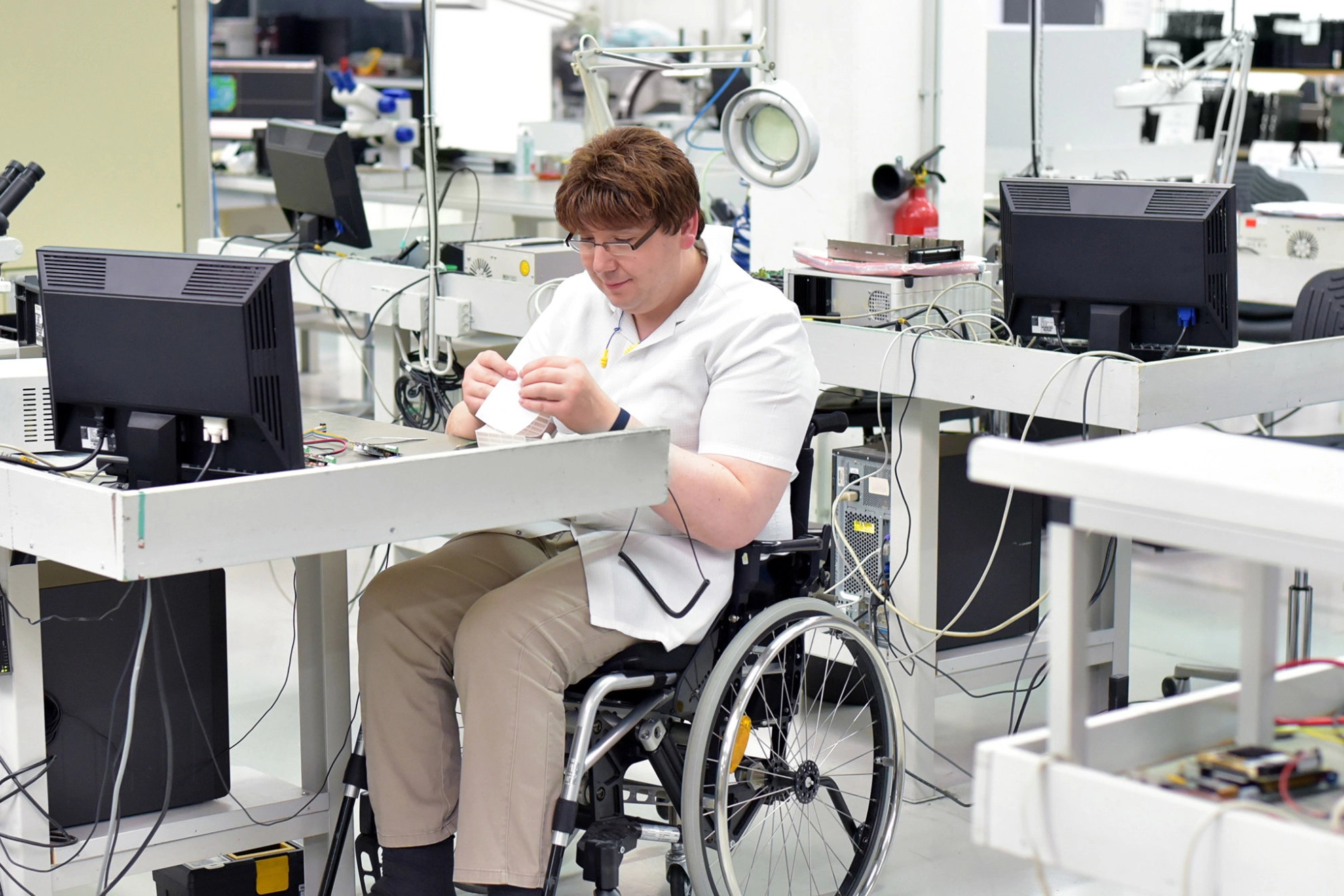
When the new class of apprentices begins their careers at Audi this fall, nine young people with severe disabilities will be among them. Among them are two visually impaired young people who have only 15 percent of their vision remaining. There is also a deaf young woman. And finally, a young man who uses a wheelchair and has spastic paralysis. “We’ve never had this before,” explains Rupert Klinger, chair of the representative body for employees with severe disabilities at Audi. The young colleague in a wheelchair will have an assistant with him during exams at vocational school so that he can dictate his answers to someone.
Vocational training for people with severe disabilities at the renowned automaker in Ingolstadt or at the plant in Neckarsulm—“it works,” says Klinger. The company places great importance on fulfilling its obligations and providing vocational training to a sufficient number of young people with health impairments. “We’re fortunate to have an executive board that stays on top of this issue,” explains Klinger. There’s a clear directive from the top: At least eight young people with severe disabilities should begin their apprenticeships at Audi each year. In addition, there are young people with severe disabilities who are completing a vocational support year. The apprenticeship programs cover a wide range of fields: industrial business administrator, toolmaker, office communications specialist, production mechanic, and warehouse logistics specialist.
Apprenticeship positions at Audi are highly sought after
“Wherever we see a chance that the young people will pass the exam, that’s where we hire them,” explains Klinger, the representative for people with severe disabilities. It is, in fact, an absolute exception for these young colleagues to fail to complete their training. Word has clearly spread about the favorable conditions at Audi. The automaker receives plenty of applications—most recently, there were 40, of which 25 were invited to an interview. Twelve were offered an apprenticeship, three of whom subsequently declined. The applicants come from all over Germany. Other automakers, on the other hand, have trouble finding enough applicants with severe disabilities. “They scour the vocational rehabilitation centers in search of young people,” says Klinger. Often without success.
Audi’s representative for people with severe disabilities takes a critical view of vocational rehabilitation centers. These centers are getting bigger and bigger, he notes, and yet they actually receive government funding to integrate young people with severe disabilities into the primary labor market. But that often doesn’t work. “Many apprentices get stuck there,” he says. “They end up working for a minimal wage.” Those who, on the other hand, complete an apprenticeship at a regular industrial company, “have a completely different sense of self-worth,” says Klinger. Especially since apprentices at Audi receive a 100% guarantee of permanent employment.
Taking a Critical Look at Vocational Training Agencies
Klinger believes that lawmakers should put a stop to the practices of vocational rehabilitation centers. After all, training is also possible in a regular industrial company—Audi is leading the way. Workstations for the new apprentices starting in September are currently being set up. For the visually impaired new colleagues, for example, special computer workstations with magnifying screens are being provided.
“Ultimately, all employees benefit when people with severe disabilities are hired,” explains Klinger. It’s “always a good thing when someone in a wheelchair joins the company,” he says. “That’s when you really see what’s not right.” After all, the apprentices make their way through the entire plant. If the workstations are then modified to be accessible for people with disabilities, “that benefits the company and, ultimately, the other colleagues as well.” A fully automatic door or a ramp—such changes are particularly helpful for older employees.