The day that changed Thilo’s life forever in the blink of an eye—the day when nothing was ever the same again—was a Tuesday in March. It was shortly after 6 p.m., and it was still light out. Thilo, then 17 years old, was riding his motorcycle home—when, at an intersection, it happened: A driver trying to turn left fails to see him and cuts him off. “He just drove off,” says Thilo. Emergency responders arrive quickly; Thilo is loaded into an ambulance, given strong painkillers on the way, and undergoes surgery at the hospital.
When he wakes up, he feels weak and his leg hurts, but Thilo tells the chief physician that he has to go to work on Friday. He has an important appointment that day. Half a year earlier, in September 2010, Thilo had started his apprenticeship as a mechatronics technician at the Daimler plant in Berlin-Marienfelde. When he wakes up after the surgery, he has no idea that he won’t be able to make it to that appointment at his training site. That he is only at the very beginning of a long, painful journey.
A lot of time has passed
To this day, seven years after the accident, the 24-year-old has had to endure numerous surgeries; he spent a total of nearly seven months in the hospital, was in rehab for half a year, and has been unable to work for a total of three and a half years. “At first, I didn’t realize just how drastic what had happened to me was. But little by little, I realized that I couldn’t just jump right back into my apprenticeship.” Weeks passed, months passed, without Thilo being able to return to his apprenticeship as a mechatronics technician. In February 2014, the standard apprenticeship period ended. “The fact that I’m working at Daimler today as a machining technician is also thanks to the tremendous dedication of Manuela Enslen, the representative for people with severe disabilities.”
Manuela Enslen, the representative for people with severe disabilities at the Daimler site in Marienfelde, advised Thilo after his apprenticeship ended to reapply to Daimler—but for a different apprenticeship as a machining technician, one better suited to him, since that role does not involve machine maintenance. Thilo won’t have to kneel or squat, since he is no longer able to do so following the accident.
A New Apprenticeship Position
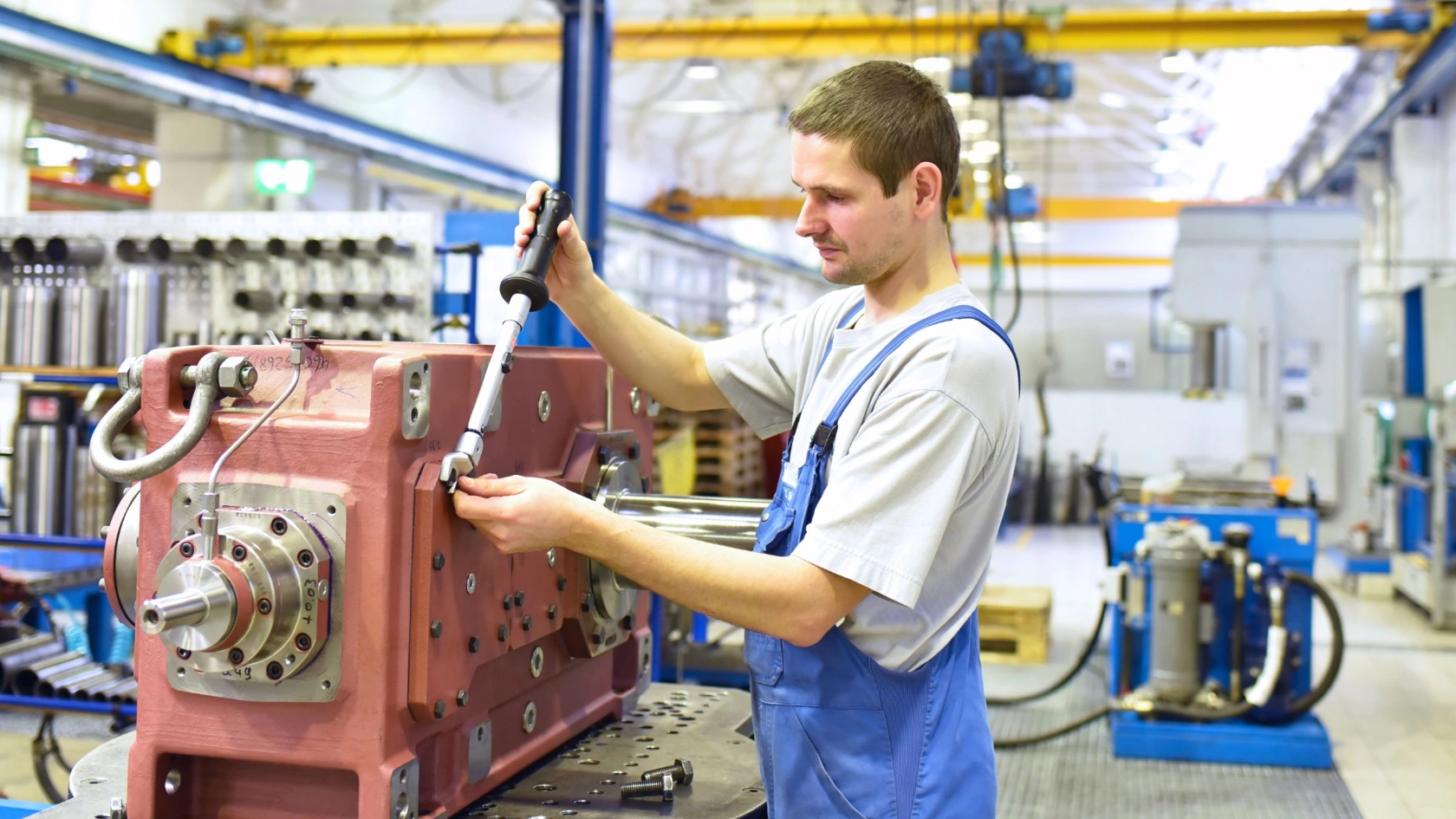
The SBV must be involved in the selection process for every severely disabled applicant. Manuela Enslen advocates strongly on Thilo’s behalf. Her efforts are successful: Thilo is offered a new apprenticeship contract. In the fall of 2014, Thilo begins his apprenticeship. The SBV and his apprenticeship supervisor ensure that he receives special, custom-made safety shoes. At the end of January of this year, Thilo successfully completes his apprenticeship and is subsequently offered a permanent employment contract. Today, Thilo works in small-batch production for oil pumps. He receives support there as well. Care is taken to ensure that he does not stand for more than half of the workday. A sit-to-stand aid was specially ordered for him for this purpose.
That day in March seven years ago changed Thilo’s life in an instant. He has had to live with the pain and motor limitations ever since, and he doesn’t manage it equally well every day. “I’m happy and grateful that I was able to start another apprenticeship at Daimler and now have a secure job,” says Thilo.
Carsten Kremling
He can still remember the shock he felt upon waking up—that split second when, in the fog of half-sleep, the realization suddenly hit him: I can no longer move the right side of my body. I have no feeling in my arm or my leg. “That was brutal,” says Carsten Kremling now, nine years after that morning that changed everything—a turning point, a watershed moment. Carsten was taken to the hospital; the doctors suspected a stroke, but that wasn’t it: Carsten Kremling, then 42 years old, receives a different diagnosis: He has multiple sclerosis, a neurological disease that is incurable, that occurs in relapses, and whose course is unpredictable. “Of course it’s stressful,” says Carsten Kremling. “That’s exactly why a supportive work environment is so important to me.”
At his company, Ilsenburger Grobblech, Carsten Kremling has found just that: solid structures that provide him with stability. A work environment tailored to his needs. This was driven and made possible by Olaf Schmiedeck, the liaison for people with severe disabilities at the site. “Without the SBV’s commitment, it wouldn’t have been possible.”
Optimal Integration Management
And a lot has been achieved. A few months before the onset of his illness, in late 2008, Carsten Kremling’s former employer, Ilsenburger Maschinenbau—where he had worked in maintenance—closed down. Carsten joined Ilsenburger Grobblech as a temporary worker in January 2009. He was initially assigned to materials testing and later worked in the cutting shop. In May 2012, he was hired permanently. This was an important step, as it provided long-term job security. And now the SBV is once again stepping up its efforts to reduce the stresses Carsten is exposed to and to create a work environment tailored to his needs. “My coworkers really pushed to get me out of the 5-shift rotation,” says Carsten. “The night shifts, in particular, took a heavy toll on me—I wouldn’t have been able to handle that in the long run.”
Carsten is leaving the distillery; the work there is too strenuous. Although the medication Carsten takes is working well, he still finds himself on sick leave for extended periods from time to time. For the past two years, Carsten has been working as a pallet driver in the shipping department, alternating between the early and late shifts—a schedule he can handle physically just fine. “The SBV has supported me well all these years; they were present at all the meetings regarding workplace integration management. That helped me a lot.”
Joining the SBV
Carsten is now actively involved in the SBV himself. Since 2014, he has served as a deputy on the SBV committee; of the 700 employees at the site, there are 53 colleagues with severe disabilities whom they support. They are currently negotiating a work-from-home arrangement for a colleague who suffers from severe rheumatism, which will allow her to work from home at least two days a week. “We’re optimistic that we’ll pull this off; we’re putting all our energy into it,” says Carsten, for whom this commitment is a matter close to his heart: “I know from my own experience how important it is for colleagues to have a strong SBV at work.”