Under the Federal Ministry of Labor’s new COVID-19 Occupational Safety and Health Regulation, employers must increasingly offer the option to work from home. The regulation, which is valid until March 15, 2021, supplements the existing requirements set forth in the SARS-CoV-2 Occupational Safety and Health Standard and the SARS-CoV-2 Occupational Safety and Health Rule.
The risk of contracting the coronavirus remains, and the danger of developing the lung disease COVID-19—even in the workplace—is very high. It is therefore essential to minimize the risk of infection and protect the health of coworkers.
Many companies are succeeding in this—but it doesn’t happen on its own. It is to the credit and success of those involved in the workplace that they have consistently promoted effective protective measures, negotiated appropriate agreements, and implemented a wide range of measures for effective health and infection protection.
Specific Recommendations for Action
To support workplace stakeholders, IG Metall developed a detailed“Guide to COVID-19 Prevention in the Workplace”back in April. The brochure has now been extensively revised, with important points added and updated. The guide outlines tools and measures for workplace prevention and comprehensive health protection, and provides specific recommendations for effective infection control in the workplace.
While protective measures such as social distancing and hygiene rules are now part of everyday work life in companies—and in many cases, a whole range of measures has been implemented—this often happens in the face of sometimes fierce resistance from employers, who all too often disregard the applicable TOP principle when selecting measures. This principle stipulates that there should be a hierarchy of protective measures in the workplace. Technical measures take precedence over organizational measures. Only when comprehensive infection control cannot be achieved through these measures should personal protective measures be considered—such as, for example, the wearing of face masks. The following applies everywhere, in all workplaces: All measures taken must be continuously reviewed and adjusted as necessary.
The basis for this is the binding requirements of the SARS-CoV-2 Occupational Safety Regulation recently issued by the Federal Ministry of Labor and Social Affairs. The regulation specifies the requirements for occupational safety during the COVID-19 pandemic and increases the level of enforceability of the necessary protective measures that employers must implement.
Binding Occupational Safety Regulation
The Occupational Safety Regulation enables works councils to enforce employees’ rights to protection against employers when necessary. Measures for infection control in the workplace include, among other things, technical aspects such as room ventilation, organizational aspects such as the scheduling of work and break times, and working from home. Where technical and organizational measures provide insufficient protection, personal protective measures such as wearing a face covering come into play. In addition to preventive measures, the regulation also includes options for dealing with at-risk groups.
“IG Metall has been a leading advocate for the new SARS-CoV-2 occupational safety regulation,” says Hans-Jürgen Urban, executive board member of IG Metall. “The new guidance document ‘Coronavirus Prevention in the Workplace’ is now available to assist with implementation at the workplace. As a guide to occupational safety and infection control, it offers valuable support for works councils.”
Demanding Co-determination
This is fundamental—because almost everywhere, occupational safety stakeholders face the challenge of implementing protective measures and continuously monitoring their effectiveness. The tools available to the works council in its prevention policy are well known: they are called co-determination and risk assessment. Importantly, in the case of COVID-19, the step of conducting a risk assessment is no longer necessary. The high risk of infection is beyond question. Therefore, companies can immediately begin negotiating preventive measures.
The goal of the workplace prevention policy must be to slow the rate at which infections spread and to protect employees. Since the coronavirus is transmitted primarily through droplet and contact transmission, protective measures to minimize the risk of infection focus on ensuring an adequate safety distance as well as on hygiene measures that minimize the risk of viral transmission via surfaces.
Implementing Measures
The corresponding minimum requirements must be met in the workplace through technical, organizational, and personal protective measures. It is not possible to make a blanket statement about which specific precautions should be taken—this is determined by an assessment of the hazards present on-site.
One thing is clear: Only a combination of measures can guarantee comprehensive and effective protection against infection. It is also clear that even the best measures are of little use if employees have not been sufficiently involved. It is very important to note that special precautions must be taken for employees who belong to a risk group, such as those suffering from cancer or cardiovascular diseases.
When selecting measures, the TOP principle applies. This prioritizes technical measures over organizational ones, followed by personal measures. The following measures are likely to be of particular importance in workplaces:
Selected Technical Measures
- Mark minimum distances at time-clock terminals or turnstiles with floor markings
- Install transparent partitions
- Use additional halls
- Adjust ventilation systems to ensure regular ventilation
- Provide additional tools
Selected organizational measures
- Ensure minimum distances in changing rooms, washrooms, break rooms, and cafeterias
- Decongest internal traffic routes
- Redesign production workflows so that the minimum distance between employees can be maintained
- Modify office workflows; agree on alternating work-from-home arrangements
- Agree on staggered work schedules and breaks
Selected personal measures
- Check for possible symptoms before starting work
- Avoid crowds on public transportation as much as possible when commuting to and from work; use a car, bicycle, or the company shuttle, where social distancing rules are followed
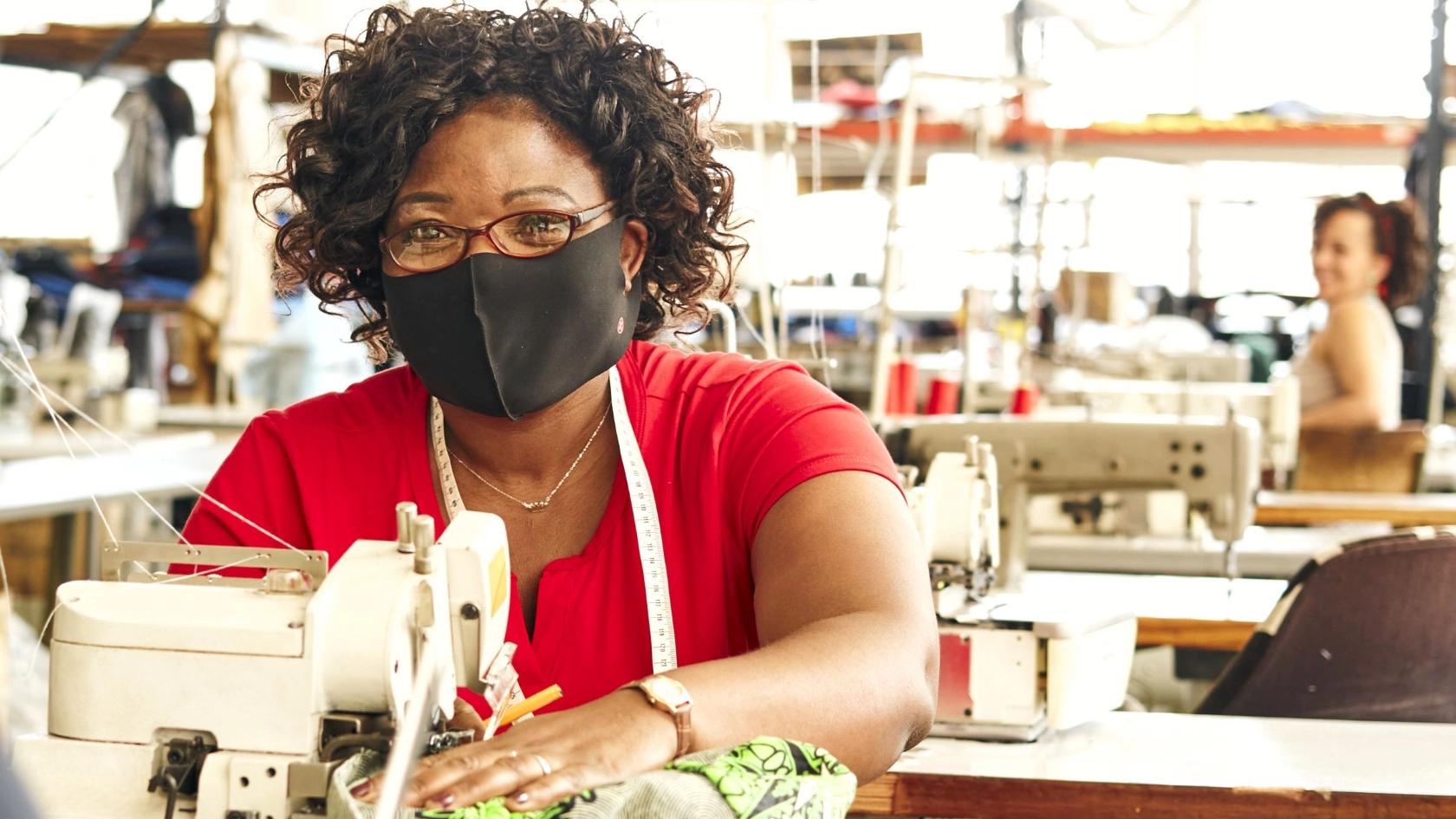
- Wear a face mask or personal protective equipment as needed
- Practice good hand hygiene
FAQ on the New COVID-19 Occupational Safety and Health Regulation
IG Metall’s Guide to COVID-19 Prevention in the Workplace (PDF, 46 pages)
COVID-19 Prevention in the Workplace: Key Points at a Glance (PDF, 2 pages)