The past two years have seen rapid growth. Supplier companies employ around 800,000 people at their German plants. That’s the highest level in 25 years. “But it would be naive to believe that this will continue indefinitely without any action on our part,” says Jörg Hofmann, Second Chairman of IG Metall, in an interview with the “Leipziger Volkszeitung.” The entire industry is in the midst of a major transformation, and according to Hofmann, companies are doing far too little to prepare themselves for new technologies and Industry 4.0 in the future .
The structural transformation of the automotive industry and the challenges it poses—including the “contract manufacturing business model”—are currently the focus of discussion among IG Metall works council members at manufacturers and suppliers in Leipzig. The choice of venue is no coincidence. “Leipzig is now the fourth-largest automotive hub in Germany, alongside Wolfsburg, Stuttgart, and Munich—and certainly the most dynamic,” says Jörg Hofmann. The main players there are BMW and Porsche. BMW operates Germany’s most modern car factory in Leipzig. Temporary agency work and work contracts played a central role in the planning of the East German site from the very beginning. The Bavarian automaker employs 3,800 permanent workers, 1,000 temporary agency workers, and 4,000 work contract employees in Leipzig.
Contract Service Partners at BMW
A BMW from Leipzig, for example, is developed largely by engineers from the service provider Aton. Employees of Rudolph Automotive Logistik supply the body shop with all raw materials, load and unload the press, and deliver parts right to the production line. Thyssen-Krupp employees assemble the front axles, which are delivered by temporary workers from the company WISAG. The company HQM installs doors and assembles engines and starters. The speedometers are calibrated and certified by the service provider Trescal.
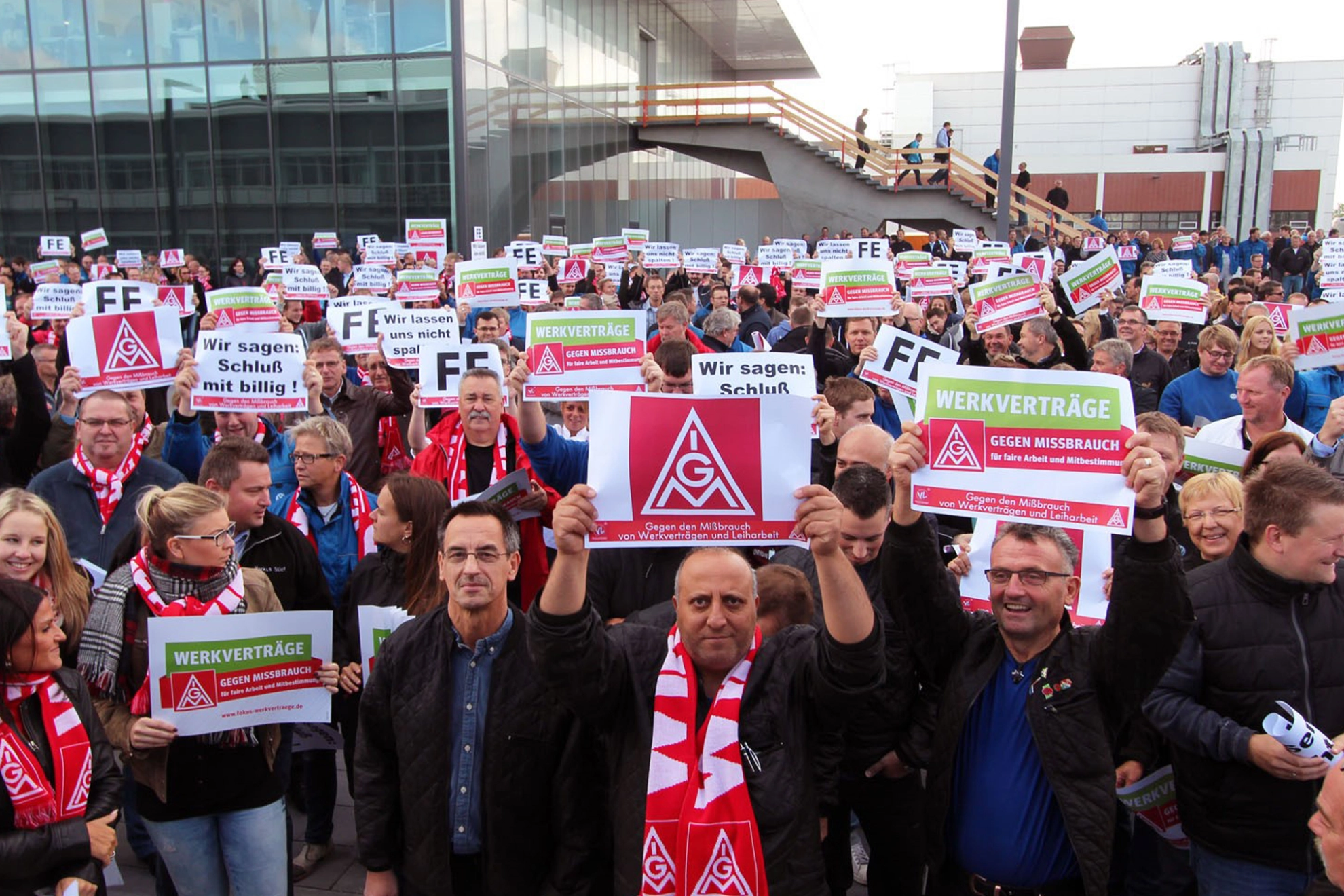
All of these companies are contract partners of BMW and are located on the factory grounds. According to IG Metall, these firms are production-related service providers that perform work that is part of an automaker’s production process. The union has now secured collective bargaining agreements for the affected employees that provide them with significant wage increases and, in some cases, shorter working hours. Previously, they were paid according to the less favorable logistics collective bargaining agreements.
More than a third of the work in automotive production is carried out by outside contractors; in assembly, the figure is 28 percent; and in research, development, and engineering, it is nearly one-fifth. These are primarily contract logistics providers, facility management firms, and development service providers that, under service contracts, take on work from the manufacturers’ core business. Service employees often work side by side with permanent staff, performing the same tasks—but under significantly worse conditions.
Right in the Middle, Yet Left Out
Jörg Hofmann considers the collective bargaining agreements for the contract service providers on the BMW campus to be a pioneering step. IG Metall aims to ensure that service providers, who generate a significant portion of the industrial value added for BMW and Porsche in Leipzig, are subject to a collective bargaining agreement with IG Metall. “It is unacceptable for automakers to award subcontracts that are part of the automotive industry’s value creation—and whose employees often even work side by side with their colleagues from the automakers on the factory floor—yet these colleagues are paid significantly less. We are taking action against this,” said the second chair of IG Metall.
In general, there is much room for improvement when it comes to subcontracting. IG Metall’s primary goal is to keep jobs within the company. Only where that is not possible does it seek to ensure fair conditions for employees at subcontracting firms. From Jörg Hofmann’s perspective, this addresses a fundamental flaw in corporate strategies that prioritize short-term profit over the long-term preservation of know-how and core competencies.
“Employers shouldn’t think they can use outsourcing to lower wages and working conditions without resistance and evade IG Metall’s jurisdiction,” says Hofmann. For IG Metall, the right to fair conditions doesn’t end with the manufacturers. It applies to the entire value chain across its industries. That means equal rights, co-determination, and collective bargaining agreements for employees at contract manufacturing firms.
At BMW and Porsche in Leipzig, IG Metall was able to chart a positive course together with the employees. Against the backdrop of the debate over collective bargaining unity , IG Metall offers automakers, suppliers, and industrial service providers a collective bargaining framework and, with it, long-term security and reliability. When manufacturers and suppliers work together as partners, they have a chance to successfully navigate structural change.