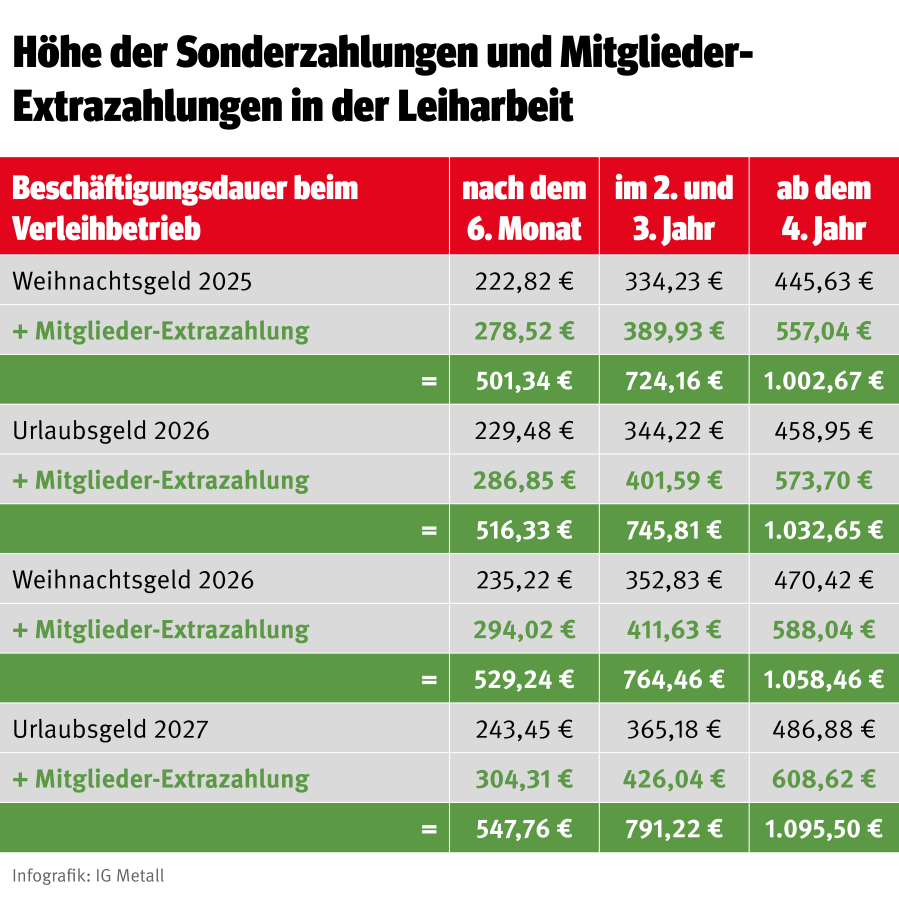
In collective bargaining negotiations over the past fourteen years, IG Metall has secured a number of improvements for temporary agency workers . These include a significant increase in wages, including through so-called industry-specific surcharges. Temporary workers also receive special payments such as increased Christmas and vacation bonuses. Exclusively for our members, there is also an extra payment of at least 286.85 euros twice a year through the “Member Benefit” program. Vacation entitlement has also been increased to up to 30 days per year.
We at IG Metall and the DGB unions were able to achieve this because there are so many of us. As a member, you not only secure the exclusive “Member Benefit,” but you also strengthen IG Metall for collective bargaining rounds. Only a strong IG Metall can secure strong collective bargaining outcomes. If you’re not a member yet—find out more here.
Higher Wages
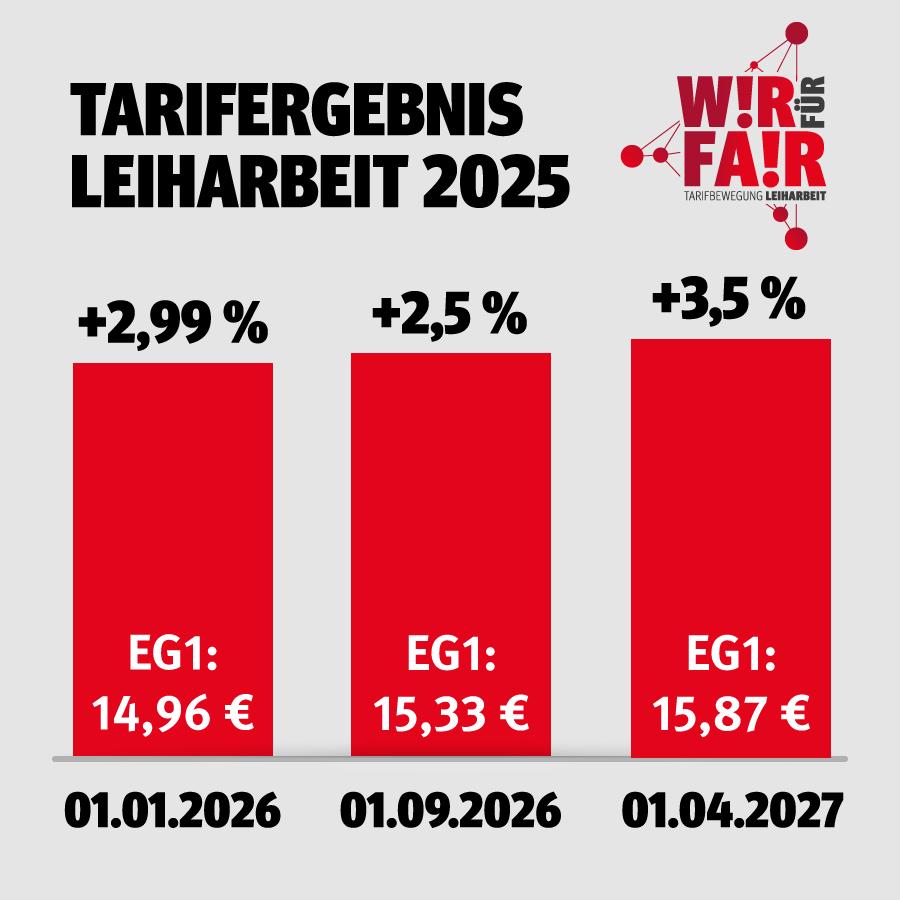
The hourly wage for pay grade 1 (EG 1)—which is also the minimum wage for temporary agency workers—rose from 7.01 euros (in eastern Germany) to 14.96 euros (effective January 1, 2026). That’s an increase of 113.41 percent over fourteen years and corresponds to an average annual wage increase of up to 8.1 percent. And wages will continue to rise in the future as a result of the current collective bargaining agreement: by 2.5 percent as of September 1, 2026, and by an additional 3.5 percent as of April 1, 2027. In 2021, the East-West wage equalization was also completed; since then, a uniform wage scale has applied to temporary agency workers nationwide.
Industry-Specific Surcharges
In addition, there are industry surcharges. These apply during assignments in the metal and electrical industries, the wood and plastics industries, and the textile and apparel industries. This means temporary agency workers earn more—and since fall 2023, this has even applied starting from the very first day of their assignment. The supplements are tiered according to the duration of employment at the client company. As a result, the hourly wages for EG 1 temporary workers assigned to the metal and electrical industry rose from 10.52 euros to 24.68 euros at the highest level of the industry supplements. Here, the increase is even greater at 134.6 percent, or 9.61 percent annually on a calculated basis. In addition, an improvement was achieved in 2025 regarding the so-called “cap” for assignments in the metal and electrical industries. As a result, temporary workers assigned to this sector will receive more money per hour in the fifth bonus tier (after nine months of assignment) going forward.
Special Payments and Member Benefits
Through DGB collective bargaining agreements, temporary agency workers also receive vacation and Christmas bonuses. The exact amount for temporary agency workers depends on their individual length of employment with the staffing agency. Starting in 2021, these annual special payments have increased significantly. Since 2024, the increase has been linked to wage growth; thus, with every wage increase, vacation and Christmas bonuses also rise.
This also applies to the member benefit paid since 2021: Members of DGB unions receive an extra payment in addition to their vacation and Christmas bonuses. Temporary agency workers can receive over 1,000 euros extra per year, depending on their length of employment with the staffing agency. To receive this, they must submit an application to the staffing agency. Requirements: At least six months of membership and six months of employment with the staffing agency as of the respective cutoff date.
In 2024, temporary agency workers also received an inflation adjustment bonus (IAP) that was exempt from taxes and social security contributions.
Vacation
In addition to the increased pay, vacation entitlement for temporary workers has also been significantly raised since 2021: 25 working days in the first year of employment, 27 working days in the second and third years, and 30 working days starting in the fourth year of employment.
Further Improvements
Last but not least, several improvements were achieved as part of the standardization of theso-called framework collective bargaining agreementin 2025. These include, for example:
- a lower threshold in the time account for the payment of overtime hours (91 hours)
- paid commuting time (calculated based on the distance between the employee’s residence and the work location, and applicable starting at 1 hour and 15 minutes)
- Only pure rest periods, such as unpaid leave, are no longer counted as working hours.