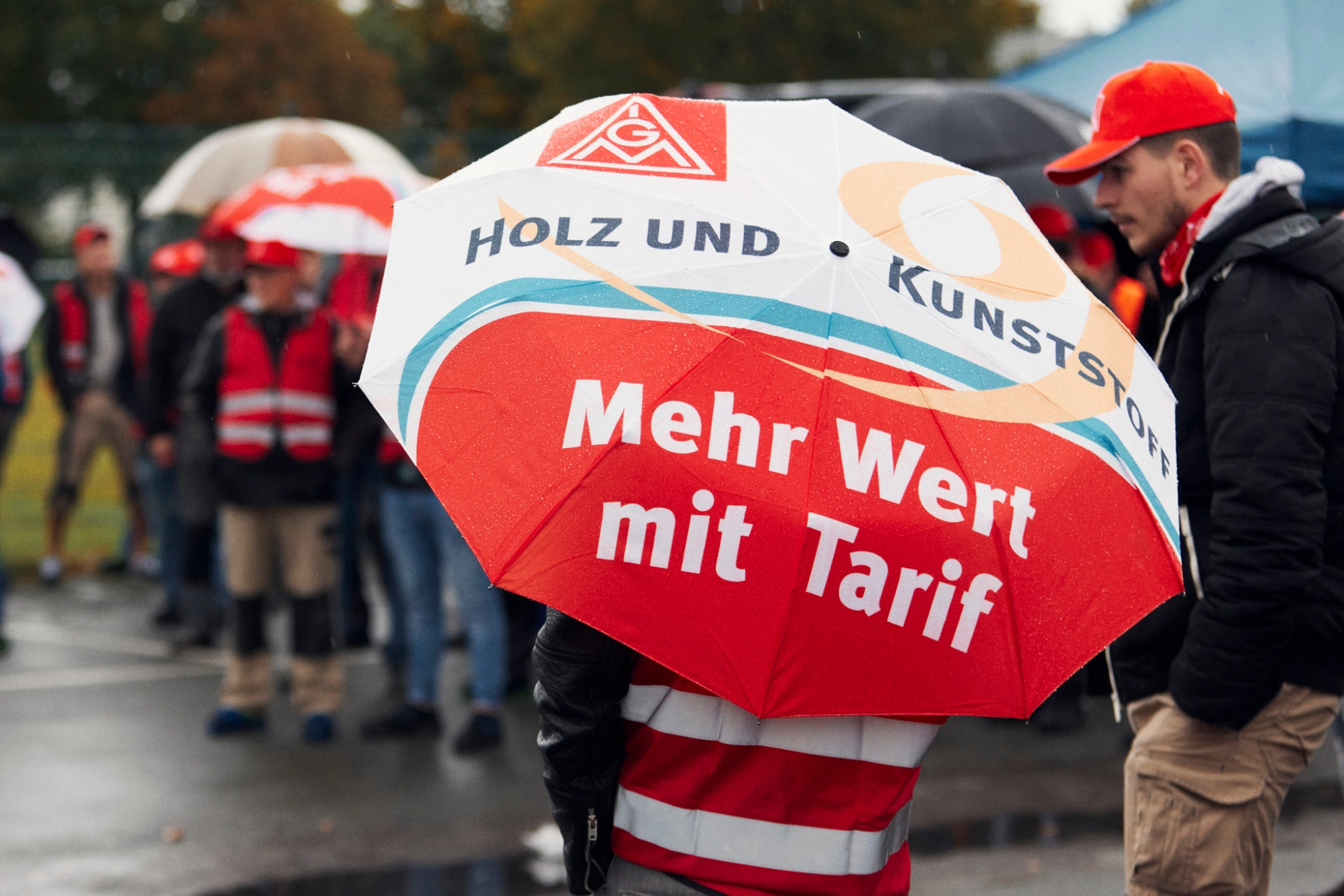
A 595-euro COVID-19 bonus now, a 3 percent pay increase starting in May 2022, and an additional 2.45 percent starting in April 2023. IG Metall negotiated this collective bargaining agreement for Saxony’s wood and plastics processing industry during the third round of negotiations.
Apprentice wages are rising disproportionately—by 30 to 50 euros, depending on the year of training, to now around 1,000 euros per month in the third year of training. They will receive a 250-euro COVID-19 bonus.
In addition, the collective bargaining agreement’s demographic fund will be doubled, gradually increasing from the current 300 to 600 euros per employee starting in 2024. This will allow more employees to enter a partial retirement program in the future.
A Step Toward Convergence—Not Divergence
At a total of 5.5 percent in two steps, the increase in collectively bargained wages in Saxony is higher than the 4.9 percent agreed upon in previous agreements in other collective bargaining regions. As a result, wages in Saxony—which are among the lowest nationwide—are closing the gap once again.
In fact, Saxon employers had even demanded concessions—a further special discount for Saxony. Management teams based in western Germany vigorously blocked any progress in the negotiations.
Unified Pressure for the First Time in Years
But on the eve of the third round of negotiations, the employees demonstrated their willingness to strike—for the first time in years—through united actions at their workplaces, thereby surprising the employers.
“Our colleagues were no longer willing to accept being left behind—against their will—by the collective bargaining developments in the western part of the country,” explains Bodo Grzonka, chief negotiator for IG Metall Berlin-Brandenburg-Saxony. “For the first time in many years, we applied unified pressure to prevent a further decoupling of wages. We have now ushered in a turning point and demonstrated our willingness to strike so that the era of low wages in Saxony comes to an end.”
Workers Want Further Alignment
However, employees and IG Metall would have liked to see an even more significant step toward wage parity.
“But: What comes before the collective bargaining round is what comes after it,” affirms Manuela Bergmann of IG Metall Dresden, who, among other things, had called on the workers at the Heidenau furniture factory to stage a protest in front of the gates. “The furniture factory workers were active and were thus able to make it clear to their employer: ‘Just having a job isn’t enough for us. Working conditions have to be right.’ With this newfound self-confidence, they will work toward the next round of collective bargaining to ensure that the pay parity is fully implemented.”
7.2 Percent in Saxony’s Writing Instruments Industry
In parallel with the wood and plastics industry, IG Metall also negotiated with the writing instruments industry in Saxony—and secured gradual wage increases totaling 7.2 percent. As a result, wages will rise to the level of the wood and plastics industry. Starting in April 2023, the same wage rates will apply to both sectors.
Warning strikes announced in Berlin-Brandenburg
The only agreement still pending is in Berlin-Brandenburg. However, the prospect of a collective bargaining agreement there receded further on Tuesday after negotiations ended without a result. Employers continue to oppose aligning wages with those in western Germany. Their offer: a two-stage increase of 2.7 and 2.5 percent—spanning 27 months. The 0.3 percent by which wages in Berlin-Brandenburg would thus exceed those in the west is hardly enough to bring wages into line. On average, workers in the wood and plastics processing industry in the east earn 14 percent less than their colleagues in the west.
Workers and IG Metall refuse to accept this—warning strikes have already been announced. IG Metall’s chief negotiator, Bodo Grzonka, stated: “This is the opposite of equalization! Employers are clearly not taking workers’ discontent seriously! They are evading the question of how we can finally achieve equal working and living conditions in the East and West. They are forcing this conflict upon us. We will now show our determination together on the streets!” said Grzonka. The next round of negotiations is scheduled for January 31.
For more on collective bargaining agreements in the wood and plastics industry