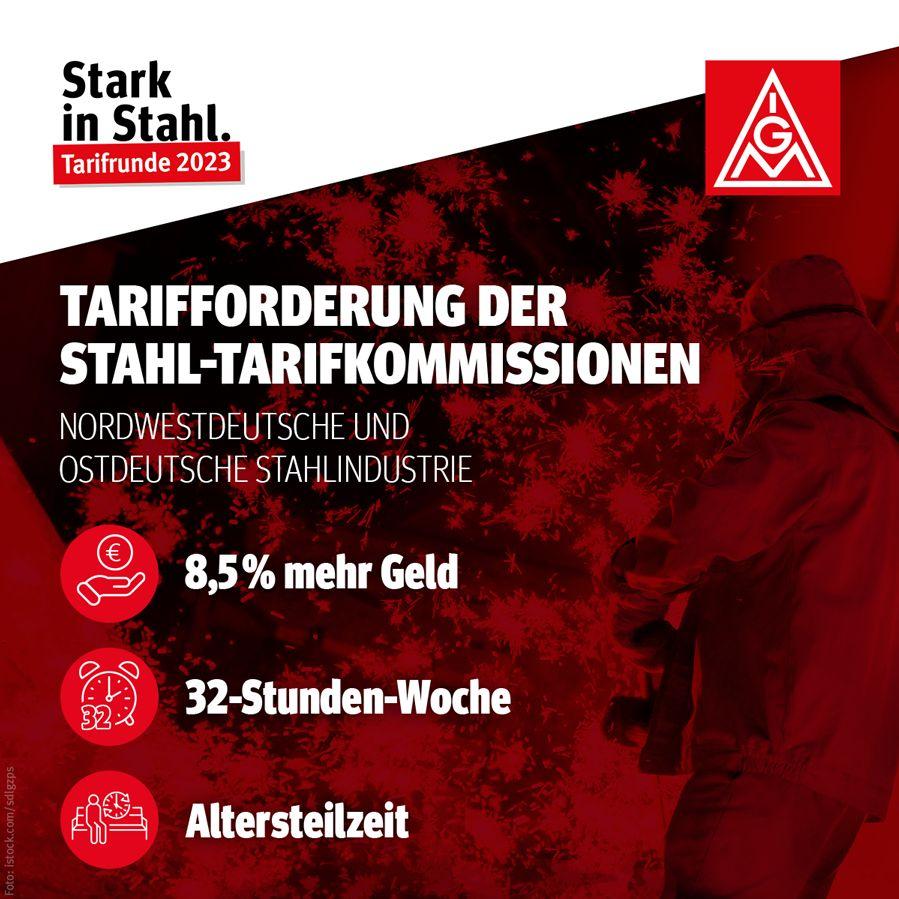
The collective bargaining agreements on partial retirement and job security should also be extended for the more than 80,000 employees in the steel industry in northwestern and eastern Germany.
How does IG Metall justify its demand for an 8.5 percent pay increase?
Stabilizing household budgets and having more money in their wallets each month—that is currently the top priority for steelworkers, as shown by a survey of 11,000 employees. Seventy-two percent stated that a pay raise is important to them given the still-high inflation.
The bargaining committee members discussed the percentage increase in their respective plants and ultimately agreed on 8.5 percent as their demand—a workable compromise—which the IG Metall executive board subsequently confirmed with its vote.
Why does IG Metall want to reduce the workweek to 32 hours?
By taking the first step toward shorter working hours, we want to lay the groundwork for a social transformation. The conversion of blast furnaces to direct reduction plants using green hydrogen instead of coke—to make steel production CO2-free—is already underway. And it’s clear that the new plants will require less labor. Further job cuts are looming. IG Metall wants to prevent this by distributing the work more evenly: If everyone works only 32 hours instead of the current 35, there will be enough work for more employees.
Social transformation also means that employees should not be the only ones to bear the cost of reduced working hours by forgoing wages and salaries—employers must share the burden as well. Full wage compensation is intended to ensure that employees, who often voluntarily reduced their working hours during the COVID-19 crisis and thereby also forwent pay, do not have to accept permanently lower wages and, consequently, lower pensions.
Reducing working hours despite a shortage of skilled workers—how does that add up?
Employers complain that they are already short on labor and skilled workers—and therefore cannot reduce working hours. However, this does not square with the fact that steel industry employers have already cut 7,000 jobs over the past three years, representing approximately 8 percent of the workforce. “Companies can’t complain about a shortage of skilled workers now if they cut staff at the first sign of trouble,” criticizes Knut Giesler, district director of IG Metall in North Rhine-Westphalia and chief negotiator for the negotiations in the northwest.
At the same time, it is becoming increasingly clear that reduced and more flexible working hours make companies more attractive to job seekers. This is often a key factor, especially for the younger generation, as they navigate their entry into the workforce after completing their studies or vocational training. And the steel industry needs well-trained skilled workers for its transformation —the transition to hydrogen and green electricity.
What does the 32-hour workweek or the 4-day workweek actually look like in practice?
A 32-hour workweek is very easy to implement in shift work. Many employees work so-called continuous or full-continuous shifts, including at night and on weekends. Their shift schedules typically call for fewer than 35 hours per week. This means that, throughout the year, employees must repeatedly work additional shifts to reach their full working hours.
37 percent of steelworkers already work fewer than 35 hours. At ArcelorMittal in Bremen, for example, the average is about 33.6 hours; in Eisenhüttenstadt, Brandenburg, it’s usually as low as 32 hours. Similar models also exist at ThyssenKrupp. A large proportion of workers even voluntarily choose shorter workweeks. However, they currently receive no wage compensation for the reduced working hours; instead, they forgo pay.
Wage compensation would also involve employers in financing the shorter workweek.
With a 32-hour workweek, a 4-day workweek is also possible—and a healthy one at that, with 8 hours per day (anything beyond that has been proven by occupational health experts to be unhealthy and increases the risk of accidents). A 4-day workweek is particularly easy to implement during regular shifts, in indirect roles, and in office jobs. And, of course, the blast furnaces won’t be shut down on Thursday evenings. They will continue to run around the clock, operated by employees on rotating shifts.
More money and fewer working hours with full wage compensation—how are companies supposed to pay for that?
To date, the government has provided massive financial support for nearly every step of the transformation in the steel industry—which is also in line with IG Metall’s demands. When the government invests so much money, companies have a responsibility to secure jobs. Ultimately, it won’t be labor costs that determine whether the steel industry undergoes transformation or not, but rather energy costs and access to green energy and green hydrogen.
At just 9 percent of revenue, the share of labor costs is comparatively very low in the steel industry. An 8.5 percent increase in wages and salaries would therefore raise total costs by a mere 0.765 percent.
When might warning strikes and strikes take place?
First, the second round of collective bargaining will take place on November 23, 2023. If no agreement is reached there, or if employers do not sufficiently address IG Metall’s demands, warning strikes could follow soon. At midnight on November 30, the peace obligation will end as the terminated wage agreements expire. After that, warning strikes will be permitted.
The steel industry in Saarland is governed by its own collective bargaining agreements with different terms. Here, the wage agreements can be terminated for the first time as of February 29, 2024.