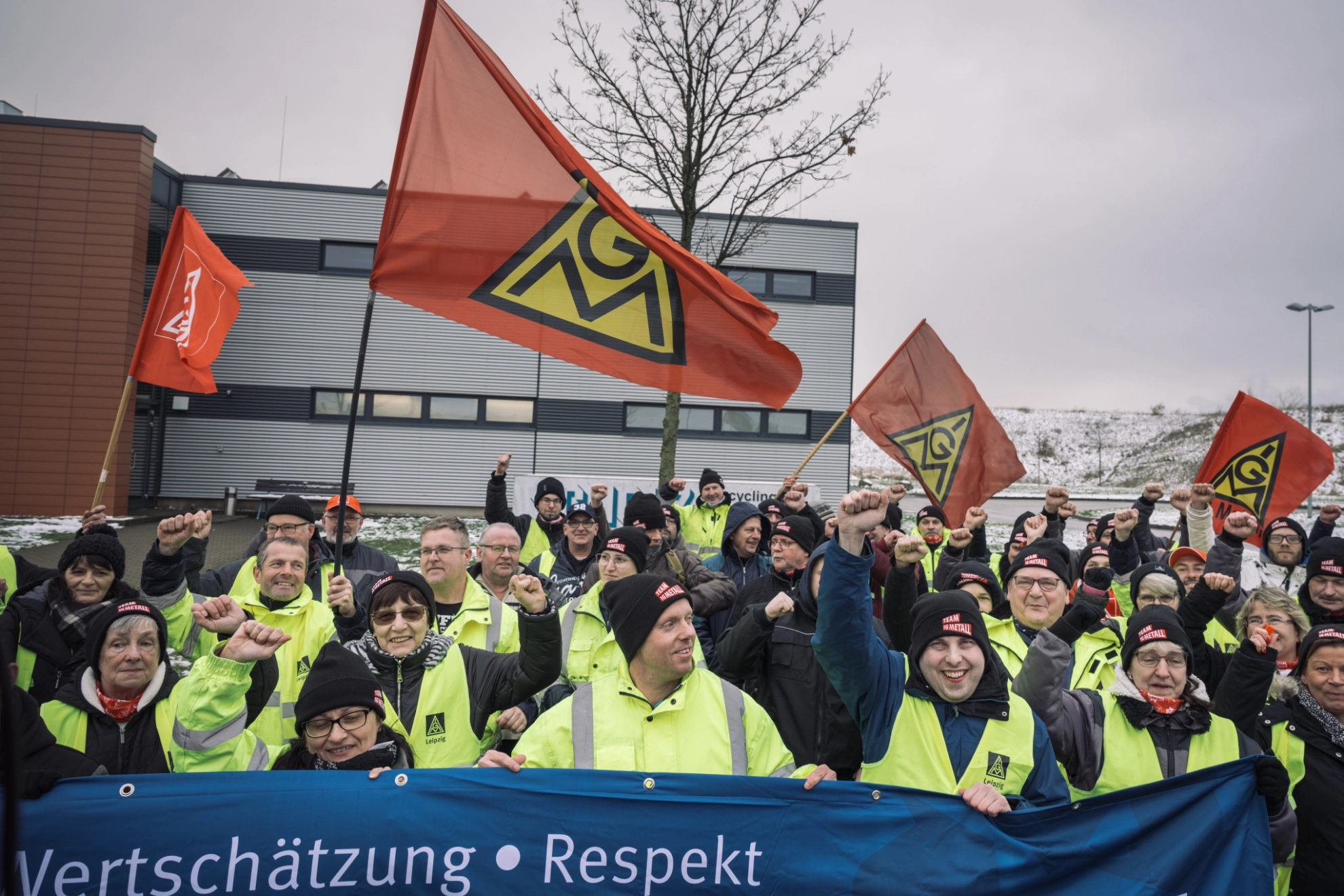
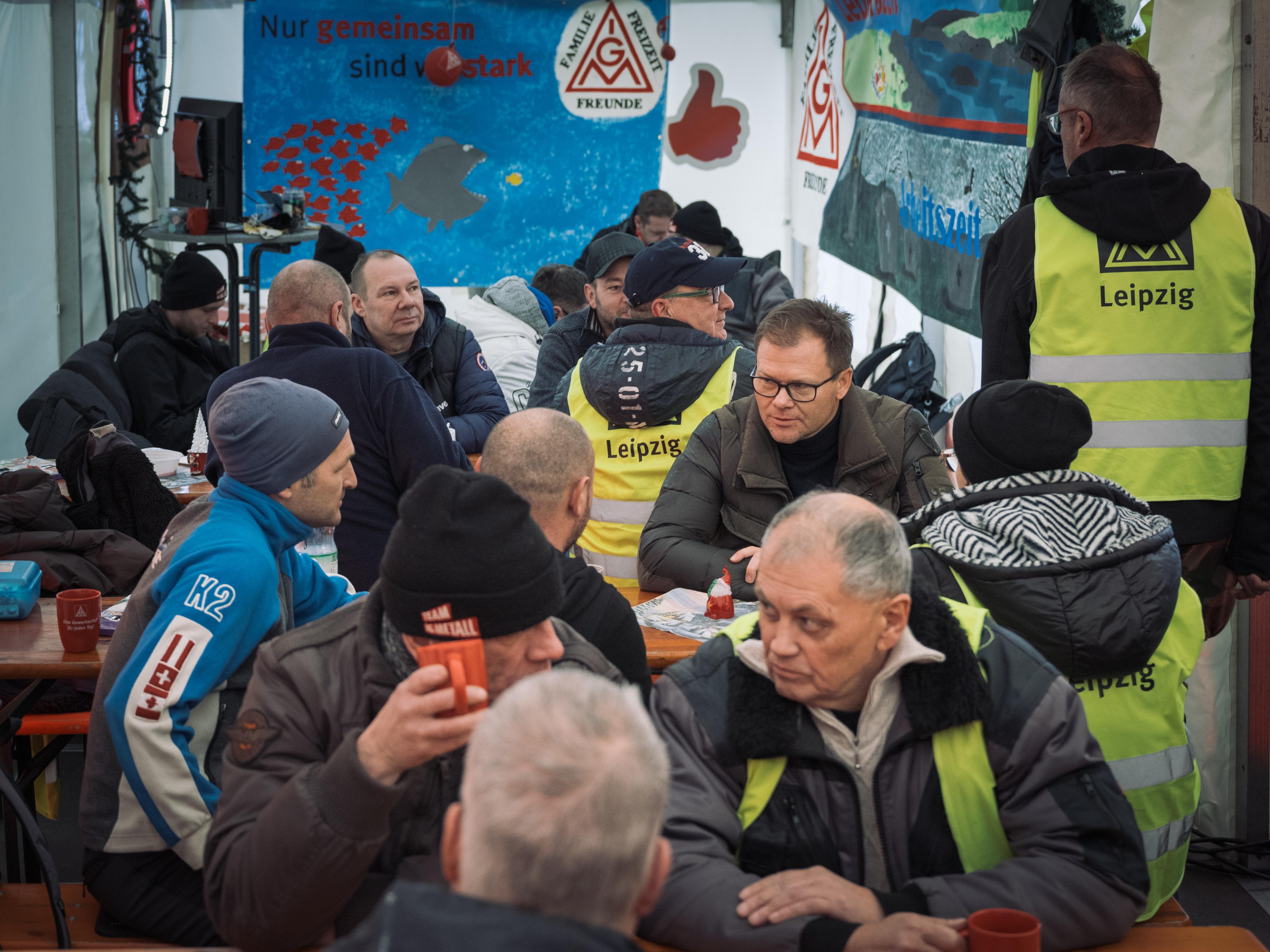
The fire barrels in front of the factory entrance are practically falling apart after 43 days on strike. The strike tent behind them is manned around the clock in shifts. If necessary, they plan to continue striking until Easter. The workers at SRW metalfloat in Espenhain near Leipzig finally want a collective bargaining agreement. It’s not just about the money (often less than 2,000 euros a month)—they want to finally be treated with respect and as equals.
Meanwhile, their strike is having an impact: The stockpiles of metals—which they sort from scrap and recycle—are slowly running out. The Riesa steel mill has already inquired about the status of their deliveries. And the aluminum they supply to BMW, Porsche, and VW is also running low.
Yet their employer still refuses to negotiate. SRW has hired security guards with dogs to patrol around the plant in an attempt to disrupt the strike . This particularly angers them: Their employer is treating its own employees like criminal rioters.
A collective bargaining agreement would also be good for the company. SRW is having a hard time finding people. Many have left in recent years. “Yet SRW really needs skilled workers here,” explains Michael Hecker, the IG Metall Leipzig negotiator at SRW, who is in the strike tent every day from early morning until late at night. “The company is shooting itself in the foot.”
In the strike tent at SRW in Espenhain.
Less than 2,000 euros a month
Management doesn’t want a collective bargaining agreement. Yet the Scholz Group, to which SRW belongs, generates 1.6 billion euros in annual revenue. Scholz, in turn, is part of the Chinese scrap metal conglomerate Chiho, which has 200 locations worldwide and 225,000 employees.
The workers at SRW in Espenhain generate hundreds of millions in revenue—yet they earn only 2,000 euros net per month, and even then only if they work night shifts. Many earn even less than 2,000 euros. They are demanding an 8 percent pay raise, 1,500 euros each for vacation and Christmas bonuses, and a reduction in the workweek from 40 to 38 hours.
Above all, they want to ensure that the employer can no longer do whatever it wants. “We’ve been talking ourselves hoarse for years—but no one listens to you, and on top of that, they treat you like you’re stupid,” says Nico angrily. He started here as a temporary worker in 2011 and is now a deputy shift supervisor and a member of the works council. “Thanks to IG Metall and our demand for collective bargaining, we’re finally able to have a discussion on equal footing.”
Hardly Any Pay Raises—Constant Sacrifices
There have been hardly any wage increases in recent years. “All year long, they kept telling us that the company was doing so badly and they couldn’t give us anything. And then at the Christmas party, it turned out to be the best year in our history after all,” says Mirco, a trained maintenance mechanic who does everything as a general laborer at SRW: operating the machines as a plant operator, sorting scrap by hand, and driving forklifts.
Last year, SRW raised wages a bit more—but only because they were below the significantly increased statutory minimum wage.
Time and again, they’ve made sacrifices—for example, during the 2010 financial crisis. Back then, they were told they’d get the money back afterward. But when they brought it up with the plant manager at a staff meeting after the crisis, he claimed not to remember it.
The workers still remember it well. That’s why they want to be covered by a collective bargaining agreement. Before the strike vote in early November, the employer had promised them a wage increase—8 percent (though spread over two years). But they rejected it. They know the employer can take that money away from them at any time. They want security at last through a collective bargaining agreement. They want to negotiate with the employer as equals. They want recognition for all those years of service.
Freezing cold in winter—scorching hot in summer
They work hard. The material that’s too large to be separated by machines using centrifugal force and magnets must be sorted by hand into more than two dozen types of metal. The conveyor belt runs relentlessly. Officially, there’s only a half-hour break per shift. One coworker is even said to have wet his pants once because no relief arrived.
It’s loud. And the halls aren’t insulated. Inside, it’s just as cold in winter as it is outside. And in summer, it gets sweltering, especially in the sheet-metal sorting booths. Although SRW has since installed air conditioners in the sorting booths, they’re of little help—just like the heating panels on the ceiling: pointless.
There’s also a sorting booth outside. It gets particularly hot there in the summer under the sheet-metal roof. And there are no heating panels. When it gets extremely cold, management brings in electric heaters. “But we have to ask three times for them,” criticizes sorter Heike. She studied energy management and worked at a power plant. But that plant closed down. She became unemployed—and after some retraining, she started working at SRW in 2009. “Things have improved quite a bit since then, especially since we elected a works council ,” Heike reports. “We used to have to stand at the conveyor belt for seven and a half hours. Now at least we have stools.”
Noisy, Dirty, and Toxic
At SRW, it’s cold, hot, loud, and dirty. About once a week, there’s a fire alarm, often accompanied by a lot of smoke. And metal dust hangs in the air everywhere, glistening and shimmering in the sun.
“No one can tell us what we’re breathing in—or how all these substances react with each other: lead, copper verdigris, aluminum, oxides, acrid-smelling car batteries, scrap from waste incineration. It’s all extremely unhealthy,” criticizes Springer Tino, who started working here back in 1995. He actually only intended to stay for two years. “Almost everyone here can off the top of their head name a handful of former coworkers who died young—shortly after retirement or even before. My uncle, too, died six months after he retired.”
Solidarity for the “Scrap Workers’” Strike
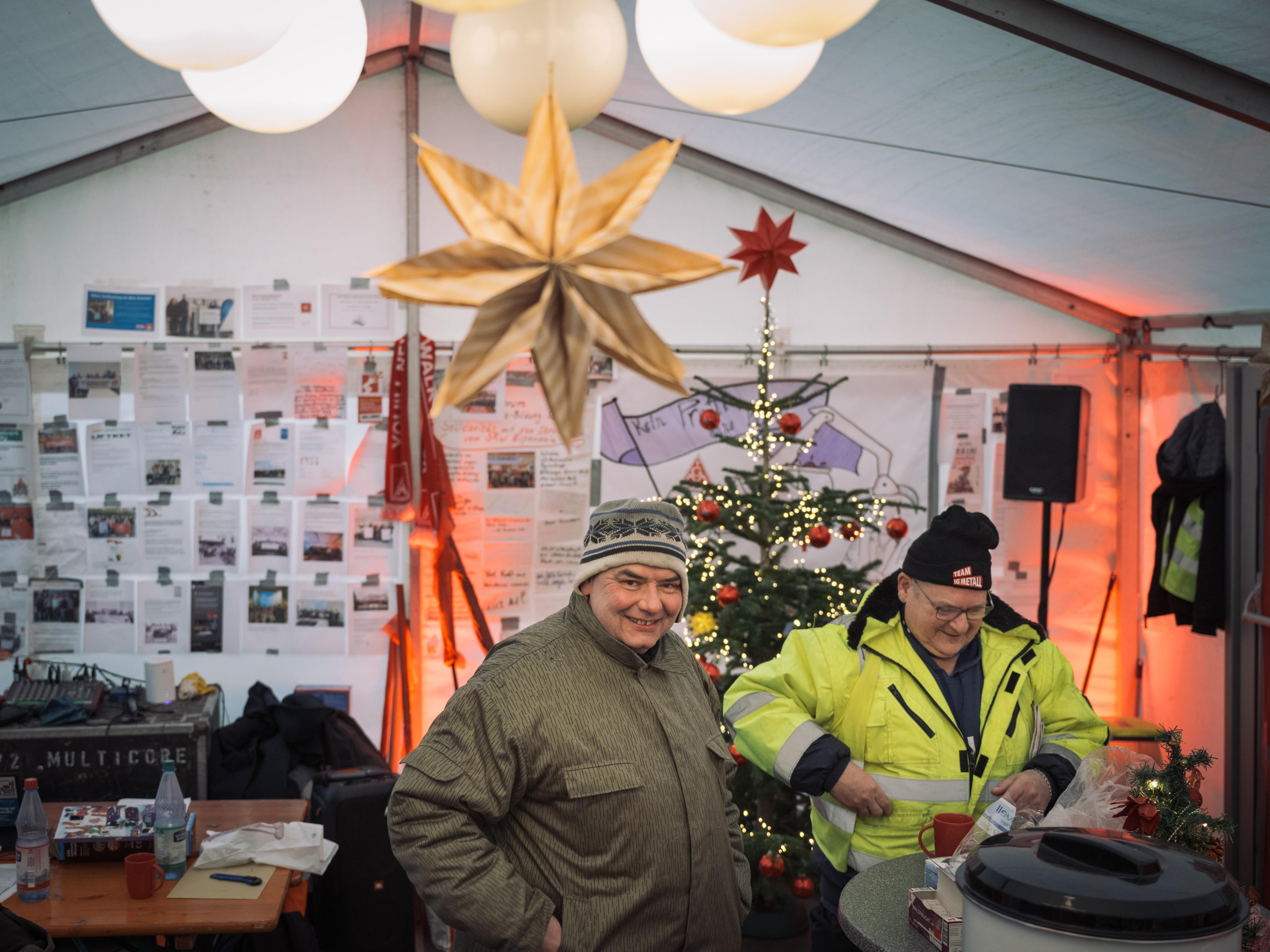
One wall in the strike tent is covered with messages of solidarity and donations from metalworkers at other plants across the country. And time and again, they also stop by in person. Today, the local youth committee of IG Metall Amberg is on the late shift. The executive director of IG Metall East Saxony is taking the night shift. Politicians have also been here, including Lars Klingbeil, Saskia Esken, and DGB President Yasmin Fahimi.
And now the media across the country are reporting on it as well. The BILD newspaper ran the headline: “Scrap Metal Strike Against Chinese Bosses.”
Inside the strike tent: a wall covered with messages of solidarity from all over Germany.
“We’ve all become one big family”
“The most important thing for us is that we finally get a collective bargaining agreement so we no longer have to beg,” explains sorter Heike. “When I saw during our first warning strike just how many people were already members of IG Metall and how everyone joined in—that made me very happy.”
When they actually went on an indefinite strike after the strike vote—when the security guards arrived with dogs and the company took them to court—they felt a bit uneasy at first, says plant operator René, who is keeping the fire barrel burning with pallet wood during the late shift today. “We’ve never done anything like this before.”
By now, a routine has settled in at the fire pit and in the strike tent. On Thursday, they’ll temporarily take down the strike tent to recharge over the holidays and spend time with their families. The strike continues. They’ll spend the holidays at home—and be back at the gates of their SRW on January 2.
The “scrap workers” at SRW have grown closer during the strike. “We used to just know each other by sight and maybe exchange a quick greeting during shift changes. Now we all know each other,” says Beate, a sorter who is also an alternate on the works council. Her husband works here too, as a plant operator and a member of the works council. “Many of us have family here,” says Beate. “But through our strike, we’ve all become one big family. We’re sticking with this together now.”
Get the latest news and background information on SRW from IG Metall Leipzig.
Show your solidarity and donate now
If you’d like to send messages of solidarity, please send them to: soli-srw(at)igmetall.de
Donations for the strikers can be sent to:
IG Metall
IBAN: DE 23 5005 0000 0000 0010 40
Reference: Soli SRW