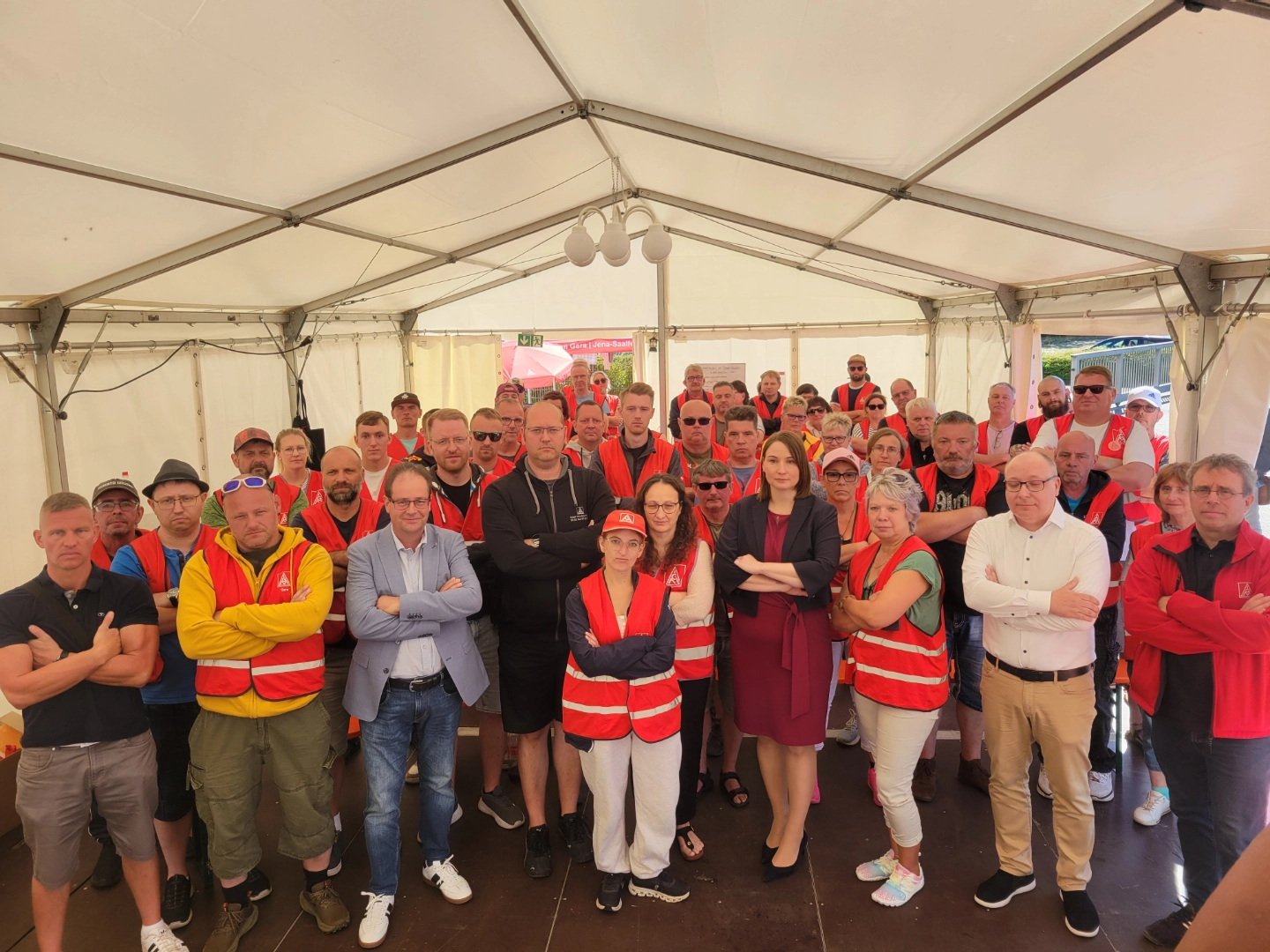
Sergio Vecchiolla is still on cloud nine. “Finally, finally, we’re being paid fairly,” says the works council chair of Bremer Lagerhaus Gesellschaft (BLG) in Wackersdorf, Bavaria. What rolls so easily off his tongue was a hard-fought battle. A struggle that ultimately led to an IG Metall collective bargaining agreement—and thus significantly more money in the employees’ wallets.
It all began with automaker BMW’s decision to outsource part of its logistics operations. Three years ago, it awarded these logistics services to a contractor, the contract logistics company BLG. The task: to pack auto parts for international shipment to assembly plants abroad. Previously, this work had been done primarily by BMW employees under the terms of the IG Metall collective bargaining agreement. Then the BLG employees in Wackersdorf took over the packing—for a fraction of the pay.
Fair Conditions Instead of Dumping Wages
That’s unfair, says Jürgen Scholz, chief representative of IG Metall in Regensburg. He doesn’t have anything against service contracts in general. “But the conditions have to be right,” he says. Equal work must be fairly compensated.
However, the conditions under which workers at contract firms operate are usually worse than those of the permanent workforce. BMW is not an isolated case: To cut labor costs, more and more companies are relying on contract work. They outsource tasks and assign them to subcontractors. There, people work for rock-bottom wages—many of them, as at BLG Wackersdorf, as temporary agency workers. Scholz: “This is completely unacceptable. We want to bring such contract firms, which operate along our industry’s value chain, back under our control.”
IG Metall Collective Bargaining Agreement Instead of Dump Wages
IG Metall is no longer willing to stand by and watch this low-cost strategy play out. It is relying on its collective bargaining agreements.
Securing a collective bargaining agreement for the metal and electrical industry was also the goal of the BLG employees in Wackersdorf. “Rationalization at any cost—that can’t be the answer,” thought the BLG works council, which was founded two years ago. The works council members distributed flyers, recruited members, and began negotiating a collective bargaining agreement. Management didn’t like that at all. “We had to use our first warning strike to shake things up a bit in the negotiations,” Sergio Vecchiolla says with a smile. Almost all employees participated. Jürgen Scholz was also pleased to see this clear sign of the employees’ willingness to fight.
IG Metall’s formula for success: many members, works councils, collective bargaining agreement
A few weeks later, following a 14-hour negotiation marathon: finally a result, finally a collective bargaining agreement, finally more money. “For many, the collective bargaining agreement means up to 10 percent more pay,” Vecchiolla explains. In addition, there are now higher vacation and Christmas bonuses, as well as a phased increase in vacation days to 30 days.
And the works council succeeded in significantly limiting the proportion of temporary agency workers. Currently, around 160 permanent employees and approximately 300 temporary agency workers are employed at BLG Wackersdorf. In other words, over 60 percent of the workforce consists of temporary agency workers. This proportion is being steadily reduced and, as of January 1, 2017, may not exceed 30 percent.
Capturing and Bringing Back
Sergio Vecchiolla and the BLG employees can be proud of their collective bargaining agreement. And Jürgen Scholz of IG Metall is certain: “We will bring even more contract firms into the fold.” Scholz already senses that the other companies on the BMW plant grounds are closely watching the BLG Wackersdorf case. “Many of our employees are currently asking whether an IG Metall collective bargaining agreement is also possible for them.”