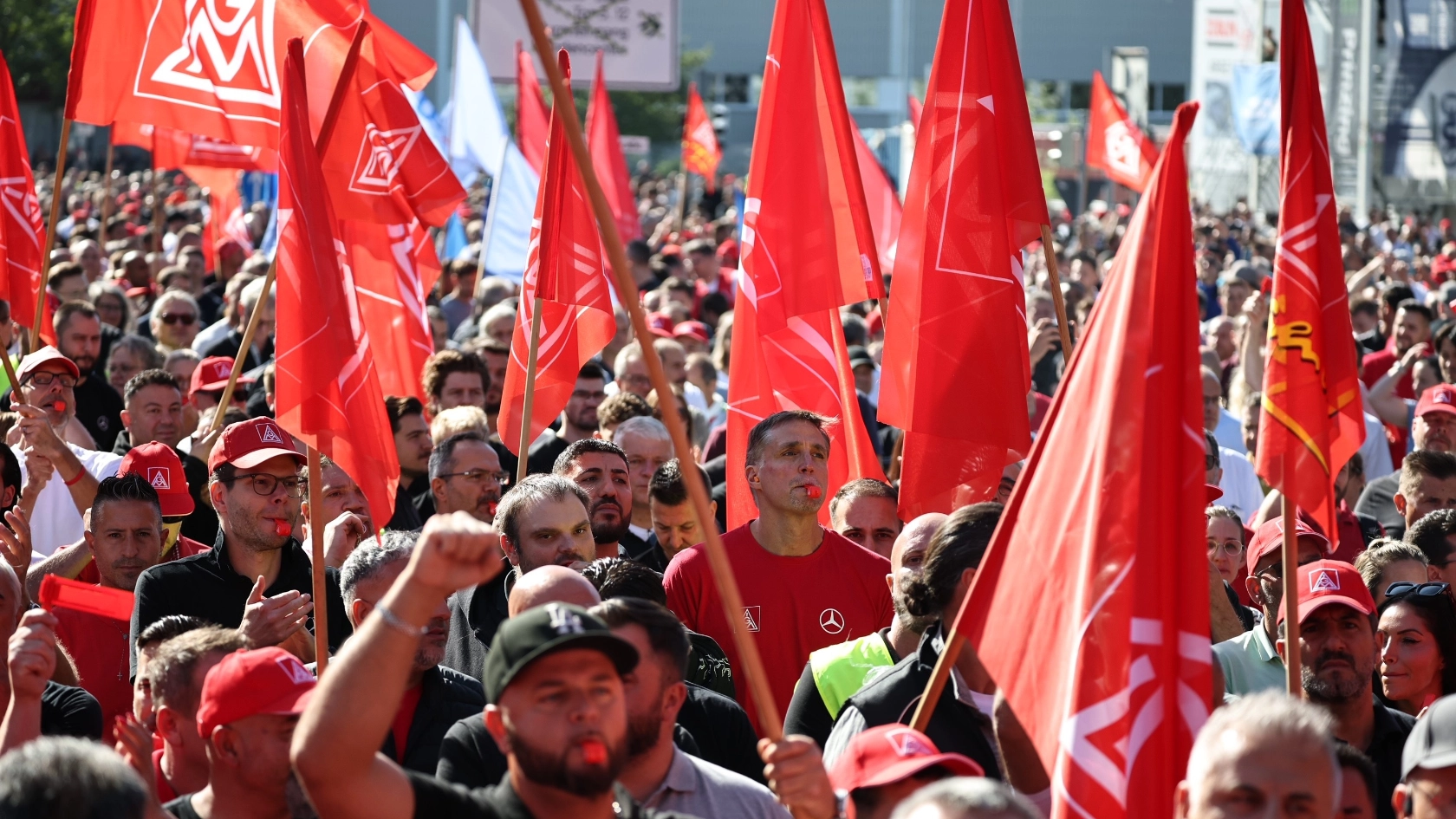
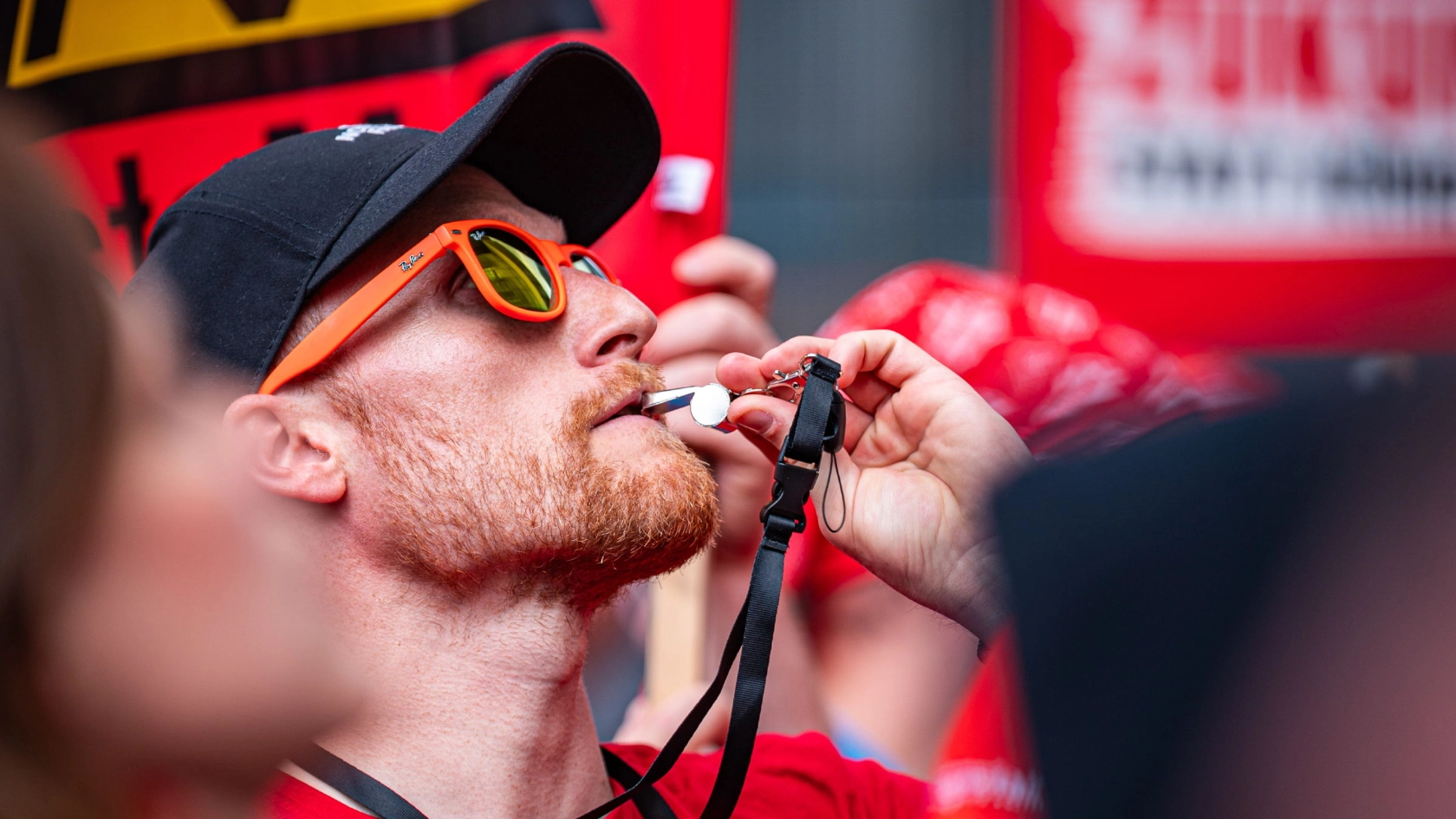
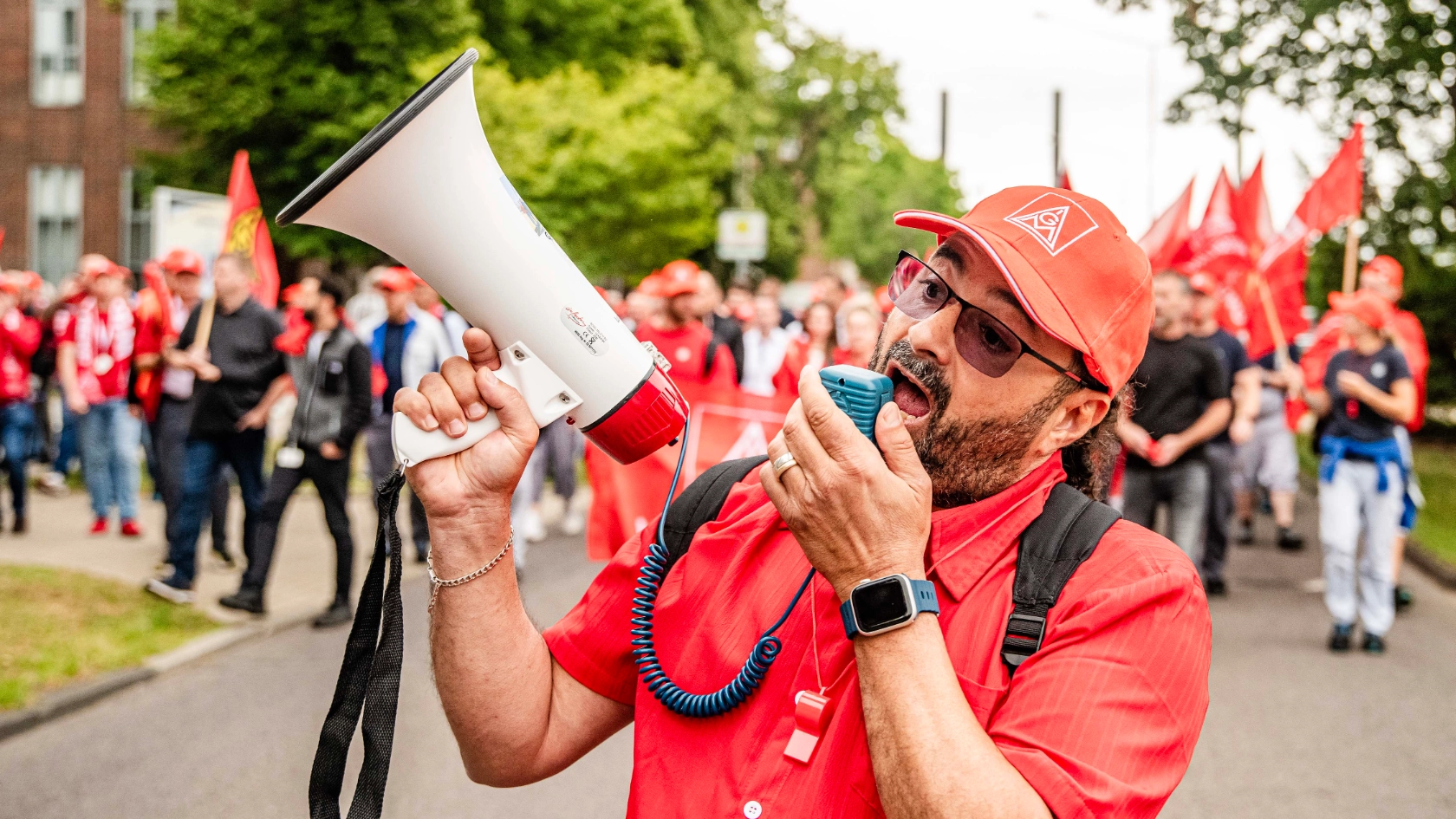
“We’re running out of time. The German steel industry and our colleagues need solutions today—not perhaps in the next legislative term,” Jürgen Kerner, Second Chairman of IG Metall, tells the approximately 2,000 steelworkers gathered in front of the Mercatorhalle in Duisburg. Inside, the National Steel Summit is about to begin, and Kerner will make it clear to policymakers and business leaders what is needed now to lead the steel industry toward a climate-friendly future and to secure its transformation and tens of thousands of jobs.
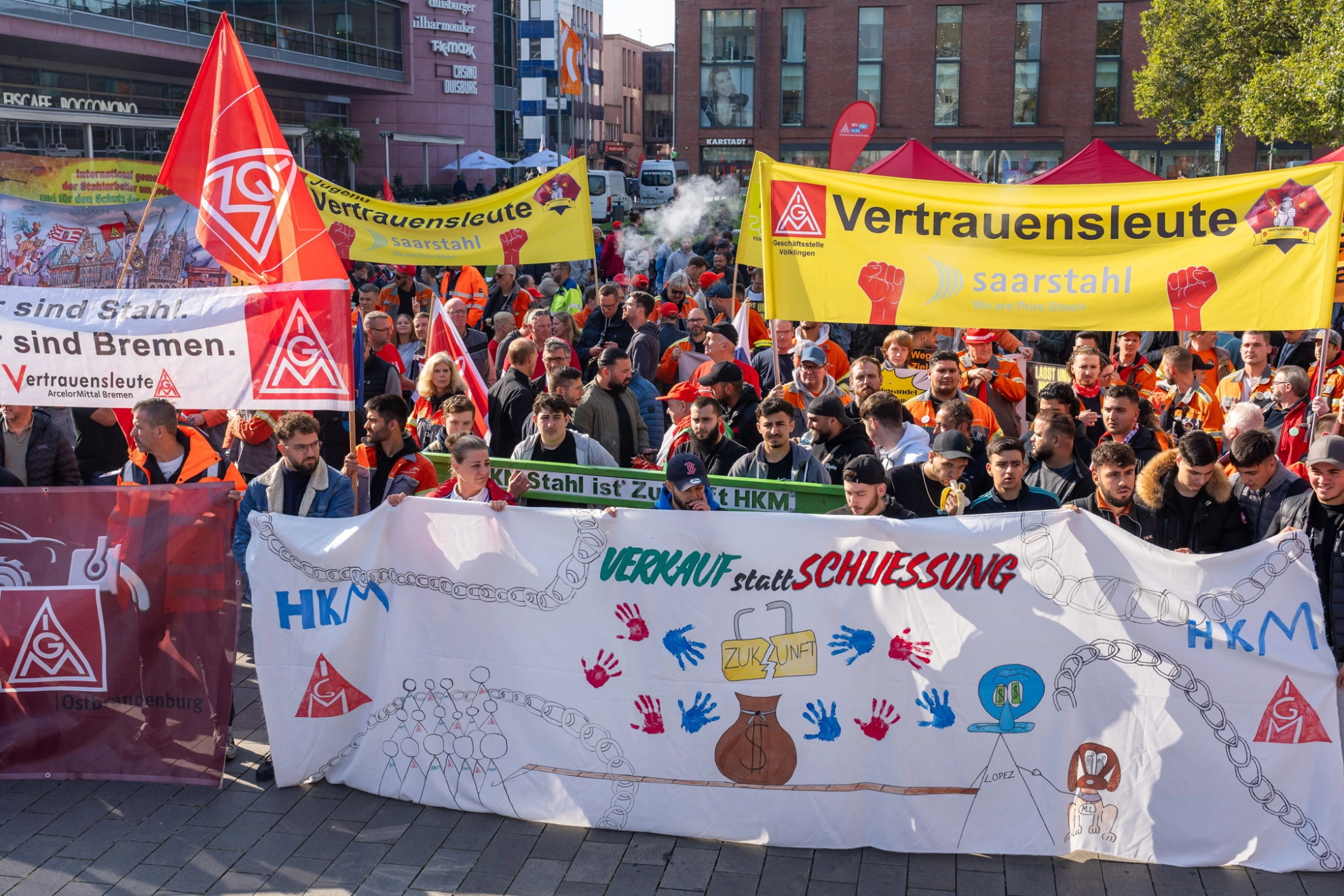
Outside, the steelworkers are drawing attention to the current state of the steel industry: They have pulled an old wooden cart up to the steps of the Mercatorhalle’s main entrance, loaded with large cardboard cubes symbolizing unnecessary ballast. The cubes read: “excessive energy prices,” “investment backlog,” “steel dumping from China,” or “overcapacity.” The steelworkers want to remind politicians of their responsibility: “Together, we must pull the cart out of the mud,” reads one large banner; another reads: “Time is running out.” And most of the posters read: “Steel is the future.”
Steel workers are fighting for their future
Metalworkers have come from around 40 steel mills across Germany: from all over North Rhine-Westphalia, from the Saarland, from Bremen, from Salzgitter—and some have even traveled the more than 600 kilometers from Eisenhüttenstadt. Many set out during the night to fight in Duisburg for the future of the German steel industry. That’s why Stefan came from the Saarland, too. The steelworker is employed at Saarstahl and emphasizes: “We have to draw politicians’ attention to these problems.” Murat also wants to “send a message.” He came from ArcelorMittal in Bremen to urge politicians to take action: “This is about jobs now,” says Murat. Mehmet is already 60 years old; he has already experienced job cuts at Thyssenkrupp in Dortmund and doesn’t want to go through that again. “We have a responsibility to our younger colleagues,” says Mehmet.
Solutions exist; policymakers must implement them
The domestic steel industry is in crisis. It has lost a significant amount of competitiveness, and the reasons for this lie in the political framework: high energy prices and unfair international competition—which policymakers are not doing enough to counter—are destroying steelmakers’ businesses. This is a problem with far-reaching consequences.
Jürgen Kerner, Second Chairman of IG Metall, emphasized at the Steel Summit: “Tens of thousands of well-paid jobs protected by collective bargaining agreements depend on the steel industry. But there is much more at stake: As a basic materials industry, the steel sector is central to the unique value-added network that makes Germany a successful industrial hub. This must be preserved and transformed into a carbon-neutral future. We expect companies to clearly commit to Germany as an industrial hub and to consistently invest in the future of domestic locations. Policymakers must establish the appropriate framework for this and create a reliable environment for the urgently needed investments. Above all, this includes a competitive industrial electricity price.”
How to Make Steel Future-Proof
IG Metall, the states of the Steel Alliance—that is, the eleven federal states with steel production sites—and the German Steel Association have joined forces in response to the strained situation facing steel manufacturers and are jointly calling on policymakers in Berlin and Brussels to secure the future of Germany and Europe as steel-producing regions through an emergency program. Three points are crucial for this:
Competitive electricity and hydrogen prices: The federal government must ensure competitive energy prices for energy-intensive industries. In short: We need an industrial electricity price. In addition, the federal government must ensure that hydrogen for climate-friendly production will be available in sufficient quantities and at competitive prices. As a transitional solution, it must continue to allow the use of natural gas.
Green lead markets: So far, demand for green steel remains low. The transition to the necessary climate-friendly steel production therefore carries a risk for manufacturers. Here, the federal government must step in and prioritize the use of low-carbon steel in public procurement contracts, thereby stimulating demand. To this end, the federal government must examine how it can make green steel more attractive—for example, through quotas or tax and incentive models.
Trade Policy Support: Currently , the German and European steel industries are struggling with global overcapacity that is flooding the European market. Often, this steel comes from countries where production receives substantial government support. The European Commission must counter this with trade policy measures. The EU’s anti-dumping and anti-subsidy measures must be consistently applied and regularly reviewed for effectiveness.
A Ray of Hope at the Steel Summit
Outside, steelworkers are chanting their slogan: “Steel is the future.” Inside, Federal Minister of Economics Robert Habeck appears to have taken to heart the calls from IG Metall, the German Steel Association, and the states of the Steel Alliance. At the Steel Summit, he emphasized: “Green steel made in Germany is what drives us. By working hand in hand with companies, the German Steel Association, IG Metall, and federal and state policymakers, we are getting closer and closer to our goal of a climate-neutral steel industry. Germany and the EU are global pioneers in the decarbonization of the steel industry. In Germany, we will convert around one-third of the country’s crude steel capacity by 2030, thereby producing approximately 12 million metric tons of CO₂-free steel and saving more than 10 million metric tons of CO₂. German steel production is at the beginning of many relevant value chains and is thus also a key driver for key industries such as the automotive and mechanical engineering sectors and their transformation.”
But for things to turn out as the Minister of Economic Affairs describes, he will have to help get the cart out of the mud. We need an affordable industrial electricity price, green lead markets, and trade policy measures. IG Metall, the German Steel Association, and the states of the Steel Alliance will continue to fight to ensure that these framework conditions are created.