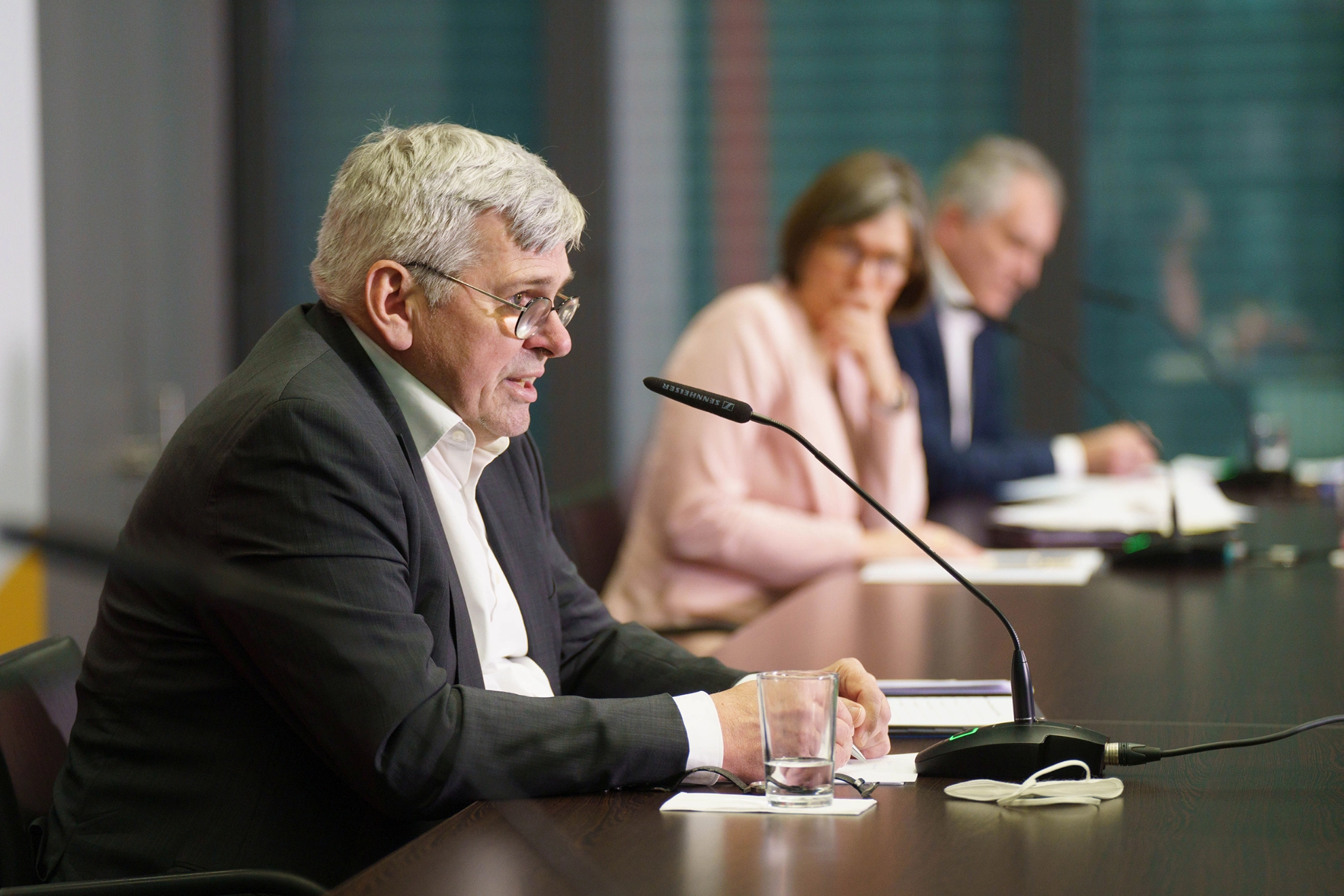
Time is of the essence, and decisive action is needed: The federal government and companies must now quickly take concrete steps toward a climate-neutral industry —while ensuring job security for workers during this transition. Jörg Hofmann emphasized this at the annual press conference in Frankfurt. “Time is running out,” said the President of IG Metall. “We must tackle both the pandemic and the transformation of our industry at the same time. Both are enormous challenges that demand swift and decisive action.”
The goal must be to create new, sustainable jobs through investment in areas where value creation is shifting. Hofmann: “We will not master the transformation in Germany with the ‘dark triad’ of downsizing, closing, and offshoring. If Germany wants to remain a strong industrial nation, it must invest heavily in the future—including that of its workers.” The IG Metall chairman called on companies to make use of the “Fund for the Future” provision in collective bargaining agreements, which was implemented in 2021: “Only those who develop a plan with their employees early on will have a future.”
Active regional structural policy is needed
“Where the economy is thriving today, industrial wastelands must not be allowed to emerge,” Hofmann warned. “From the employees’ perspective, the success or failure of the transformation is determined by the regions in which they live.” In our view, an active regional structural policy, the promotion of regional transformation networks, and new labor market policy instruments—such as the transformation short-time work allowance and the right to paid part-time training—are central prerequisites for a successful transition. “Jobs and companies will change, in some cases dramatically. Our stated goal is to give every worker a clear path to good work—good industrial work—during the transformation. We need this new promise of security, because transformation can only happen with, not against, the workers. We will continue to hold companies and policymakers accountable on this,” said Hofmann.
Transformation Is Only Possible with Strong Worker Participation
This transformation can only succeed with workplace democracy in practice, said Christiane Benner. The vice chair of IG Metall called on companies to support the upcoming works council elections this spring: “Transformation in the interests of employees is only possible with strong co-determination.” At the same time, Benner called on the federal government to comprehensively overhaul the Works Constitution Act, which was last fundamentally reformed in 1972. “Our core demand is this: Employees and their representative bodies must be able to help shape the strategic direction of companies and workplaces. This includes greater co-determination in the area of training.”
Despite the pandemic, we are in good financial shape
We at IG Metall have weathered the second year of the COVID-19 crisis, 2021, on a stable footing: We continue to have 2.2 million members and, due to contact restrictions and a lack of new hires by companies, have seen only a slight decline of 2.1 percent. The metal and electrical industry, by contrast, cut 2.4 percent of its jobs during the same period.
There was no decline in revenue: Membership dues total 592 million euros—slightly more than in the previous year. “Despite the pandemic, we are in good financial shape. We are managing our finances soundly. No political action, no strike will fail due to a lack of funds,” concluded IG Metall Chief Treasurer Jürgen Kerner.
Crucial steps for the transformation of various industries will be taken this year, emphasized Kerner, who is also responsible for IG Metall’s industry coordination: “In the aviation, rail, and steel industries in particular, 2022 will determine whether the transformation succeeds,” said Kerner. “We want to make Germany a hub for state-of-the-art rail and infrastructure technology and a leader in CO2-neutral aviation.” For the steel industry, a transformation fund of 10 billion euros is needed by 2030.