When Health Minister Nina Warken (CDU) speaks about the topic of long-term care, she doesn’t shy away from strong language. “We don’t need a minor reform; we need a fundamental reform,” the CDU politician said back in the summer, when a federal-state working group on statutory long-term care insurance was launched.
A major reform is “urgently needed” to “make the long-term care system future-proof” and to “give people greater peace of mind regarding long-term care in old age.”
The minister’s working group has since presented its findings, which are intended to serve as the basis for a draft bill. Minister Warken plans to implement her reform in 2026.
The brief but heatedly debated abolition of “Care Level 1” is not on the working group’s list. Nevertheless, from the perspective of workers, the proposals do not bode well.
“Unfortunately, the working group has failed to pursue new and truly solidarity-based approaches,” says Hans-Jürgen Urban, Social Affairs Director at IG Metall. “With the proposals presented, long-term care will remain a private financial burden and a risk of poverty for many.”
Urban criticizes the fact that insured individuals will continue to bear a large portion of the costs themselves in the future: “Those in need of long-term care and their relatives need significant and lasting relief.”
The working group’s fundamental flaw, he argues, is that it does not want to make the long-term care system more based on solidarity: “With a universal insurance system into which civil servants, politicians, and high-income earners also contribute, we could implement an efficient and equitable comprehensive long-term care insurance system.”
Exorbitant Costs
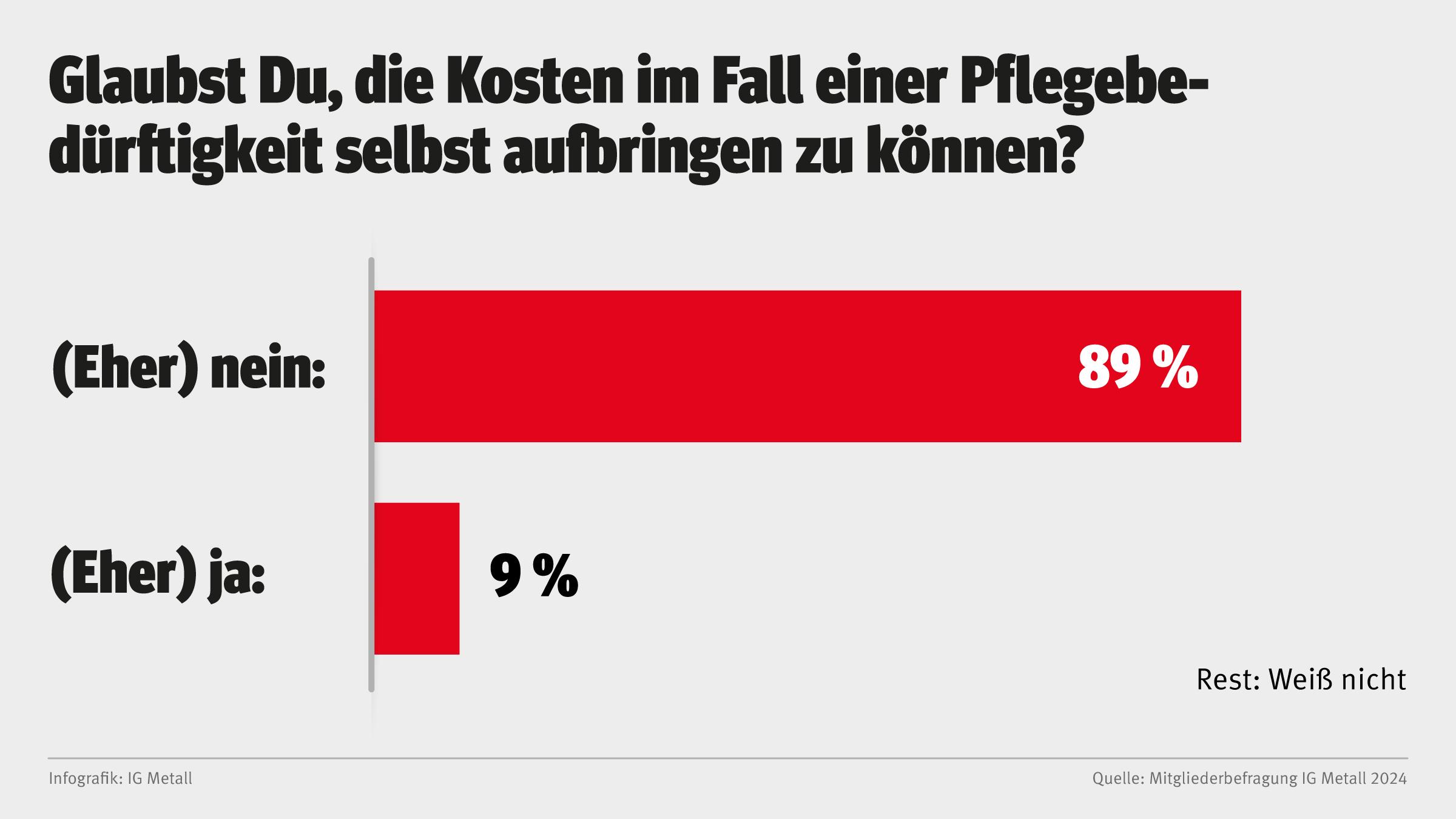
Even today, long-term care insurance benefits are insufficient. The copayments for nursing home beds are barely affordable, averaging more than 3,100 euros per month. According to the survey, very few IG Metall members expect to be able to cover these costs (see chart).
Across-the-board benefit cuts would hit the majority of workers hard if they ever needed long-term care. The fact that such cuts are still being discussed—such as the elimination of long-term care level 1—does not bode well for workers.
The proposal for more private long-term care planning should also give workers pause. After all, if long-term care services are privatized, it will cost workers real money.
After all, private provision means that workers bear the costs of supplemental coverage entirely on their own. Under the statutory long-term care insurance system, they share the costs with their employers. No wonder employers’ associations are particularly vocal in calling for more private provision.
Yet the example of the Riester pension shows that individual supplemental coverage is not only unfair—it simply doesn’t work. Those who need it most cannot afford private policies at all. In the end, it is primarily insurance companies that profit by selling opaque contracts with high fees.
Citizens’ Insurance – A New Start Based on Solidarity
Everyone agrees that long-term care insurance needs a fresh start. But cutting funding to the bone and privatization would be the most antisocial way to achieve this. And it’s not the only way—even if business-friendly politicians and economists keep claiming it is. Instead, long-term care insurance can be reformed on the basis of solidarity.
Step one would be to set a cap on so-called “out-of-pocket costs”—that is, the portion of long-term care costs that insured individuals or their relatives must pay themselves. These costs are so high that long-term care has long since become a risk of falling into poverty.
In addition, the federal government should repay the long-term care insurance system the funds that were diverted to other purposes during the COVID-19 pandemic.
At the heart of a major long-term care reform would be the introduction of a universal insurance system into which all working people contribute.
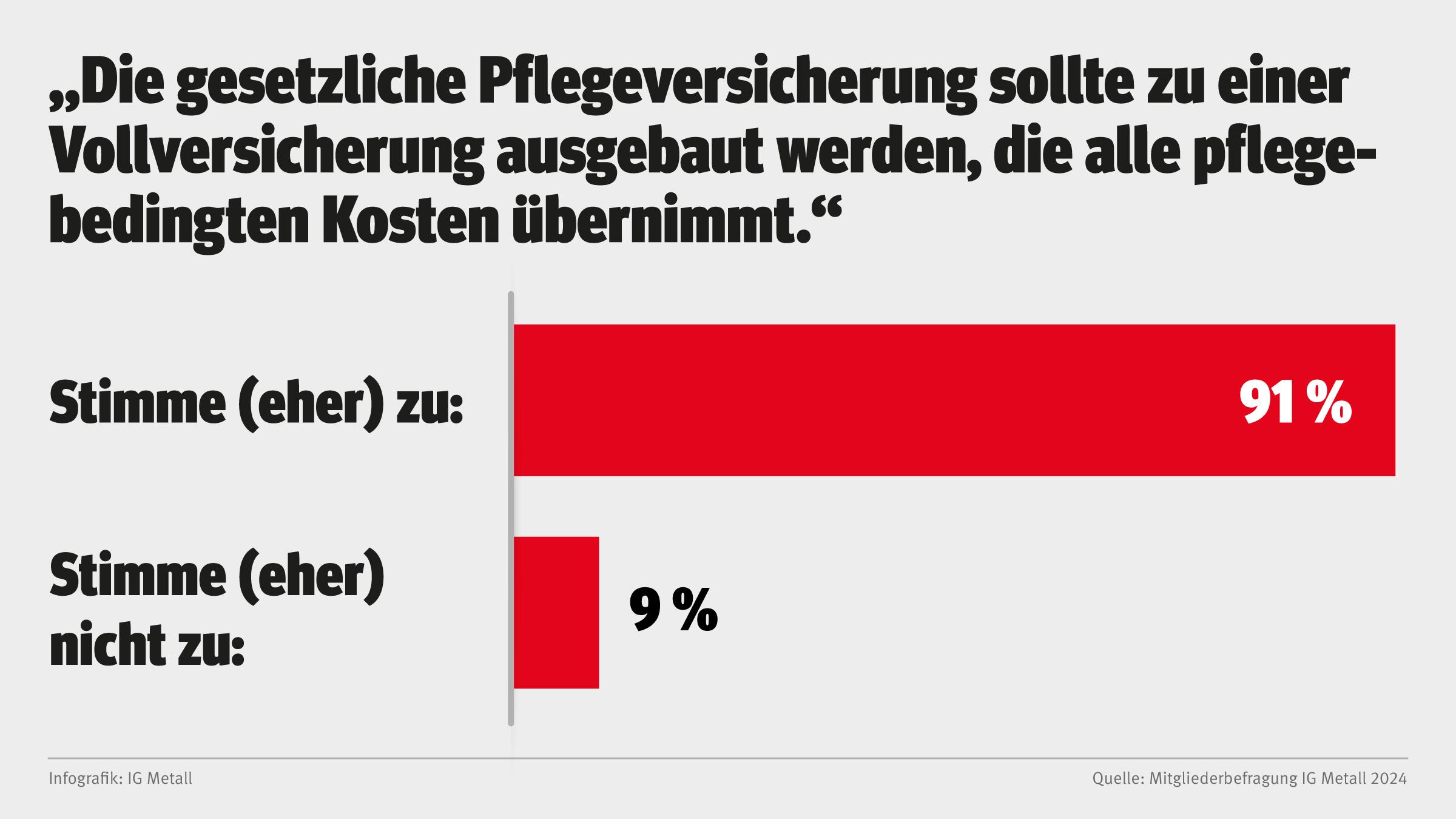
As comprehensive coverage, it should cover all long-term care-related costs in the future, not just a portion. Comprehensive coverage instead of partial coverage: a major step toward greater social security in an increasingly aging society. A large majority of IG Metall members support this demand (see chart).
Broadening the Basis of Financing
A citizens’ insurance system would broaden the base for financing long-term care. So far, those with private insurance have been excluded. However, they often have above-average incomes and fewer health risks. This separation puts the statutory long-term care insurance system at a systematic disadvantage.
A universal insurance system, into which all working people contribute, would end this division. The result would be a truly solidarity-based community and the end of the current two-tier society.
Long-term care could be made even more equitable if the so-called contribution assessment ceiling were raised—meaning that high earners would contribute somewhat more to the costs of the welfare state. And if contributions to long-term care insurance were levied not only on earned income but also on other types of income—such as investment income or rental income.
Calculations show that such a reform would make “comprehensive” long-term care insurance possible—and with stable contribution rates.
Introducing a universal insurance system would certainly not be easy. After all, it challenges existing privileges. But Health Minister Warken has said herself: She wants to fundamentally overhaul long-term care insurance and not just attempt a “minor reform.”
We should take the minister at her word.