What do you do when an experiment goes wrong? Should you keep repeating it, hoping that it will eventually lead to the desired result? Or do you admit failure and take a different path that offers a better chance of success?
These questions come to mind when looking at pension policy over the past 25 years.
Back in the 2000s, Gerhard Schröder’s federal government completely overhauled the pension system. Benefits under the statutory pension insurance were to be permanently reduced. The resulting pension gap was to be closed by occupational pensions, but above all by private pension plans.
Instead of a single central pillar, retirement provision would henceforth be based on three pillars: statutory pensions, occupational pensions, and private retirement savings. The government assumed that, in the future, all employees would contribute four percent of their gross income to private retirement savings.
So much for the theory.
Reality check? Disappointing!
What has actually happened: The benefit level of the statutory pension has fallen significantly. In 2000, the pension replacement rate was 53 percent. Today, it stands at just 48 percent. This has consequences for the retirement security of most people.
The pension replacement rate describes the ratio of a standard pension to the average earnings of all insured persons.
A declining pension level means that pensions are falling behind wages. As a result, retirees are being cut off from the general trend of rising prosperity. They are, on the whole, losing purchasing power.
This was a deliberate political choice. Employers can look forward to lower social security contributions. And the government can shift more costs onto the pension insurance system without having to raise the necessary tax revenue from the wealthy. In the language of the pension reformers at the time, this makes the pension insurance system “sustainable for the future.”
So this part of the plan worked out: Statutory pension benefits were scaled back. But the second part—replacing them with private retirement savings—still isn’t working today.
Pensions Dominate Retirement Planning
For the majority of people in Germany, the statutory pension is by far the most important form of retirement provision.
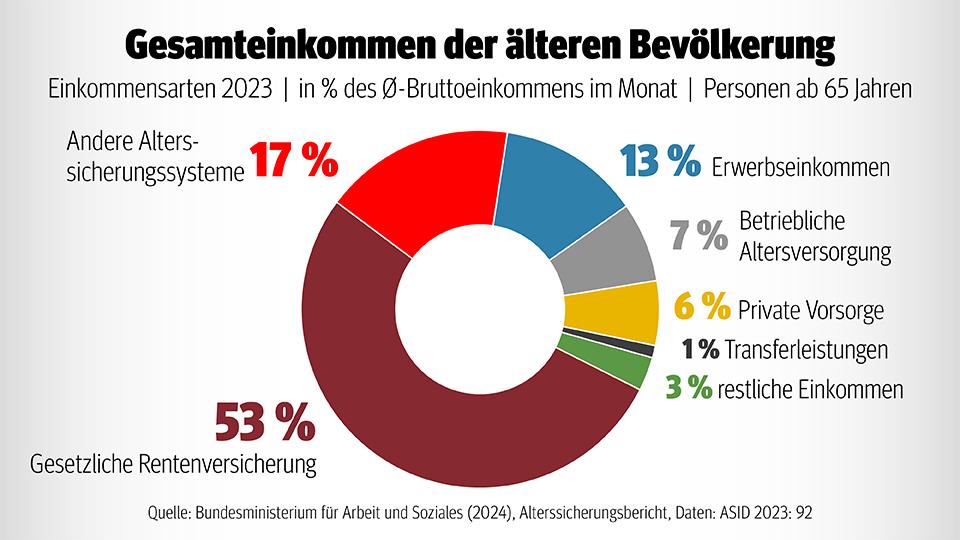
This applies, first of all, to the current generation of retirees. Looking at the total income of those over 64, 53 percent of it comes from the statutory pension. Income from private retirement savings accounts for only six percent of total income (see chart).
The importance of the pension system is particularly pronounced in the east. For nearly 75 percent of East German retirees, the statutory pension is their sole source of retirement income. Company pensions, for example, are added much less frequently. And per capita benefits from private retirement plans in East Germany are only slightly more than half as high as in West Germany.
These retirees are directly feeling the impact of the weakening of the pension system. They also have no alternative: it is too late for them to secure an occupational pension or private retirement savings.
In the West, it is more common to combine different types of benefits. But even there, the statutory pension remains the most important source of income.
While many people have additional income beyond the old-age security systems—such as interest or rental income—the amounts from these sources tend to be rather low on average, especially in eastern Germany. And only a minority benefits from them.
Workers need a strong pension
Even the younger generations, who are still in the workforce, will rely heavily on the statutory pension later in life. According to the German government’slatest Pension Security Report, about 62 percent of employees contribute to an employer-sponsored or government-subsidized private pension plan (“Riester”)—or to both systems. This means that nearly 40 percent of employees do not have any additional retirement savings in the strict sense.
Even if we take a broader view of the term “retirement planning” and include, for example, other private pension insurance plans or home ownership, one-sixth of workers still rely exclusively on the statutory pension for their retirement.
Furthermore, those who make private provisions usually do not do so to the necessary extent. They are therefore unable to offset the cuts in benefits from the statutory pension insurance system. They do not reach the four percent of gross income that the federal government had once envisaged.
In an analysis, the German Pension Insurance Agency states: The target of 4 percent of gross income can “generally only be achieved by individuals who have both entitlements under an occupational pension plan and a Riester pension plan.” This “generally calls into question the viability of the three-pillar model.”
What has not yet been taken into account is that the Riester pension has fallen short of most expectations: inflated interest rate forecasts, underestimated administrative and commission costs. Thus, Riester has turned out to be a dead end in German social policy.
Solidarity Instead of Privatization
Twenty-five years after the major overhaul of the pension system, one thing is clear: the three-pillar model of retirement provision does not work. And it has never worked. In its pension concept, IG Metall therefore calls for the statutory pension to be strengthened once again.
“The goal must be to sustainably strengthen the statutory pension as the most important pillar of retirement provision for everyone and to include everyone, ”says IG Metall’s Social Affairs Director Hans-Jürgen Urban. “The focus must be on strengthening the jointly funded statutory system for all generations.”
Cutting back on the statutory pension system in favor of private retirement savings only strengthens the financial lobby and relieves employers of their responsibility for retirement provision. Employees—and especially the younger generation—would then have to bear the costs of their retirement provision increasingly on their own.
Urban’s conclusion: “People don’t want financial market experiments; above all, they want reliability and solidarity-based financing. This is only possible within and through the statutory pension insurance system, with a pension that is secure in the long term and more contributors to the solidarity-based system.”