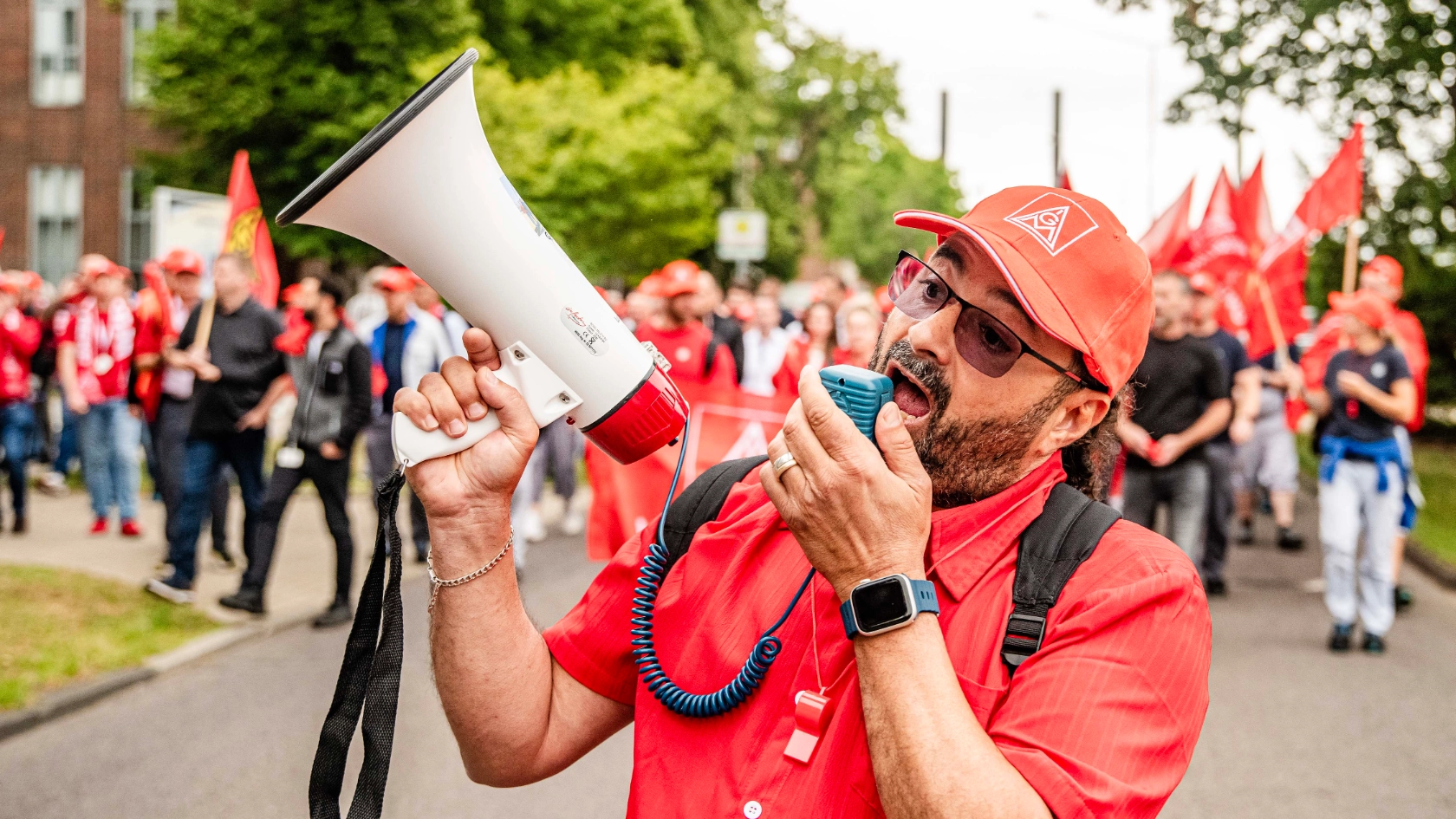
The news came as a shock to Manfred Tezky. It was an evening in late June, and the metalworker was sitting in front of the TV watching the news.
That’s when he heard it: The federal government wants to abolish the “block model” for partial retirement. The full pension after 45 years of insurance coverage (“Pension at 63”) is also set to be eliminated. The retirement age is set to rise.
“It was like the ground being pulled out from under my feet,” recalls the 58-year-old. “You work hard, do the math, and make plans, and then something like this happens.”
There’s a reason the metalworker is so alarmed: He signed his partial retirement agreement at the end of 2024. Everything was planned: the start date for partial retirement, the end date, and the start of his full pension.
His working life as a trained mechanical engineering technician was supposed to end in 2033. By then, he would be 65 years old and have a total of 48 years of insurance contributions in his pension account. A long life full of work. “You don’t enter into a partial retirement agreement on a whim,” says the metalworker. “It’s part of long-term life, career, and financial planning.”
He now sees this plan, built up over the years, in jeopardy. Many questions are swirling through his mind: Will there be a gap between the end of partial retirement and the start of his pension? Will he have to accept reductions in his pension? Will he be short on money during retirement?
The major pension reform is coming
The source of Manfred Tezky’s fears is the federal government’s Pension Commission. At the end of June, it presented 33 points for pension reform. The federal government intends to adopt these proposals in their entirety.
“All elements of this reform package must now be implemented swiftly,” said Chancellor Friedrich Merz (CDU) during the presentation of the commission’s report. The reform is intended to be a major undertaking and to restructure the statutory pension insurance system for the coming decades.
But what do the reform plans mean for working people—for people like Manfred Tezky?
Many questions remain unanswered. The Pension Commission’s recommendations are far from becoming law. A draft bill is expected in the fall. It will then have to pass through the Bundestag. A lot can happen in the meantime.
For partial retirement agreements already signed under the “block model,” there is likely to be grandfathering provisions for contracts already agreed upon . But for the future, this path to retirement could be blocked.
There are also other unresolved issues. The retirement age is set to rise, and the so-called“retirement at 63” programis to be phased out. This pushes the goal that employees must reach even further into the future. Or they will have to accept higher pension reductions than they anticipated when they signed their partial retirement agreement.
Partial retirement must end when the statutory old-age pension begins. If the retirement age is raised, plans would have to be adjusted accordingly. Policymakers have not yet provided an answer to the fact that, for many people in partial retirement, the conditions for their retirement could change.
Because so much remains unclear, pension plans are currently causing great uncertainty. In many companies, this uncertainty is palpable, reports Andrea Sicker, deputy executive director of IG Metall Bamberg: “When we provide information on this topic at company meetings, we receive many questions afterward.”
The impending elimination of the block model for partial retirement and the retirement option at age 63 are the most pressing issues in the current debate on social policy. “Our colleagues are worried about their life plans,” says the IG Metall representative.
Paths to Retirement
The industry has been cutting jobs on a massive scale for many months. Partial retirement is an important tool in this context. It enables a secure transition into retirement. It is used in many companies across the IG Metall sectors—reliably, based on collective bargaining agreements, and with good conditions for the affected colleagues.
The “block model” is the most common approach. Under this model, partial retirement is divided into two phases of equal length: In the first phase (the work phase), employees continue to work as usual. In the second phase (the leave phase), they no longer work.
Across all industries and occupations, the vast majority choose this option. The rate stands at around 80 percent.
IG Metall’s Social Affairs Director, Ralf Reinstädler, therefore calls the possible end of the block model “disastrous.” “Partial retirement is not an early retirement program,” he says. “Especially in the context of industrial transformation, it helps to shape the transition between generations in a socially responsible way, to support experienced employees in a dignified exit from working life, and at the same time to create opportunities for younger workers.”
Even employers are against it
The significant benefits are one reason why even employers want to keep the block model. Rainer Dulger, president of the employers’ association, calls it a “proven tool for managing the transition to retirement” that provides flexibility for both companies and employees. Dulger himself comes from the metal industry and is well acquainted with the conditions in the sector.
Without the block model, retirement would be less flexible. Employees and companies would be deprived of autonomy and decision-making power.
Yet the numbers regarding partial retirement are modest anyway. There is hardly any evidence of “mass early retirement.” In 2024, approximately 274,000 employees were in partial retirement. Fifteen years ago, the number was more than twice as high.
Above all, Manfred Tezky hopes that the all-clear will soon be given on this issue—so that he can carry out his life plans without further worries.
“I come from a working-class family where many died young,” says the metalworker. He wants to enjoy his retirement for a little while. “I’ll soon have worked for 45 years—at some point, enough is enough.”