Too Much and Too Long
One aspect often overlooked in the debate on working hours is the relationship between working hours and workload. The DGB figures speak for themselves here. Just under 30 percent of respondents state that the workload (very) often cannot be completed within the scheduled work hours. For 45 percent, this is rarely the case. Only one in four respondents reports being able to complete the workload within the scheduled work hours every time.
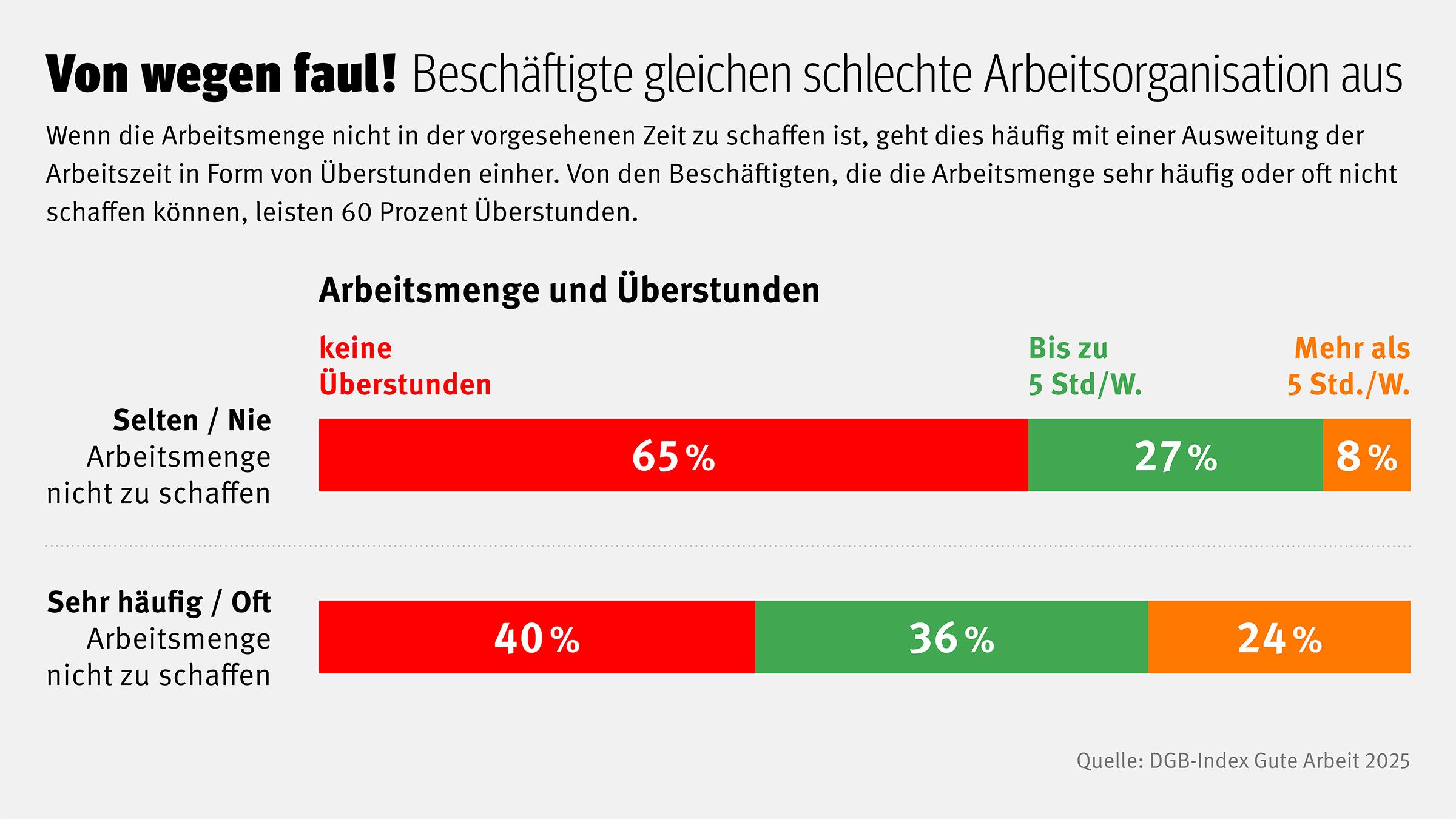
When the workload cannot be completed within the allotted time, this is often accompanied by an extension of working hours in the form of overtime. The study shows that among employees who are very often or often unable to complete their workload, 60 percent work overtime. For 24 percent, this amounts to more than five hours per week. Among those whose workload is never or rarely too high, 35 percent work overtime, and 8 percent work more than five hours of overtime.
“The DGB Index figures underscore that the myth of lazy workers is far from reality,” says Hans-Jürgen Urban, executive board member of IG Metall. “The majority of our colleagues report that, at least from time to time, the workload cannot be completed within the scheduled working hours. And it is precisely where this occurs more frequently that employees work longer hours. If this becomes a permanent condition, it takes a toll on their health. When employers then complain about high rates of sick leave, they should ensure that work is organized in a way that protects employees’ health—and not discuss cutting colleagues’ pay when they are sick.”
Strong Desire for Shorter Work Hours
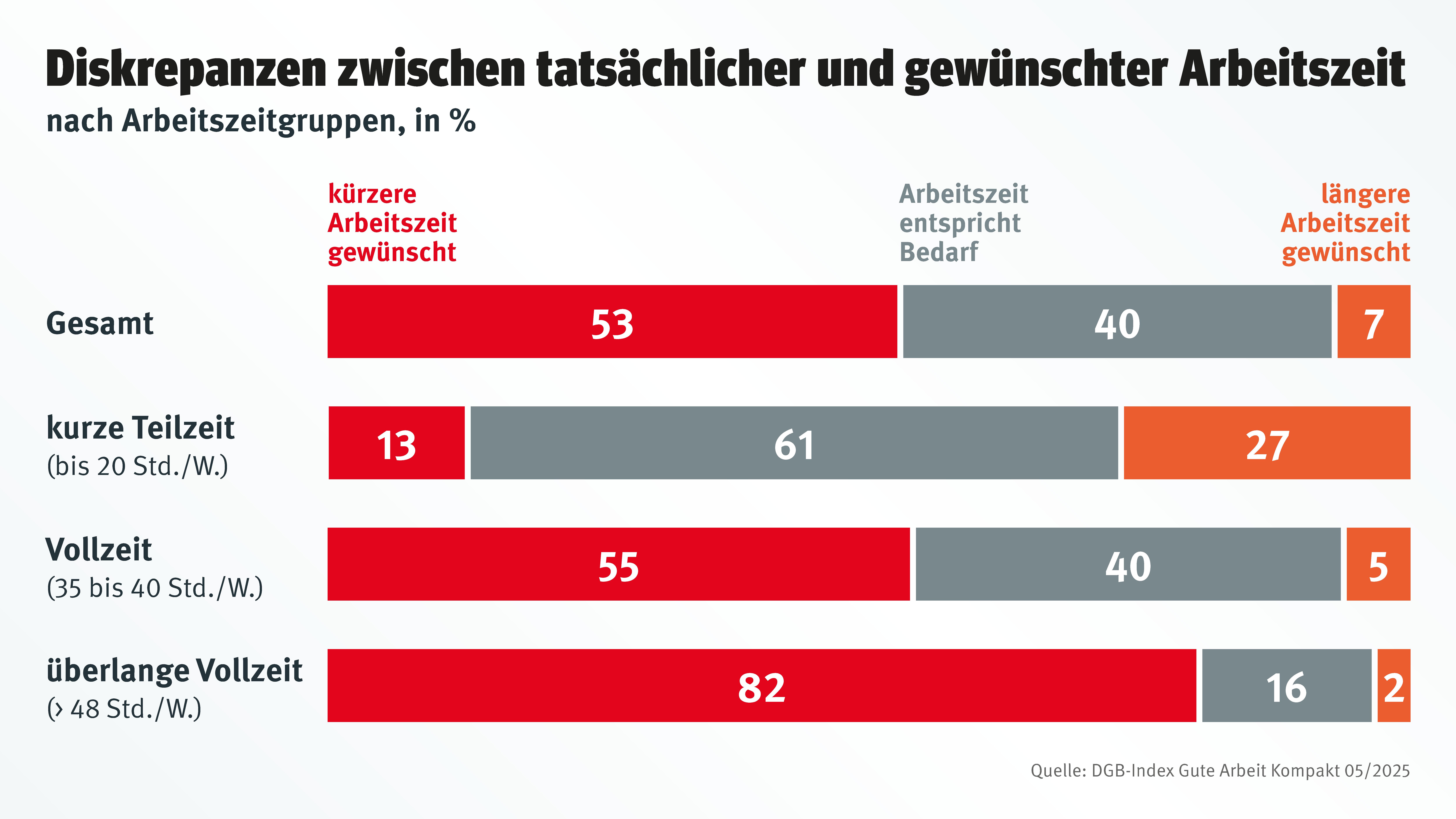
Overall, employees in Germany work varying numbers of hours: there is a wide variety of work-time models and a broad range of weekly working hours. Full-time employees work an average of 41.4 hours per week, while part-time employees work 25.2 hours. The average weekly working time is 36.3 hours
The longer the actual working hours, the stronger the desire to reduce them. This is particularly evident among employees with excessively long working hours: 80 percent of those who work more than 40 hours per week want to reduce their working hours—by an average of 7.2 hours. For workweeks exceeding 48 hours, employees even wish to reduce their hours by an average of 14.8 hours per week.
Significant Discrepancy Between Men and Women
The study’s data indicate a significant difference between men and women—both in terms of actual weekly working hours and desired working hours. While men work an average of 39.9 hours per week, women work 32.3 hours. A key reason for this gap is that working women are significantly more likely to bear the primary responsibility for caregiving tasks such as child care, caring for relatives, or housework.
A clear discrepancy between the genders is also evident in terms of desired working hours: men would like to work an average of 35 hours per week, while women prefer an average of 28.7 hours per week.
Employers Are an Obstacle to Flexible Work
The DGB study clearly shows that the biggest obstacle to implementing flexible work schedules is not the Working Hours Act. Employees’ desire for different work schedules usually fails due to rigid company structures, high workloads, or a lack of child care.
Among employees who would like to work fewer hours, the most common reasons are the specific way work is organized within the company, the heavy workload, and the financial losses associated with reducing hours. About 60 percent of respondents in each case state that work processes or the volume of work to be handled stand in the way of a reduction. A similarly high proportion (namely 59 percent) cannot afford to reduce their hours due to the resulting loss of income.
The most frequently cited obstacle to extending working hours, on the other hand, is work processes. Half of the respondents (51 percent) cite such workplace structures as the reason their desire for longer working hours has not been realized.
Collective bargaining agreements enable flexible work schedules for employees
Working hours that aren’t always dictated solely by the company—but sometimes tailored to employees’ needs? It’s possible: In recent years, IG Metall has secured collective bargaining agreements in an increasing number of industries and companies that give employees more say in their working hours.
In the metal and electrical industries, for example, employees have been entitled to what’s known as“short full-time”since 2019. This allows them to temporarily reduce their individual workweek to up to 28 hours. Employees with children, family members requiring care, and those working shifts can also apply for up to 8 additional days off per year through the so-called T-ZUG option.
Collective bargaining agreements now also offer the choice between pay and time off in the steel industry and in an increasing number of skilled trades sectors. A survey by the Institute for Employment Research (IAB) shows that around 59 percent of employees with such options under collective bargaining agreements choose to take more time off.