It is a fatal mistake: In the months following Adolf Hitler’s “seizure of power,” the independent unions still hope that the “Nazi nightmare” will soon be over—just like the constantly changing governments of previous years. “Organization instead of demonstration” and “Keep calm” were the slogans issued by the leadership of the General German Trade Union Federation (ADGB).
But on May 2, 1933, all hopes were dashed.
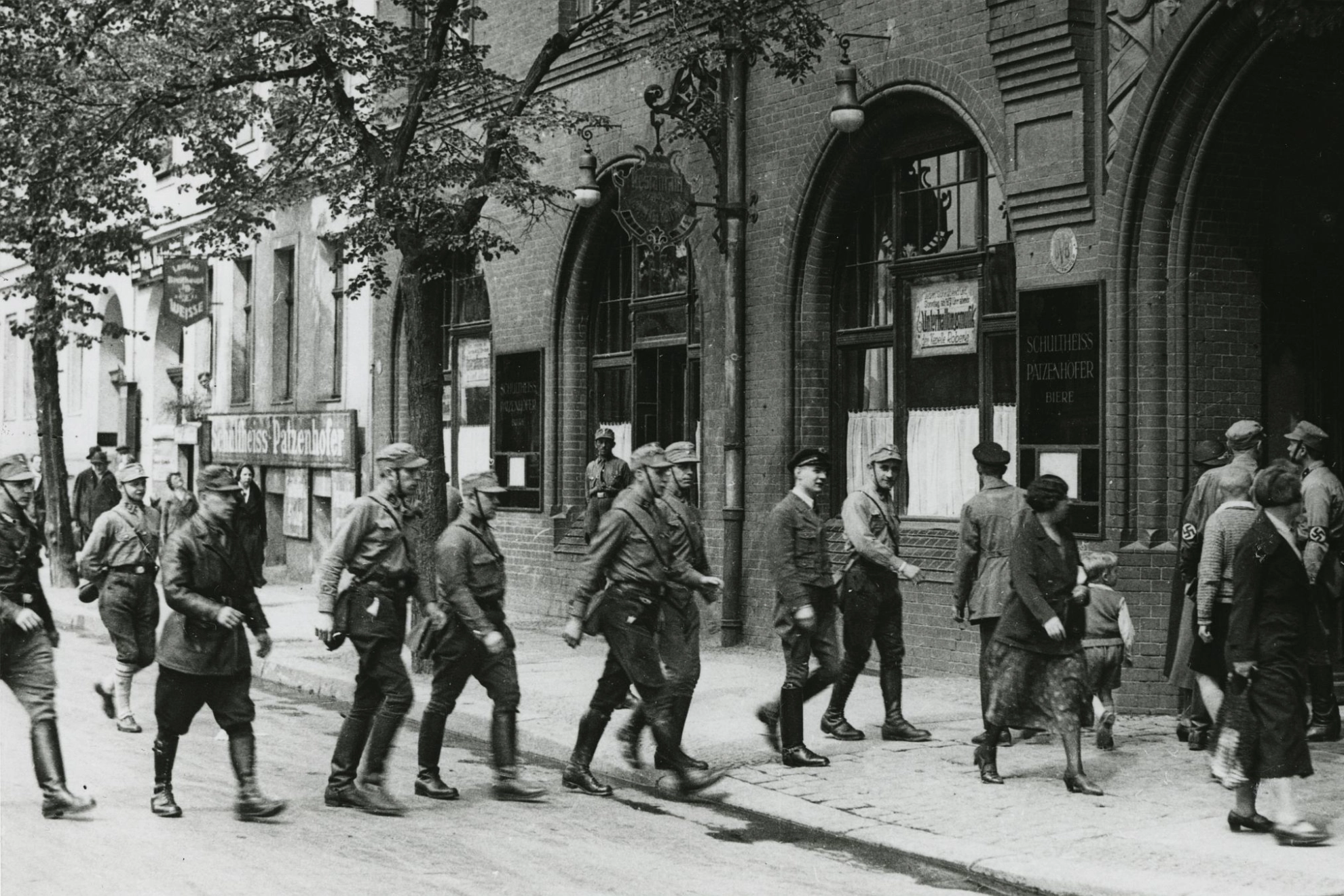
All across the country that day, SA squads pulled up in front of union buildings. They stormed the buildings, looted and ransacked them, and hoisted the swastika flag.
“The Nazis arrived in several buses, with crowds of SA youths from all over the surrounding area,” recalled the late Hans Schwert, who watched the storming of the trade union building in Frankfurt am Main from outside. “They kicked in the doors and beat our colleagues out onto the street.”
It was only on that day that many truly realized what was happening in Germany, according to the union leader, who later spent years himself in Nazi custody.
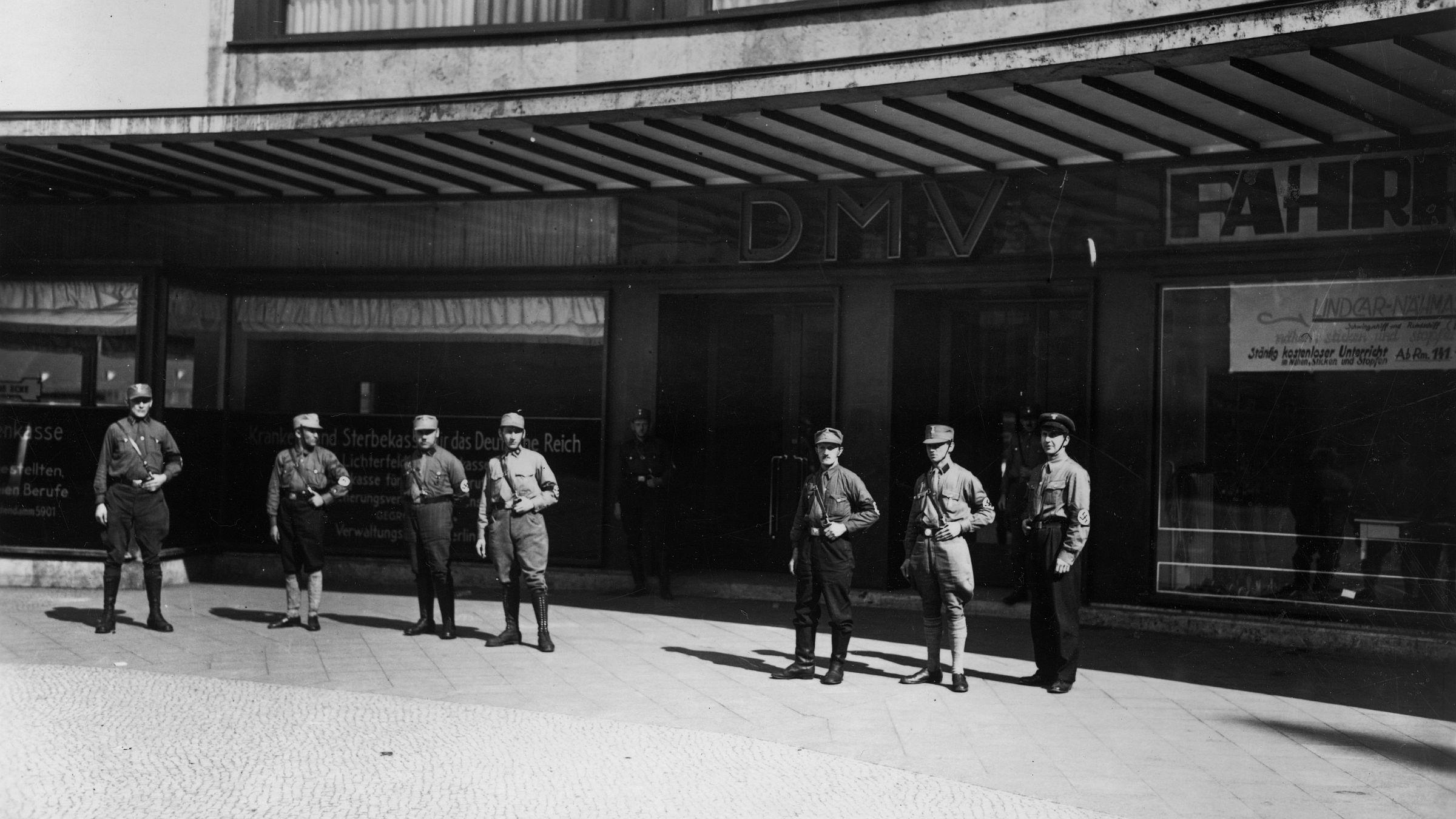
SA men in front of the Berlin headquarters of the German Metalworkers’ Association, the predecessor organization of IG Metall.
Photo: Kunstbibliothek / Photothek Willy Römer
Thousands were mistreated and arrested that day. Some were murdered on the spot. Others disappeared into prisons, penitentiaries, and concentration camps (KZ).
The Nazis confiscated the unions’ assets and transferred them to the newly founded German Labor Front (DAF). From then on, there was no longer any free representation of workers’ interests or co-determination for employees.
Shortly thereafter, the Nazis also banned the SPD and the Workers’ Welfare Association—thereby eliminating the last remaining organizations of the labor movement.
Weakened Unions
The labor unions were severely weakened by this point. In 1933, they had fewer than half as many members as they had in 1920. Nearly half of the remaining members were unemployed. This diminished the impact of a general strike, which the Communists in particular were calling for.
Added to this was the Nazis’ obvious willingness to use violence: the unions were up against half a million armed SA members. They could not count on the ultra-conservative Reichswehr.
So they try to adapt. In a letter to the government in April 1933, the ADGB declares its willingnessto “placeits organizationat the service of the new state.”
The idea behind this course of action: Open resistance would give the Nazis a pretext for a coup d’état. The ADGB does not want to stray from the constitution—even though the Nazis have long since done so and are merely maintaining the appearance of legality.
A Stolen Day
The day before the crackdown, Hitler rebrands the labor movement’s Day of Struggle as “National Labor Day.” May 1 becomes a legal holiday for the first time—with pay.
At Tempelhofer Feld in Berlin, the Nazis organize a massive propaganda spectacle with around one million participants, including an air show and fireworks. Thousands of union members march along, gritting their teeth.
But their destruction had long since been decided. Hitler and his propaganda minister, Goebbels, already had the plan for May 2 in place by mid-April. A secret circular sent to all Nazi departments states: “Tuesday, May 2, 1933, at 10 a.m., the forced alignment against the free trade unions will begin.”
The dictatorship arrives more quickly and brutally than the union leadership could ever have anticipated. It has been barely more than three months since Reich President Hindenburg appointed Hitler as Reich Chancellor. By then, the Nazis were actually already on the decline. In the Reichstag election of November 1932, the NSDAP had achieved only 32 percent—five percent less than in July 1932. Yet conservative politicians and business leaders persuaded Hindenburg to hand over power to Hitler.
By Force
In the weeks following January 30, 1933, the Nazis overhauled the rule of law by brute force. The civil service and police were “purged” and brought into line with Nazi ideology. From left to right, the National Socialists eliminated all opponents: Communists, Social Democrats, trade unionists, and Jews were terrorized, mistreated, and deported to the first makeshift concentration camps. The republic and the rule of law were dead just a few weeks after Hitler took office.
Even before May 2, the Nazis raided individual union headquarters. According to a letter from the ADGB to Reich President Hindenburg, 25 union headquarters had already been permanently occupied by March 1933.
With the“Enabling Act”of March 1933, the Nazi government stripped Parliament of its powers. The Nazis secured the necessary two-thirds majority in the Reichstag by banning the Communist Party and revoking its seats. The SPD voted against the law. Many members of Parliament, including numerous trade unionists, later paid for their courage with their lives in concentration camps.
Learning from History
In prisons and concentration camps, trade unionists of various political persuasions—Social Democrats, Communists, and Christians—came together. During the Weimar Republic, they had been at odds with one another. Now they realized that their disunity had paved the way for the Nazis. Together, they mounted resistance.
After World War II, they founded new“unified trade unions”in which all political factions were represented. Never again would the labor movement be fragmented—and thus weak. The fatal mistake of the spring of 1933 would never be repeated.