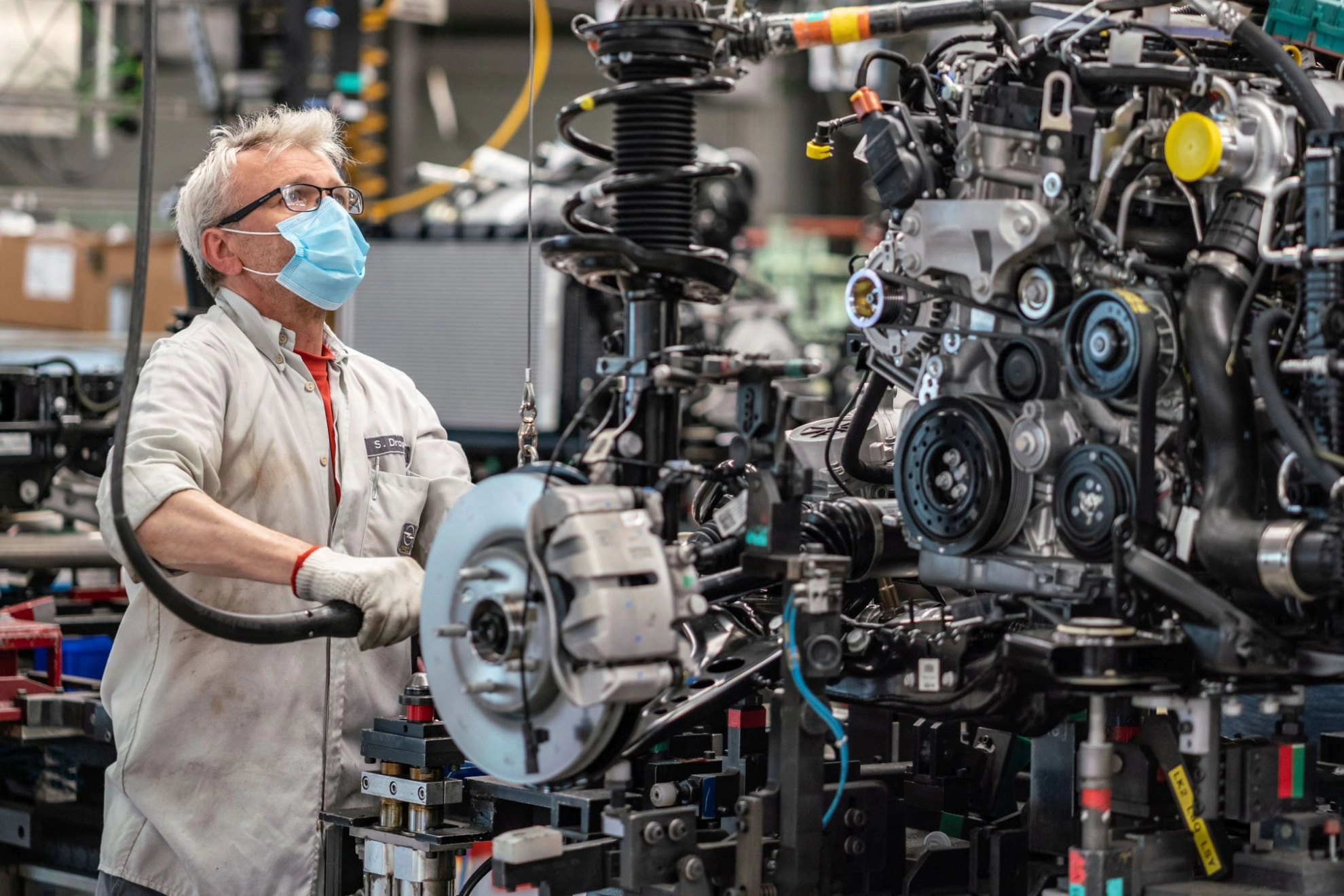
On Tuesday, there was a works meeting at Opel in Eisenach; at that point, the employees had no idea they would be placed on short-time work for three months. Then, on Wednesday evening, the company dropped the bombshell. The chip shortage would force them to halt production until Christmas: zero short-time work. Employees are to stay home. The announcement shortly after the town hall meeting shows that management was shying away from critical questions from the workforce and works councils.
This is not surprising, because something about this story just doesn’t add up. Thuringia’s Minister President suspects as much and smells a scam at the expense of employees and taxpayers. Meanwhile, IG Metall and the Opel works councils see further red lines that the parent company, Stellantis, is clearly crossing.
Minister President Suspects Deception
The current short-time work regulations in Germany help secure employment during the COVID-19 crisis. IG Metall had therefore called for simplified short-time work regulations, and the Ministry of Labor, led by Hubertus Heil (SPD), delivered. Just under three weeks ago, the Federal Ministry extended the regulations once again. As a result, until the end of the year, only 10 percent of a company’s workforce needs to be affected by the loss of work for the company to be eligible for short-time work. Furthermore, the Federal Employment Agency will continue to reimburse employers in full for social security contributions during short-time work. The idea behind this is that a crisis through no fault of their own—such as the COVID-19 pandemic—must not come at the expense of employees. The 2008 financial crisis also showed that companies that place their employees on short-time work instead of laying them off recover more quickly from the crisis.
So is Opel within its rights to extend the short-time work—which has been in place at the plant for quite some time—to the last shift as well, effectively shutting down operations for the coming months? Thuringia’s Minister President Bodo Ramelow doubts it. The politician accuses the company of solving its problems at the expense of taxpayers. “The question is whether the short-time work benefits are factored into the company’s own overall productivity calculations,” Ramelow told MDR. If the global corporation believes it has weathered the crisis well, then that would be a “bitter shifting of the blame for its own failure onto the backs of taxpayers.”
Dutch Management Distributes the Chips
Does the “Dutch” conglomerate Stellantis intend to enrich itself at the expense of German taxpayers, as Ramelow suspects? The fact is: Computer chips, which are now installed in cars in large numbers, are in short supply, and some manufacturers have therefore already had to resort to short-time work. But it’s also a fact that Stellantis, which owns the Opel Group, continues to build cars. Admittedly, fewer than they’d like, but the assembly lines aren’t at a standstill at all plants. Which plants receive the coveted chips and which come up empty—and thus have to scale back or even halt production—is decided by the corporate headquarters in the European tax haven of Amsterdam.
If Stellantis has its way, Eisenach will now be among the losers, with the plant set to keep its doors closed until the end of the year. Uwe Baum, chairman of Opel’s general works council—who himself first learned of his parent company’s plans from the newspaper—sharply criticizes them: “Until now, there was a gentlemen’s agreement that the chips would be distributed among all plants so that production could continue everywhere. Now, of all places, the plant in Eisenach is supposed to come away empty-handed,” said the union representative.
The Grandland Must Stay in Eisenach
In Eisenach, workers build the Opel Grandland. So will production of that model be halted for now? No, it will continue to be produced. It’s just that, for the time being, it will be built again in Sochaux, France. The irony of the situation: The French have long since removed the Grandland from their production portfolio. “Starting it up there now is like launching production of an entirely new car. That costs a lot of time and money,” explains Bernd Lösche, works council chairman in Eisenach.
For Lösche, the attempt to shut down production in Eisenach for the next three months and shift production to Sochaux at the expense of the employees in Eisenach and German taxpayers is the first red line. However, the company could get away with it due to a loophole in the law.
The works council chair has had enough when it comes to the Grandland facelift: Employees in Eisenach were actually supposed to start building the new version of the Grandland now, as it’s set to be available at dealerships soon. If Stellantis is now planning to build the Grandland with the redesigned body in France as well, they would be stealing the Eisenach employees’ product for the next few years. “We won’t let them do that to us,” Lösche declares. General Works Council Chair Baum emphasizes that it cannot be in Stellantis’s interest to take work away from the employees, since layoffs for operational reasons are ruled out for all Opel sites through 2025. IG Metall and the works councils had secured this provision in the future collective bargaining agreement.
Up to 11 million cars will not be built
Not only Opel, but also Volkswagen, Daimler, BMW, and Ford have already had to shut down operations for many weeks this year because there aren’t enough semiconductors available on the market. Around the world, automakers—as well as companies like Sony and Microsoft—don’t know how to satisfy their hunger for chips. The result in the consumer electronics sector: Sony’s and Microsoft’s new game consoles, the PlayStation 5 and the Xbox Series X, have been sold out for months.
Instead of raking in big profits from gamers with their new products, they’re plagued by production bottlenecks. And the chip shortage is also severely slowing down the recovery in the automotive industry, which is now beginning after difficult months of the COVID-19 pandemic. The consulting firm Boston Consulting estimates that ten to eleven million vehicles will not be built this year. The chaos is due to globalization taken to extremes and management errors in the auto industry.
Globalization and Management Mistakes Destroyed Value Creation
Demand for semiconductors has skyrocketed. Hardly any electronic device can function without silicon chips anymore. Yet even though chips are in such high demand, price competition in this segment is extremely fierce. As a result, semiconductor production is now almost exclusively concentrated in the Far East. And manufacturers there must operate at full capacity; otherwise, the business is not profitable. Consequently, they are hesitant to expand their operations, especially since it was recently impossible to predict how long the COVID-19 pandemic would continue to slow sales of cars and other products.
But car manufacturers are also to blame for their predicament: When car sales plummeted during the COVID-19 pandemic, they canceled their chip orders, thinking they could get them back on the market at any time. Fat chance. When the economy recovered and the manufacturers wanted to get back on track, others were faster. They snatched the chips right out from under Stellantis & Co.’s noses.
“The market will sort it out” is a favorite phrase of neoliberal managers. But what these so-called “economic experts” tend to forget is that this usually takes a very long time. And the situation with chips is no different. It isn’t until the middle of next year that the demand for raw materials is expected to slowly start being met again. For German manufacturers, however, there is a ray of hope coming from “Silicon Saxony”: Bosch’s new chip factory, which just began operations in Dresden, will also help, at least in part, to clear the backlog of demand. The supplier is demonstrating that chip production is a topic of the future and a profitable business in Germany as well. Politicians and companies should follow this example and continue to promote chip production throughout Europe to make domestic industry less dependent on the global market.
Stellantis Avoids Taking a Clear Stance on Eisenach
It remains quite unclear whether short-time work in Eisenach will end in January and production will finally get back on track. Stellantis wants to keep all its options open here. The company only states that it intends to resume production in January, provided the chip shortage has been resolved by then. However, experts now predict that the semiconductor market will remain tight until the middle of next year. On top of that, the chip shortage in Eisenach stems from the executive suite at the company’s headquarters in Amsterdam.
“Stellantis’s vague statements are of no use to the employees or to us on the works council,” complains Lösche, chairman of the Eisenach works council. He is calling on management to speak plainly. Although short-time work benefits are being increased to 92 percent thanks to IG Metall and the Opel works councils, the time off will not feel like paid vacation for the metalworkers at Opel Eisenach. There is widespread fear that the company is planning to close the plant in the long term. The fact that employees in Eisenach are on edge stems from the strict cost-cutting program that has been in place for years. It has gone so far that the grass around the plant is no longer being mowed. Instead of a technology company, the Eisenach facility now looks more like an industrial ruin.
IG Metall Fights for Hard-Hit Western Thuringia
Plant closures have dominated the landscape in Western Thuringia in recent years. Suppliers were particularly hard hit. “Companies like JD Norman, Mitec, Plastic Omnium, and Autotest had to close or were taken over by new owners. The bottom line has always been massive job cuts,” reports Uwe Laubach, IG Metall’s representative in Eisenach. Instead of genuine transformation through the development of new products, Laubach criticizes the responsible corporate leaders, noting that so far, only job cuts have been evident in his region. So he’s not surprised that Opel workers in Eisenach are nervous.
He intends to fight for the employees and for a successful transformation. So do the works councils and employees at Opel. IG Metall has already secured political support for the region. As a result, IG Metall is in the process of establishing a transformation network that will support the shift toward climate-neutral mobility. In addition, politicians—not only from Thuringia but also from Berlin—have pledged to closely scrutinize Stellantis’s actions in Eisenach.