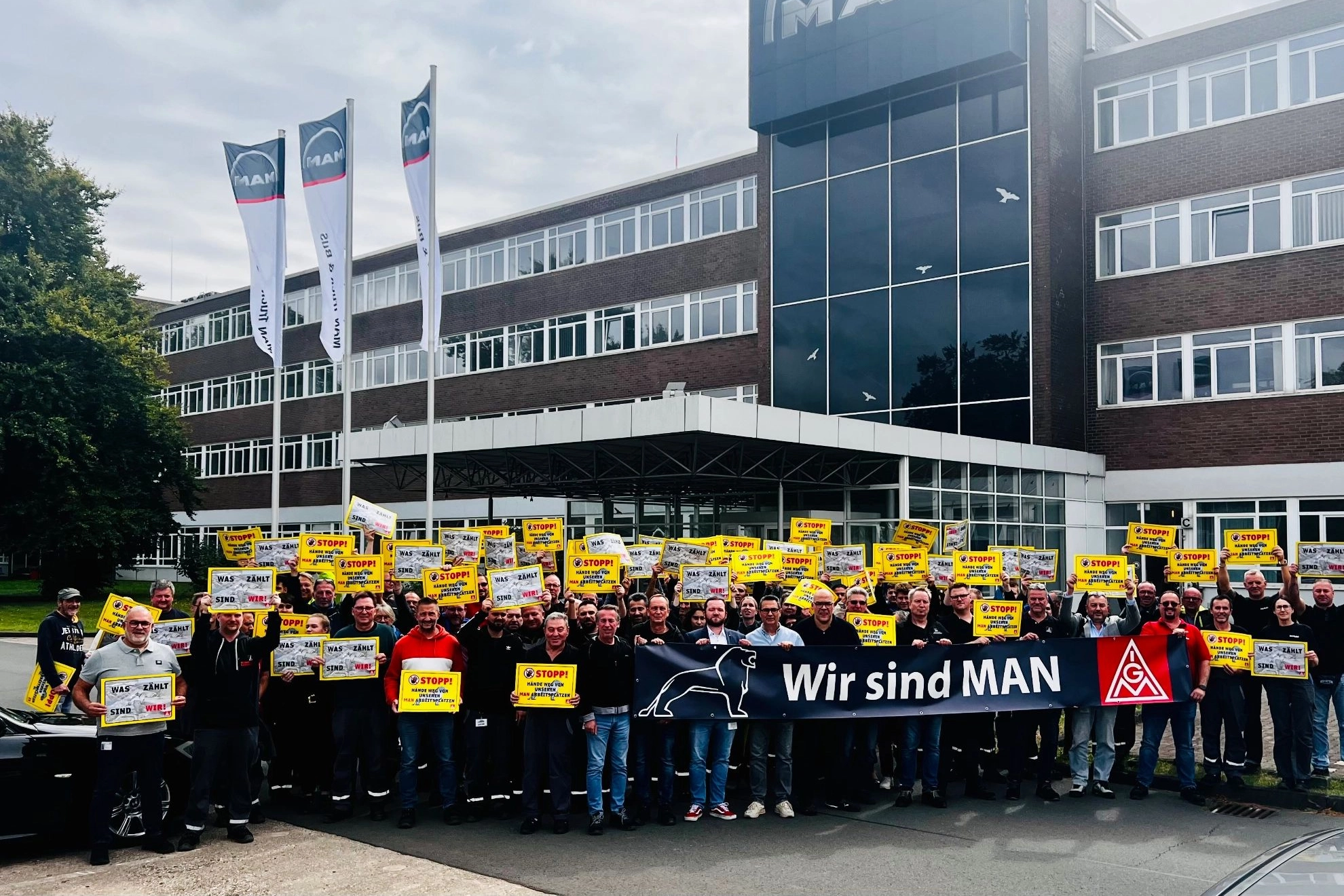
Mass layoffs at MAN Truck & Bus in Salzgitter were set to begin as early as January 2027. According to the corporate management’s plan, wheel flanges, steering knuckles, crankshafts, and other components were to be gradually relocated to existing facilities in Eastern Europe, and up to 1,300 of the 2,161 jobs were to be cut—despite high profits. Only spare parts logistics were to remain.
Pressure Applied Through Protests
But that is no longer on the table. Following intensive and at times difficult negotiations, IG Metall and the management of MAN Truck & Bus SE have reached a far-reaching collective bargaining agreement for the Salzgitter site. The agreement provides long-term protection for employees, safeguards local industrial value creation, and establishes binding foundations for a transformation characterized by worker participation and social justice.
The production of truck components at MAN in Salzgitter will remain in place. There will be no layoffs, and redundancies for operational reasons are ruled out until at least 2035.
In addition, employees now have a say in the future of their site: The collective bargaining agreement also includes the establishment of a joint steering committee for the transformation. In recent weeks, experts, skilled workers, and managers have already developed numerous proposals and, in some cases, carried out detailed cost analyses—ranging from optimizing machine utilization times to potential new products.
“In a challenging economic situation, we have succeeded in averting a brutal, uninspired gutting of our site,” explains Hüseyin Uc, chairman of the works council at MAN in Salzgitter. “We were able to prevent layoffs for operational reasons, secure an employment guarantee through 2035—with an option to extend it through 2040—and at the same time secure important investment commitments for our site.”
A Say in the Future—No Sacrifice of Pay
In return, the employees are not giving up any money or other benefits covered by the collective bargaining agreement. The employer is even paying them back money that it had already taken away: Management unilaterally terminated works agreements regarding bonuses and allowances. With their January paychecks, employees received several hundred euros less. The pressure was enormous.
“The way they threatened us—saying they’d relocate everything—is something I’ve never experienced in 16 years of collective bargaining,” says chief negotiator Carsten Maaß, collective bargaining secretary for the Lower Saxony and Saxony-Anhalt regional leadership. “But the employees stood up to the pressure—and even asked us which plant gate we would close first. This collective bargaining outcome is no coincidence; it is the result of solidarity in action. United ranks and an exceptionally high level of unionization within IG Metall turned individual hardship into effective bargaining power.”
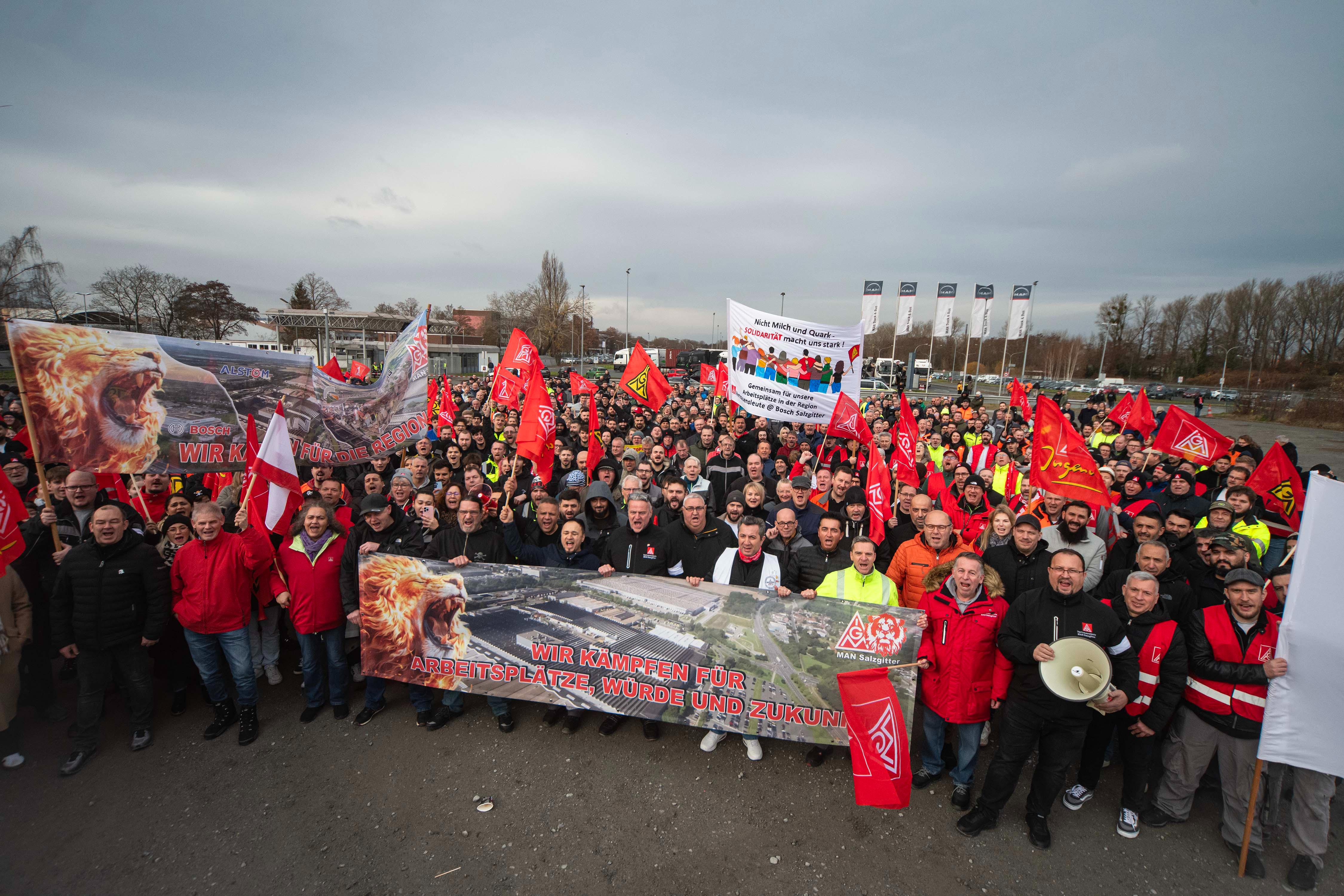
Demonstration at MAN Salzgitter, supported by metalworkers from other plants.
Employers and employees are now jointly realigning the Salzgitter site. Jobs lost as a result of the transformation will be phased out exclusively in a socially responsible manner through demographic measures, such as partial retirement. However, the expansion of spare parts logistics in Salzgitter will also create new jobs. MAN has provided a job guarantee through 2035; there is even the possibility that additional staff will need to be hired starting in 2030.
The Salzgitter site will now have its own binding industrial vision, based on maintaining and modernizing key production areas as well as expanding spare parts logistics as a core competence location. MAN is investing 59 million euros for this purpose. Within the steering committee, company management, the works council, and IG Metall are jointly developing and steering future products, competencies, and industrial development steps. The goal: new products should be strategically located in Salzgitter whenever economically viable.
“We’re not undergoing a ‘chainsaw transformation ’ here; instead, the future at MAN in Salzgitter is being shaped together with the team,” explains Andrea Deiana, deputy works council chair and head of the IG Metall shop stewards at MAN in Salzgitter. “The workforce remains on board; no one will lose their job. Furthermore, employees do not have to make any concessions under the collective bargaining agreement—that’s an important signal. Without a strong IG Metall standing alongside the workforce, our plant would be nothing more than an empty shell—without production and without people.”
For more information and background, contact IG Metall Lower Saxony-Saxony-Anhalt and IG Metall Salzgitter-Peine.