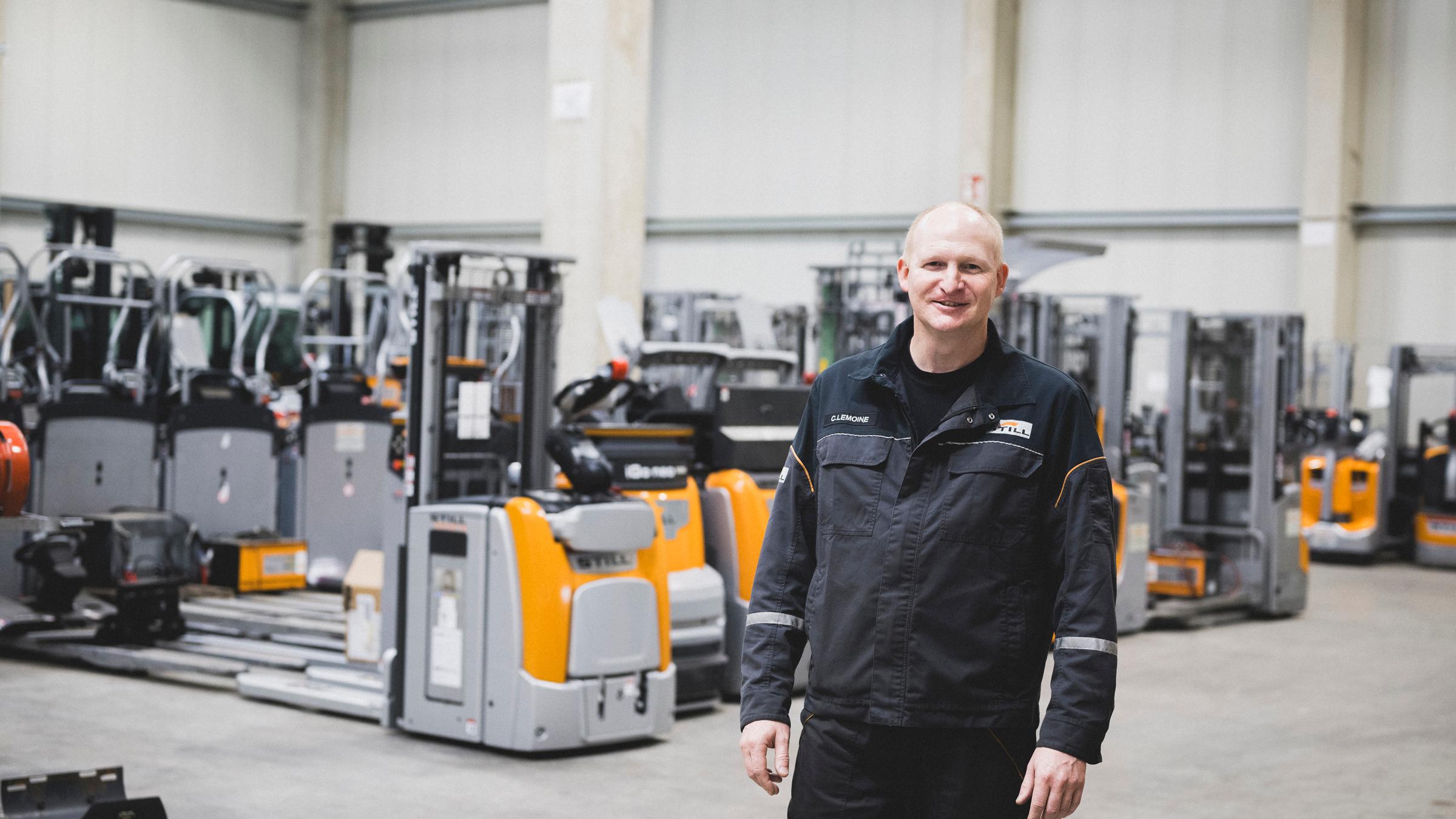
Christopher Lemoine is constantly on the road—and usually on his own: As a service technician at STILL, a manufacturer of industrial trucks and provider of intralogistics solutions, he maintains and repairs forklifts used in industrial and other facilities. Based at the STILL branch in Fürth/Nuremberg, he and his colleagues cover the entire northern half of Bavaria. Depending on where he lives and where he’s assigned, that means spending a lot of time in the car.
The car is also his office: In recent years, service technicians—like many other field employees—have had to take on more and more administrative work. Christopher makes phone calls and holds video conferences from his car.
Christopher has an additional special responsibility: he serves on the works council (BR). He often advises colleagues from his car, helps them out, or takes their questions with him to address them later at the branch office or from home at his leisure.
Balancing Work and the Works Council
“There are days when I handle various works council meetings on the go from my car and have to interrupt my work with the customer,” Christopher reports. “If I know I have several works council meetings in a row, I try to handle them from the branch office or from home and drive to the client’s site before or after. It gets tricky when colleagues call you while you’re at the client’s site and have an issue they need addressed.”
Work on the works council is actually supposed to take place during working hours. But Christopher can’t just put his service work at the client’s site on hold, even if he had a lot of works council work that day.
Christopher Lemoine services and repairs STILL industrial trucks directly at customers’ facilities.
“When I invite Chris to meetings, I always feel a little guilty because I don’t know what situation he’s in,” says Thomas Dresler, Christopher’s works council chair at STILL Bavaria, who works at the Munich headquarters—often on the go. “In a normal workplace, you can check out with your manager—and it’s clear: you’re going to do works council work for now. But Chris always has the customer in the background who needs his technician.”
Works Council More of an Obstacle to Career Advancement
The media often reports on “powerful” works council members in large industrial companies who earn as much as managers. But the reality for the vast majority of works council members is quite different. Christopher isn’t paid any better than his colleagues. On the contrary: Many see a works council position more as an obstacle to their career.
“If you’re less available as a technician, you can’t take on the more demanding jobs for customers—especially not the ones where you have to react quickly,” explains Christopher Lemoine. “I’ve already had to turn down quite a few of those.”
The result: Even though works council work offers members like Christopher many benefits—he develops specialized knowledge and leadership skills—and is therefore also a gain for the company and its employees, works council members run the risk of earning less money than their colleagues in the long run.
This also applies to works council members who are released from their regular jobs, such as works council chair Thomas Dresler, who has been working exclusively on works council duties since 2017. Before that, the trained mechatronics technician first worked as a service technician and then in field sales. A large portion of his pay consisted of commissions on his sales. In Thomas Dresler’s case, the works council did succeed in having an average commission rate “indexed to the collective bargaining agreement.” This means that his previous average commission becomes a fixed component of his pay and increases in line with collective bargaining raises. However, a 100 percent transparent pay structure, comparable to that of his colleagues in sales, is not guaranteed.
The compensation of works council members is highly controversial from a legal standpoint
In fact, Section 37 of the Works Constitution Act states: “Members of the works council shall be released from their professional duties without any reduction in pay” and “The pay of works council members shall not […] be set at a lower level than the pay of comparable employees with a career progression typical for the company.”
But what constitutes “comparable employees” and “career progression typical for the company”? In practice, this is a recurring source of dispute. Often, there are no “comparable employees” with “career progression typical for the company” at the workplace. And what about all the qualifications that works council members acquire in the course of their duties—for example, through IG Metall training in labor law and economics —and the responsibility they bear for the company and its employees, such as in negotiations with the employer?
Earlier this year, a ruling by the Federal Court of Justice (BGH)—which does not actually have jurisdiction over labor law—on works council compensation at VW caused even more unrest. Since then, numerous employers have been attempting to cut their works council members’ salaries, in some cases drastically. There are now dozens of ongoing lawsuits regarding compensation.
This frustrates Thomas Dresler. Even more disadvantages—even though the demands of works council work have increased steadily in recent years, for example due to ever-more frequent corporate restructurings and digitalization. He sees the risk that employees will no longer want to run for the works council and certainly will not want to take time off for it, especially in companies with a high proportion of field staff. In his view, legislative action is needed to address this issue, Thomas Dresler reports. “I’ve already spoken with members of the Bundestag about this.”
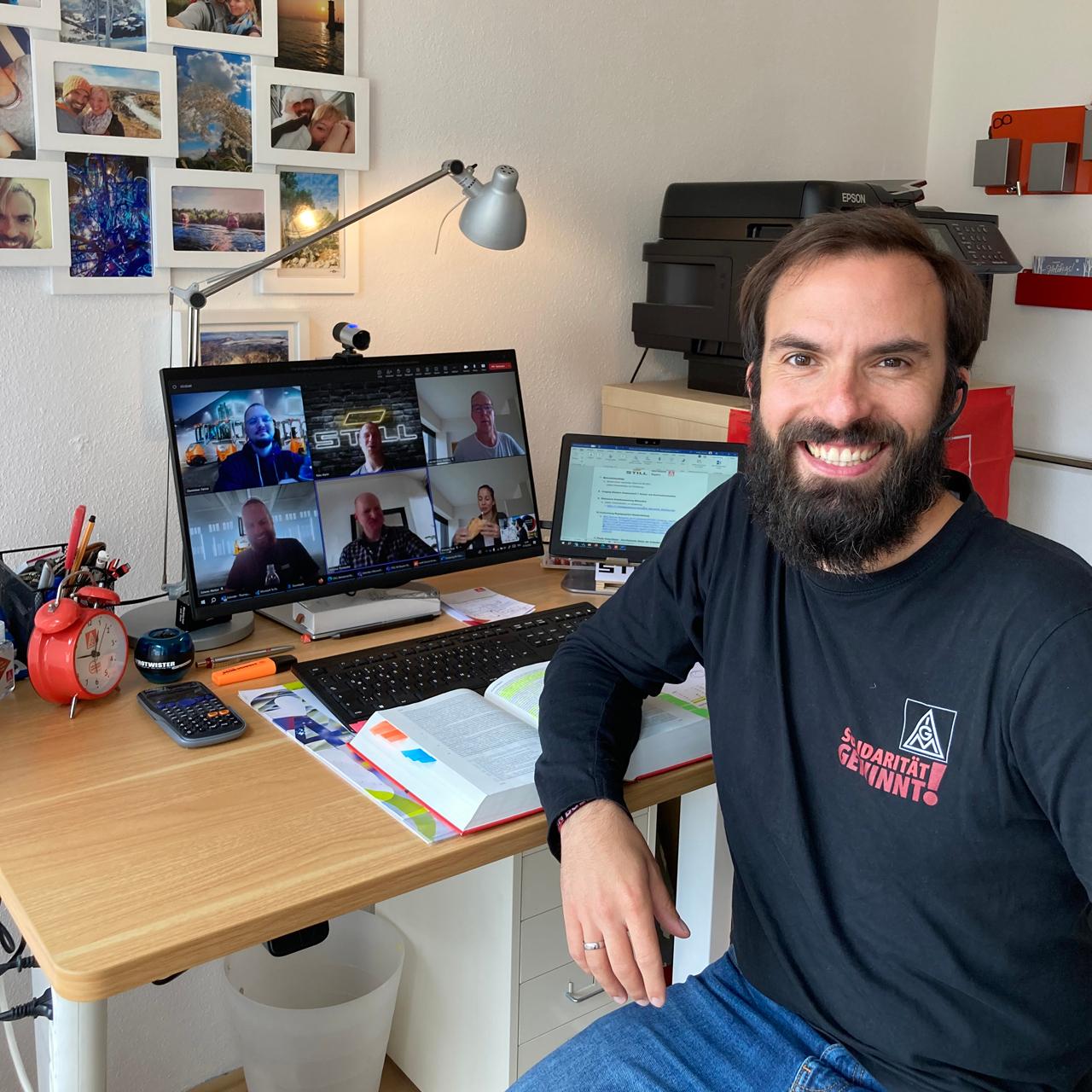
Thomas Dresler, Works Council Chair at STILL Bavaria, on the job.
IG Metall and the DGB are now pushing for a legally certain framework for works councils. The Federal Ministry of Labor and Social Affairs (BMAS) has commissioned experts to develop reform proposals. Initial rulings by labor courts in Bremen and Braunschweig also show that the salary cuts imposed on works council members were unjustified and that the Federal Court of Justice (BGH) likely misinterpreted the legal situation.
How to attract new candidates for the works council?
Christopher knew it would be difficult when his former works council chair approached him ten years ago—even though works council work wasn’t as complex back then as it is today.
But Chris ran for the works council anyway. He has always been socially active. “I do this because it’s important that we, as employees, can participate, have a say, and help shape things. Collective bargaining agreements, laws—these need to be implemented and defended. If we as employees don’t do that ourselves, then who will?”
That’s why Christopher, Thomas, and the other works council members at STILL Bavaria invest a lot of time and energy in recruiting candidates for the works council and for active participation, such as serving as IG Metall shop stewards. They reach out to employees. And for several years now, they’ve been taking interested employees to weekend conferences. At the next one in November, 23 interested employees will be attending again. There, they discuss problems and work out very concrete solutions.
“We ask: What’s bothering you? What could be improved? Do managers have solutions for this? What alternative ideas do you have?” explains Thomas Dresler. “Then we look at the Works Constitution Act together and let the people themselves work out options for action.”
Time and again, this approach inspires employees to get involved in works council work: In the last two works council elections, they had twice as many candidates as there were seats to be filled.
“This ensures a broad democratic base,” says Thomas Dresler. “Ultimately, this is both good and sensible: Because regardless of the issues surrounding the compensation and professional development of works council members—which urgently need to be resolved—working on the works council offers more than just financial compensation: Solidarity, personal growth, and the ability to make a difference—rather than just focusing on one’s own job duties—is a value in itself that we as employees should cherish.”