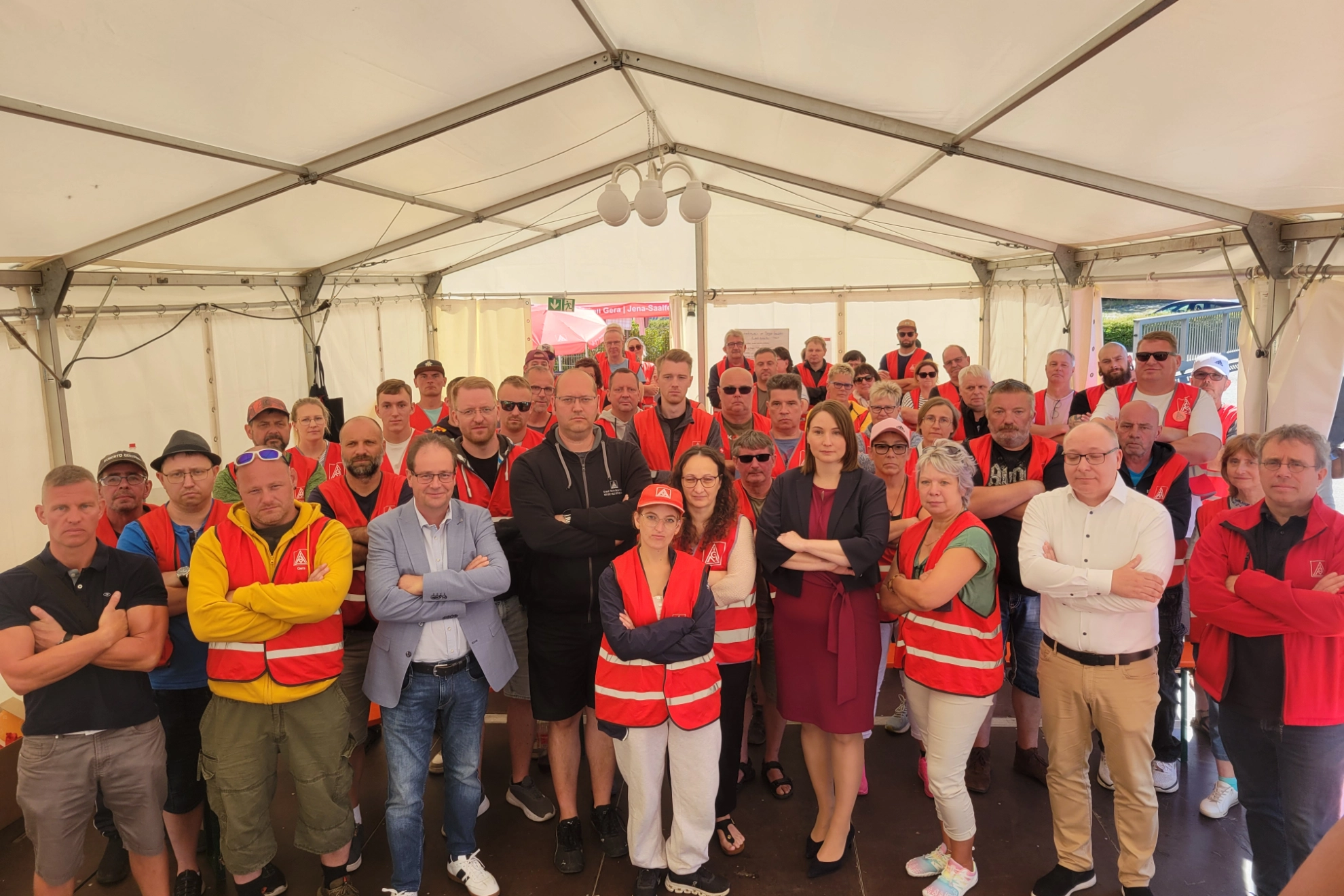
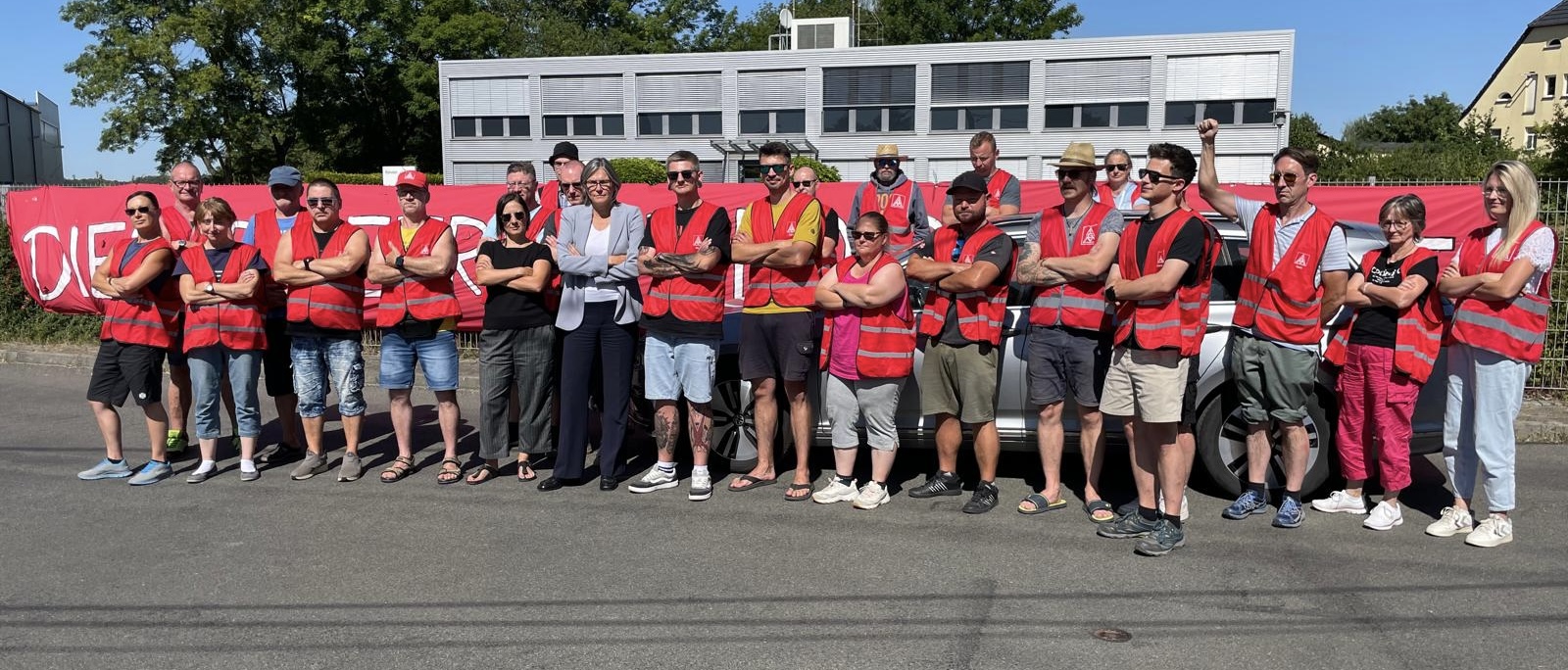
After nearly four weeks on strike, employees and IG Metall have secured a social collective bargaining agreement at Kelvion Brazed PHE GmbH in Nobitz-Wilchwitz (Thuringia). With over 80 percent in favor, the approximately 230 IG Metall members at the plant voted for the social collective bargaining agreement offered by management following negotiations: severance pay of up to 1.5 months’ salary per year of service for employees up to age 59 (decreasing linearly thereafter), a transition program with income supplementation and a training budget, an increase in strike pay, and a ban on layoffs for operational reasons through December 31, 2026.
The 230 IG Metall members at Kelvion in Wilchwitz had been on strike since August 4. By the end of the year, management plans to relocate heat exchanger production—not to a low-wage country, but to the west, to Sarstedt in Lower Saxony.
“With the first indefinite strike in eastern Thuringia in 35 years, we have achieved a historic union victory. Through determination and unity, we have succeeded in forcing management to take responsibility for a plant closure that is more than questionable,” explains strike leader Tom Knedlhanz of IG Metall Gera. “The fact that our colleagues withstood every form of pressure for weeks impressively demonstrates the strength of our colleagues, who have been the backbone of this plant for decades. This is a testament to our workers’ power. Our message is: It’s worth fighting for!”
With the collective bargaining agreement now in place, the way is clear for at least a partial takeover by an industrial investor. Talks are ongoing.
Questionable Relocation Came as a Complete Surprise
On May 8, Kelvion management announced the relocation and closure to the employees—on a Friday, without any explanation. From the employees’ perspective, the relocation to the west makes no sense at all. The plant in Wilchwitz is profitable and has a full order book. Its plate heat exchangers are used in heat pumps, air conditioning systems, wind turbines, and even data centers—“products of the future made in Germany,” as the employees here say. In addition, wages in Sarstadt, Lower Saxony, are higher—management sometimes touts a 25 percent wage increase.
IG Metall and the workers cannot prevent the relocation itself. Under German law, decisions regarding business locations fall under the freedom of enterprise. However, it is possible to demand and enforce a social collective bargaining agreement to mitigate the consequences of the relocation for the workers.
100 Percent in Favor of a Strike – Nationwide Solidarity
After the relocation plans were announced in May, the IG Metall bargaining committee at Kelvion negotiated with management four times—without success. After even the sixth warning strike failed to persuade management to back down, 100 percent of IG Metall members at the plant (93 percent of the workforce) voted in favor of a strike in a strike ballot on August 3.
Solidarity with the strikers grew nationwide. Bundestag Vice President Bodo Ramelow (The Left) visited to show his support, as did Thuringia’s Minister of Labor Katharina Schenk (SPD). Employees at other Kelvion locations also stood behind them. For example, employees of Kelvion Machine Cooling Systems in Monzingen demonstrated their solidarity in front of the plant during a works meeting. Employees at the main plant in Sarstedt, Lower Saxony—where production is slated to be relocated—also reacted with disbelief to the relocation plans.
“What is happening at Kelvion is of nationwide significance,” emphasized IG Metall President Christiane Benner during her visit to the strikers in Wilchwitz. “We must not accept deindustrialization like we saw in the 1990s.”
Further information, photos, videos, and background details are available fromIG Metall Gera-Jena-Saalfeld.












To load this video, you must enable YouTube cookies and thereby agree to the YouTube privacy policy.