Regional Offices
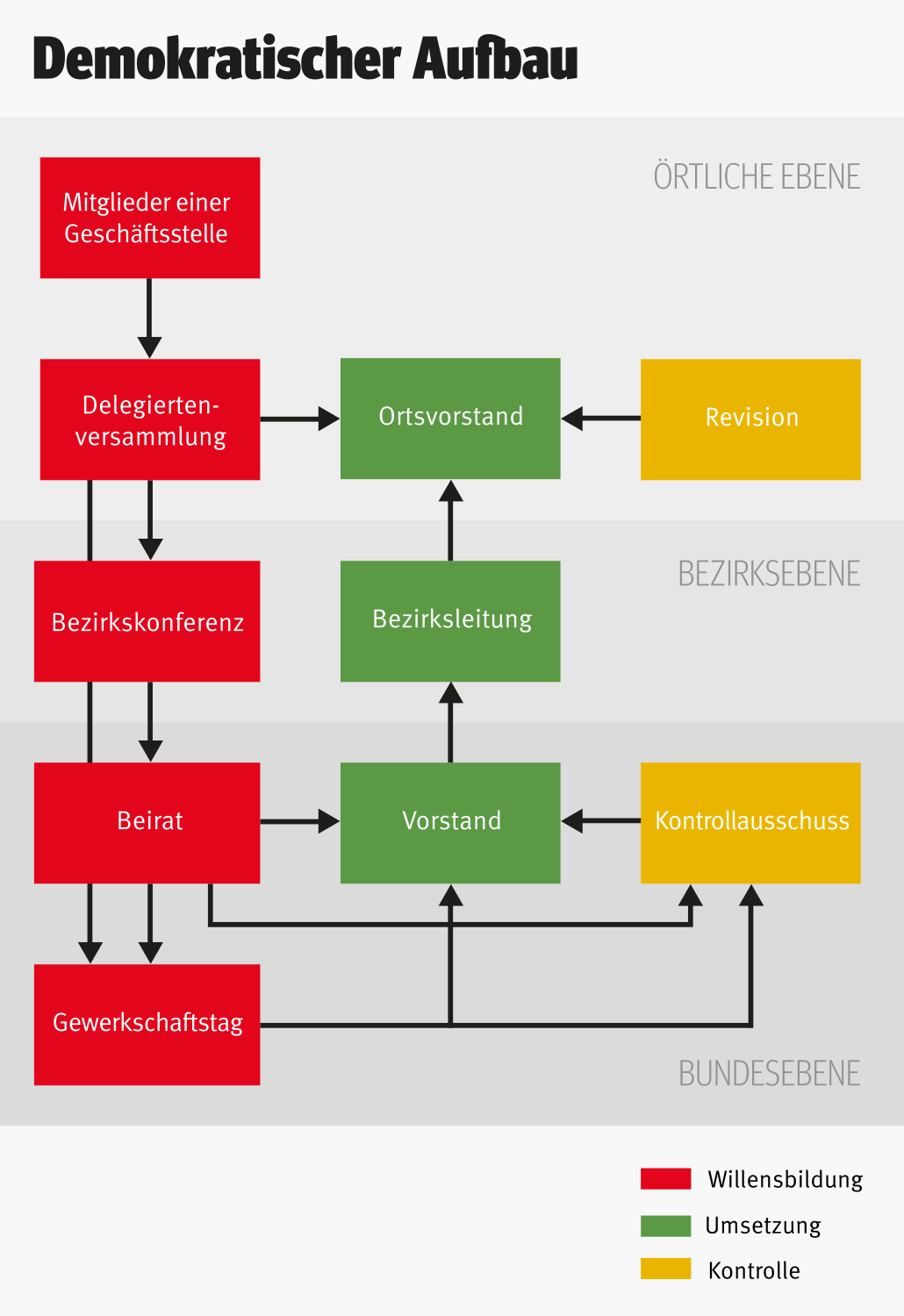
More than 145 regional offices form the foundation of IG Metall. More than half of these offices each serve more than 10,000 members.
Delegates’ Assembly
IG Metall members in each local chapter elect representatives to the Delegates’ Assembly. The Delegates’ Assembly meets four times a year and decides, for example, on actions to be taken in workplaces. The delegates elect the local chapter’s executive board, the members of the bargaining committees, and the delegates to the Union Congress and the District Conference.
Local Executive Board
The local executive board manages the IG Metall branch office. It consists of the two authorized representatives and the at-large members. The first authorized representative of a branch office is always a full-time employee. The at-large members are volunteer officials. Depending on the size of the branch office, the second authorized representative may be a full-time employee. The entire local executive board is elected for a four-year term and confirmed by the IG Metall executive board. The local executive board implements the resolutions of the delegates’ assembly and manages the office.
District
IG Metall is divided nationwide into seven districts: North Rhine-Westphalia, Central Germany (Hesse, Thuringia, Rhineland-Palatinate, Saarland), Coastal Region (Hamburg, Schleswig-Holstein, Mecklenburg-Western Pomerania), Lower Saxony and Saxony-Anhalt, Berlin-Brandenburg-Saxony, Bavaria, and Baden-Württemberg.
District Executive Committee
The district leadership consists of the district director, district secretaries, and representatives of the district commission. The districts generally conduct collective bargaining negotiations, supported in this process by the bargaining commissions.
District Conference
The District Conference meets once a year. The delegates to the District Conference elect the District Commission, confirm the collective bargaining commissions, and elect the members of the Advisory Board. They also address current and upcoming issues related to collective bargaining, organizational matters, and union policy.
Union Congress
The Union Congress is the highest decision-making body of IG Metall. An Ordinary Union Congress takes place every four years and is convened by the Executive Board. At the Union Congress, the delegates elect the Executive Board and the Audit Committee. The Union Congress adopts the bylaws and sets union policy.
Executive Board
The Executive Board is responsible for implementing the resolutions of the Union Congress. Its key functions also include terminating collective bargaining agreements, ratifying collective bargaining agreements, and deciding on strike ballots and strikes. The Executive Board consists of the First and Second Chairs, the Chief Treasurer, as well as two additional executive members and 29 volunteer board members.
Advisory Board
The Advisory Board is the highest decision-making body between union conventions. It meets at least three times a year and is composed of representatives from the districts and members of the Executive Board.
Audit Committee
The Audit Committee ensures that the Executive Board complies with the bylaws and implements the resolutions of the Union Congress and the Advisory Board. The Audit Committee is elected by the Union Congress and has seven members, who may not hold any other positions within IG Metall. The Audit Committee reports to the Regular Union Congress at the end of its term.
Audit
At IG Metall, auditors at the local, district, and central levels review the finances and report to the Delegates’ Assembly.