Automatic translation
This article has been translated automatically using computer technology. While we strive for accuracy, some wording or details may differ from those in the original article.
This translation was not manually reviewed. For important facts, quotations or legally sensitive information, please consult the German original. Individual selections, images, embedded media or technical terms may have been translated differently or incompletely.

The IG Metall Trainee Program: Career as a Union Secretary IG Metall Perspective: “Turn Your Commitment into a Career”

To be well-prepared for full-time political work at IG Metall, young women and men can complete a training program. Through our trainee program, we provide a range of technical, methodological, and organization-specific skills.

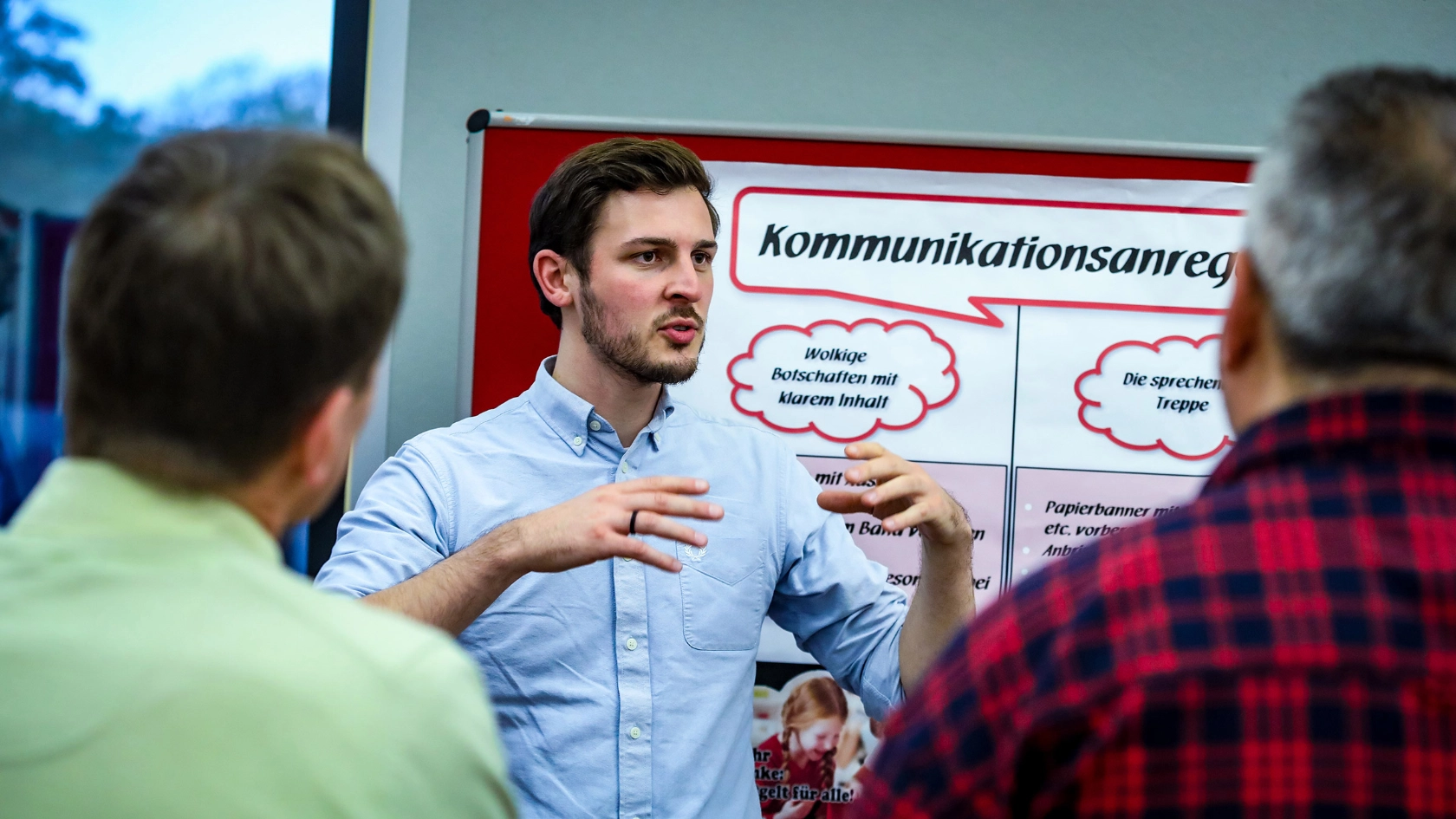
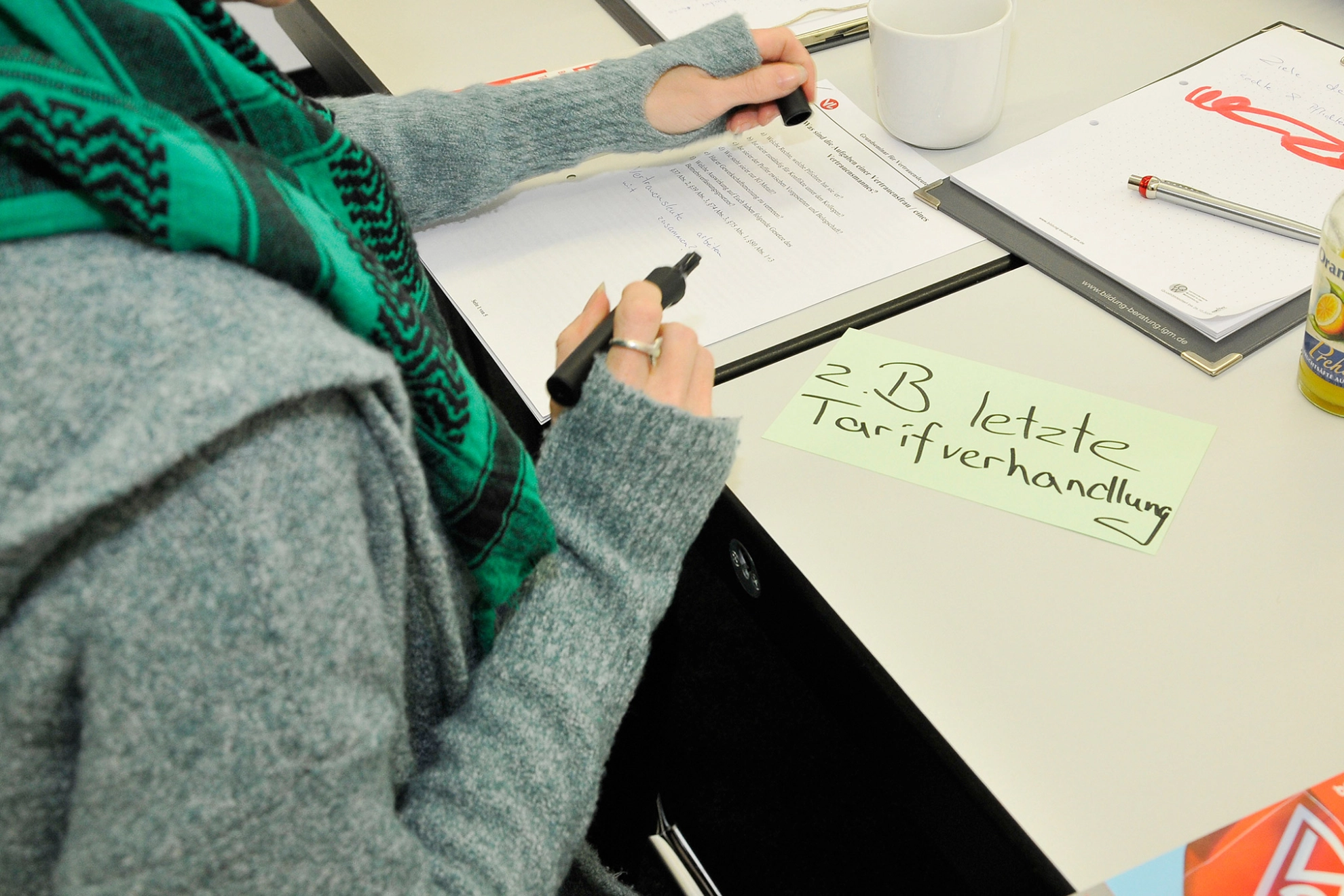
Lernsituation im Seminarraum


Young, committed women and men can complete a twelve-month trainee program at IG Metall—providing a solid foundation for their future work as union secretaries. The trainee program enables them to acquire and deepen the necessary qualifications. Every year in May and November, a twelve-month course begins, consisting of a mix of seminar phases and practical placements.

Theory and Practice

The program consists of a good mix of theoretical and practical training. The theoretical seminar modules take place between the practical placements. Here, the trainees learn everything a union secretary needs in terms of background knowledge: collective bargaining policy, basic social and economic sciences, and labor and social policy. They also learn how to organize themselves and their work: How do I present something? What does communication mean? How do I plan a project? During the practical placements, trainees shadow staff at the IG Metall Executive Board, district offices, and local branches. In another practical placement, trainees gain hands-on experience working on a current IG Metall project.


On-Site Trainee Mentors

The trainee mentors at the IG Metall district offices and branch offices ensure that the practical placements run efficiently and productively for the trainees. This allows the trainees to gain realistic insights into the job tasks and how work is organized.


Part of Human Resources Development

Every year, the number of applicants far exceeds the number of available spots. IG Metall has been able to attract young people who bring exactly what the organization needs: solid theoretical knowledge, usually paired with workplace experience and political engagement. The trainees are at an age that makes it easier for them to connect with the young people we want to recruit as members for IG Metall.


The Outlook

After completing the trainee year, the trainees are well-prepared to serve as union secretaries in many positions within IG Metall. Most of the graduates to date work in IG Metall’s regional offices.


What Does It Mean to Work at IG Metall?

Most people’s lives are shaped by work—paid employment is crucial for income, education and qualifications, the realization of one’s abilities, social security, and societal development.

In our economic system, work is primarily geared toward generating private profits, which are all the higher the more economically the workforce is utilized: Labor is regarded as a cost factor subordinate to profit motives. This dependent form of work gives rise to differing interests, conflicting interests, and conflicts that, at their core, revolve around fair compensation, humane working conditions, and the balance between external and self-determination—in other words, justice, democracy, and human dignity. The organizations that represent these workers’ interests are the labor unions.

Full-time work in a union therefore means working with and for people and their interests—interests that would not be upheld without unions.

Full-time employees, known as union secretaries,

  • They advise members on all issues arising from their working lives and help them assert their rights; to this end, they are familiar with the relevant collective bargaining agreements, laws, and procedures,
  • establish in-house representative bodies—so-called works councils or youth and trainee representatives—and support them in their work; that is, they advocate for fair pay, working conditions that promote health and personal well-being, regulated working hours, quality vocational training, secure jobs, and democratic rights in the workplace,
  • organize and maintain a network of worker-oriented institutions, economic experts, and attorneys to serve as a support group for representing workers’ interests within the workplace,
  • negotiate with the other side—employers and employer associations—on collective bargaining agreements, through which the interests of working people, if they are union members, become legal entitlements,
  • are not “guardians” of the people they represent, but actively involve them in decision-making and the advancement of interests; it is about democratic participation, mobilizing union work, organizing, and “first-person” involvement,
  • they speak with individuals, in groups, and at meetings; they design and lead informational, discussion, and educational events—their core task is effective communication;
  • ensuring that workers’ perspectives are represented in the public sphere—through connections with the media, social organizations, and political decision-makers, as well as through campaigns, rallies, and demonstrations,
  • in this way, influencing the political, economic, social, and environmental development of our society,
  • lay the foundation for all of this by strengthening their own organization—by recruiting, engaging, and retaining union members,
  • participate regularly in appropriately tailored continuing education programs as part of IG Metall’s workforce development initiatives,
  • and, through training, the acquisition of skills, and experience within IG Metall, are also able to take on leadership roles.

Those who work full-time for a union are driven by a personal commitment—they have turned their dedication into a career. The trainee program ensures that this work is carried out at a high professional standard.


The Ideal Trainee Profile

Practical experience
Through volunteer work in the union, in the youth council, or on the works council; through vocational training; or through work at the company.

Qualified
A college degree, attendance at the European Academy for Labor, or in-depth knowledge acquired through seminars and continuing education.

Open-minded
Open to social and political developments and the unique role of labor unions.

Committed
Trainees should be willing to work with others to make a difference for others and should already have experience in social engagement.

What IG Metall Offers

High-Quality Training
A systematic training program—with learning content that serves as “general qualifications” useful throughout the modern workforce. Plus specialized knowledge that provides a solid foundation for working as a union secretary. Practice and theory, meaningfully integrated, along with social and methodological skills and up-to-date contextual knowledge.

Employment Contract
IG Metall trainees receive a fixed-term employment contract for the duration of the training program.

Trainee Salary
Trainees receive appropriate compensation during their training.

Friendly Colleagues
Working toward common goals, standing together for a cause—these are special working conditions that you don’t find everywhere. At IG Metall, trainees meet people who want to make a difference—colleagues with strong ideals.

Who’s it for?

The Selection Process
Many young people want to become trainees at IG Metall. That’s why selected applicants undergo a comprehensive selection process in which they demonstrate their skills, knowledge, and motivation.

IG Metall’s Human Resources department and the works council have established the training conditions for trainees in a works agreement.

The Training

The IG Metall trainee program lasts twelve months. Seminar phases focused on theoretical learning alternate with practical assignments. The program is intensive and systematically organized.

The trainees expand their knowledge and supplement it with subject-specific expertise; they gain insights into the organization’s day-to-day operations and familiarize themselves with relevant areas of work.

To ensure that trainees can, above all, expand their professional expertise, IG Metall emphasizes a broad range of topics in its trainee program. However, the training is also designed to foster organizational and methodological knowledge and skills.

The program is consistently guided by the concept of a trade union-oriented career path. There are no exams—instead, there is interim feedback and a final workshop in which the acquired skills are put into practice.

What, how, and where does the training take place?

WHAT?

  • Structures and Organizational Units
  • Opinion-Forming and Decision-Making Structures
  • Member and Organizational Development
  • Successful Branch Office Operations

Union Work in the Workplace

  • Reaching out to workplaces (workplaces without a works council)
  • Work of Works Council Committees
  • Interaction Between the Works Council, Union Representatives, and Union Offices

Recruiting and engaging members

  • Organizing Methods
  • Member-Centered Offensive Strategy and Campaigns

Theoretical foundations of union work

  • Trade Union and Social Theory
  • Collective Bargaining Policy
  • Business Administration
  • Economics
  • Labor Law
  • Social Policy
  • Industrial Relations

Work techniques and communication

  • Presentation
  • Communication Training
  • Consulting Skills
  • Project Work
  • Time Management and Personal Work Organization
  • Information and Communication Technologies
  • Role Clarification and Self-Management

HOW?
Seminars and Training Sessions
In most cases, the trainees work as a closed group; however, some seminars are also open to full-time colleagues from IG Metall.

Practical Assignments
Work placements lasting several weeks with the IG Metall Executive Board, a district leadership team, a local office, and an IG Metall project. A work placement offers a trainee:

  • Basic information and a solid introduction
  • A practical work assignment
  • Many insights into day-to-day work, for example through participation in office meetings, plant visits, sales representative meetings, company-wide meetings, and negotiations
  • A contact person who acts as a “mentor.”

During the practical phases, trainees work independently on a task and gain experience in project work. The contact persons organize regular opportunities for sharing experiences.

WHERE?
The trainee program takes place at many locations nationwide—not just during the practical placements lasting several months. The seminars are held at IG Metall’s training facilities, primarily at the
Bad Orb Training Center.

Frequently Asked Questions About the Trainee Program

  1. Who can nominate candidates for the trainee program?
    Anyone. Branch offices, district management, and works councils. However, interested individuals can also apply on their own initiative.
  2. Who should consider applying?
    Active members of employee representative bodies—candidates are expected to have in-depth knowledge, a strong commitment, and a willingness to continue their education. College graduates with degrees in social sciences, economics, law, or the humanities. Graduates of the European Academy of Labor.
  3. How are applicants selected?
    Those invited based on their written application will participate in a selection process conducted by the IG Metall Executive Board. This process is tailored to the needs of IG Metall.
  4. Does it matter whether I am or have been active in a union?
    Yes. Membership and active participation in a union, as well as political and social engagement, are required.
  5. How do I find out about the job opening?
    Through our job board on igmetall.de, through ads in “direkt” and “einblick,” and through IG Metall contacts. The start dates are May 1 and November 1, respectively.


Paths to IG Metall

Subscribe to the newsletter