No progress, no result: IG Metall and the employers parted ways on Wednesday without reaching an agreement. “The third round of collective bargaining in the West German textile and apparel industry was a failure,” said IG Metall negotiator Miriam Bürger afterward. After more than 13,500 workers had underscored their demands through warning strikes, the employers made only minimal concessions.
After seven hours of negotiations, the employers’ new offer is also insufficient. Instead of the demanded 8 percent pay increase applicable to the pay scale, the other side is offering only minor adjustments to its initial offer: 4 percent starting in October 2023 and 2.5 percent starting in October 2024—with a term of 26 months. The inflation adjustment bonus remains unchanged. 1,500 euros are to be paid out in two installments: 1,000 euros in April and 500 euros one year later. Partial retirement and the demanded minimum amount of 200 euros are not part of the offer. “We won’t be fobbed off. This isn’t some luxury debate; our demands are justified and necessary,” said Marc Otten, a member of the IG Metall negotiating committee, following the negotiations.
Showing Employers the Red Card
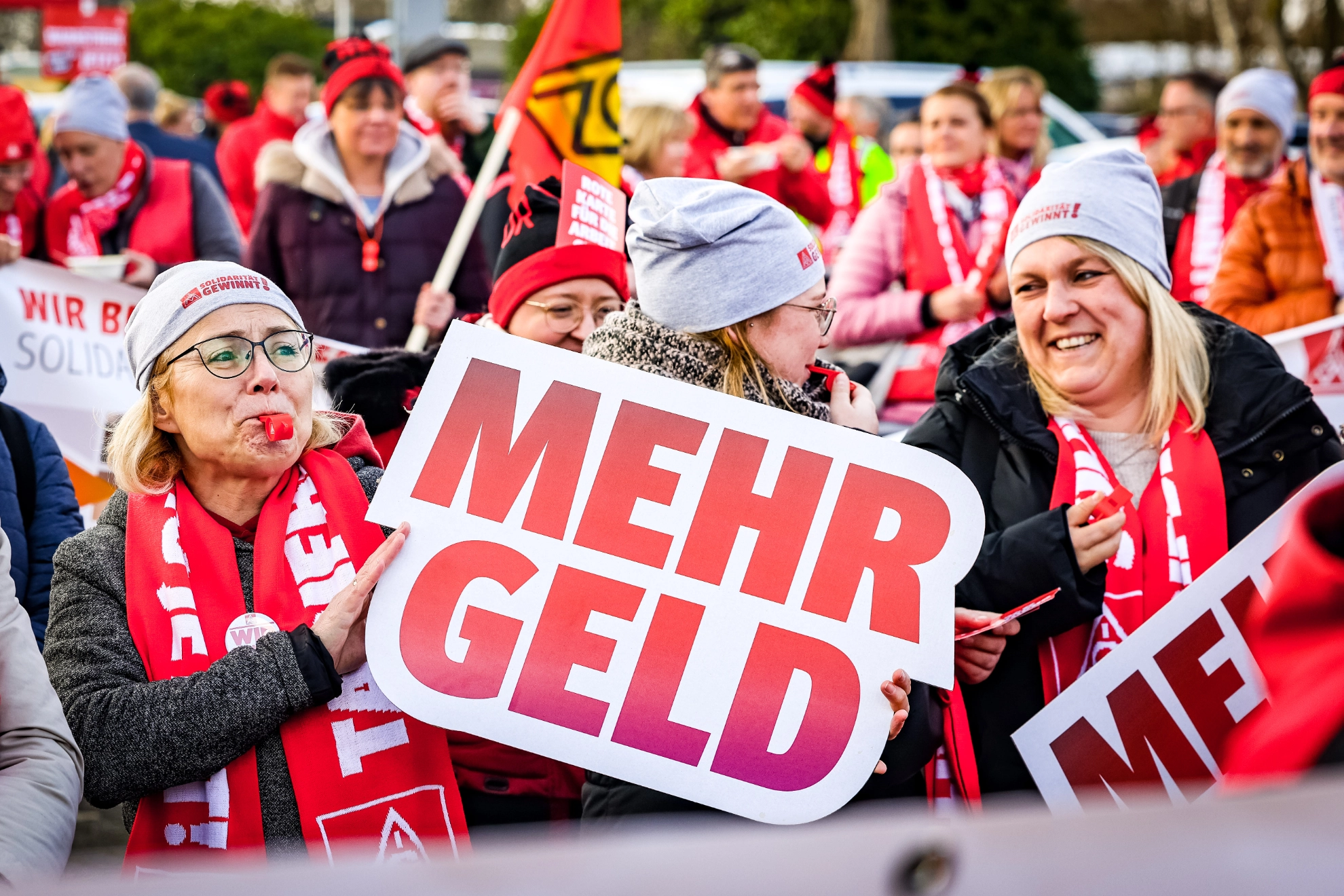
Warning strikes have been taking place nationwide for the past two weeks. More than 13,500 workers have already walked off the job on short notice and participated in workplace actions. On the day of the negotiations alone, more than 750 workers from North Rhine-Westphalia, Rhineland-Palatinate, and Lower Saxony traveled to the negotiation venue in Kaarst. Loud chants and songs drew the employers out in front of the negotiation venue ahead of the talks, where the workers showed them the red card.
Marita Mohning, who works at Leineweber in Herford, also sees red when she thinks about the partial retirement program that employers want to remove from the collective bargaining agreement. She is currently in the partial retirement program herself and will retire in a few months. “I worked for 49 years until I was no longer physically able to do so. That’s why we urgently need to preserve the partial retirement program so that others can benefit from this opportunity as well.” Her colleague Martina Schneider also came to Kaarst and believes that, in addition to the partial retirement program, wage increases are important. “We also need wages that allow us to leave the workforce earlier. Because only if we earn enough while we’re still working will our retirement benefits be sufficient.”
Setting the Course for the Industry’s Development
Better incomes are also urgently needed to attract and retain skilled workers and the workforce in general. But instead of working constructively to address problems such as the shortage of skilled workers in these industries, employers are proving stubborn. For Miriam Bürger, it’s clear that these collective bargaining negotiations will shape the future. “What happens to these industries in the coming years will be decided now.” We cannot allow ourselves to fall further behind. “But that will only succeed with attractive pay raises that are reflected in the pay scales.”
In the coming days, the warning strikes will enter their second round. “Our colleagues are ready for the next wave of warning strikes. The employers’ offer was insufficient—one could almost call it outrageous,” says Sabine Kühn, works council chair at Hornschuch and a member of the negotiating committee. The next round of collective bargaining will take place on March 31.